On eBird ↗
Egyptian Goose
Live sightings near you, the range map, bar charts of when it is seen, and Macaulay Library photos and recordings.
Egyptian Goose
Alopochen aegyptiaca
The Egyptian goose (Alopochen aegyptiaca) is an African member of the Anatidae family including ducks, geese, and swans. Because of its popularity chiefly as an ornamental bird, the species has also been introduced to Europe, the United States, and elsewhere outside its natural range. Egyptian geese were regularly represented in ancient Egyptian art.
From the article Egyptian goose on Wikipedia (CC BY-SA), quoted section by section
Description
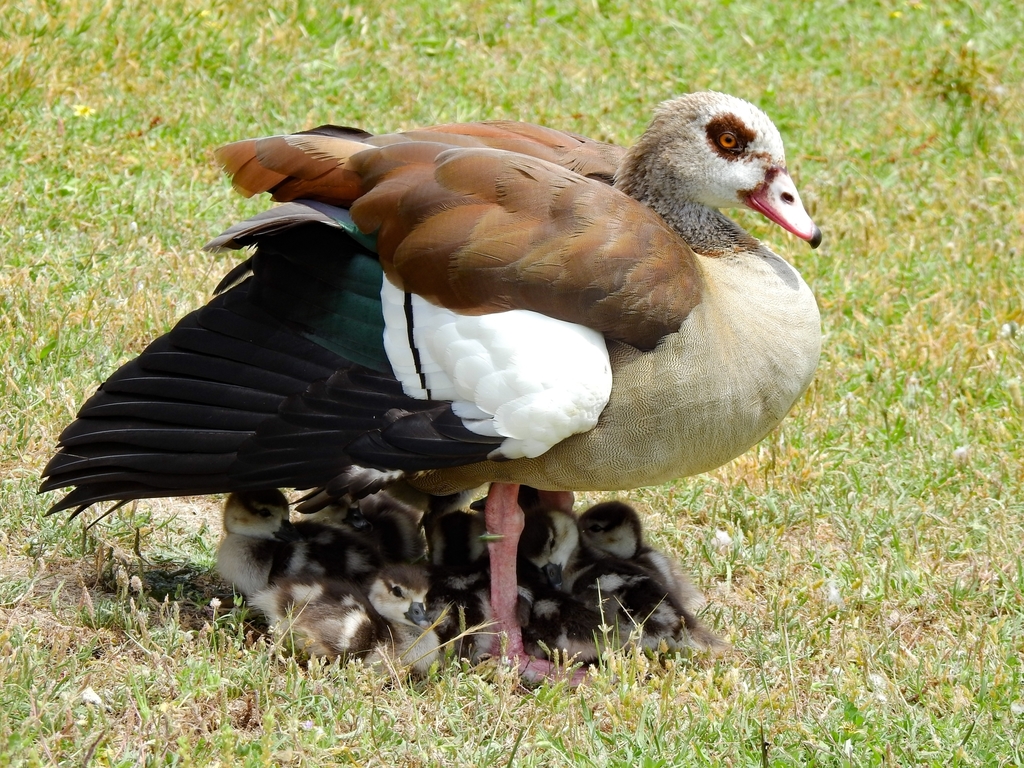
It swims well and appears heavy in flight, more like a goose than a duck, hence the English name. Typically, they are 63–73 cm (25–29 in) in length and weigh 1,500–2,348 g (3.307–5.176 lb). The sexes of this species are identical in plumage, but the males are usually somewhat larger. They vary greatly in plumage tone, with some birds greyer and others browner, but this variation has not been observed to be sex- or age-related. A large part of the wings of mature birds is white, but the white is hidden by the wing coverts when at rest. When it is aroused, either in alarm or aggression, the white is displayed. Egyptian geese in the wild can live for up to 15 years, while captive individuals have been recorded reaching an age of 35. The voices and vocalisations of the sexes differ, the male having a hoarse, subdued, duck-like quack, which seldom sounds unless it is aroused, as well as a louder, breathy call, which is performed in a rapid sequence, sounding somewhat like a steam engine. The female has a far noisier raucous quack that frequently sounds in aggression when tending her young. The male Egyptian goose attracts its mate with an elaborate, noisy courtship display that includes honking, neck stretching, and feather displays.
Range & habitat
The Egyptian goose is native to sub-Saharan Africa and the Nile Valley, where it is widespread and common to abundant, though it has become scarce in the northern Nile Valley. It is found in open or semiopen habitats, typically near fresh water, ranging from lowlands to 4,000 m (13,000 ft) above sea level in the Ethiopian Highlands and largely absent from dense forests and deserts. While not breeding, it disperses somewhat, sometimes making longer migrations northwards into the arid regions of the Sahel and occasionally even reaching the North African nations of Algeria and Tunisia, historically a more frequent part of its range. It was found in southeastern Europe (north to the lower Danube Valley and southern Hungary) until the early 1700s and in parts of Turkey and the western Middle East until the early 1900s (and has since re-established through escaped captives), but its historical ranges in these places is known incompletely and the reason for the disappearances also is unknown.
United Kingdom. The British populations of the Egyptian goose date back to the 17th century, when it was introduced to estates and parks, though the species was only formally added to the British bird list in 1971. The British introductions were the first outside its native range, but these individuals did not spread widely and are not known to have expanded into other countries. …
Wikipedia: “Distribution”
What it does
This species nests in a large variety of situations, especially in holes in mature trees in parkland. The female builds the nest from reeds, leaves, and grass, and both parents take turns incubating the eggs. Incubation takes 28 to 30 days. Egyptian geese usually mate for life. Both the male and female care for the offspring until they are old enough to care for themselves. Such parental care, however, does not include foraging for the young, which are able to forage for themselves upon hatching. Egyptian geese typically eat cereal crops, leaves, and grasses, occasionally also eating locusts, worms, or other small animals. Until the goslings are a few weeks old and strong enough to graze, they feed largely on small, aquatic invertebrates, especially freshwater plankton. As a result, if anoxic conditions lead to the production of botulinum toxin and it gets passed up the food chain via worms and insect larvae insensitive to the toxin, entire clutches of goslings feeding on such prey may die. The parents, which do not eat such organisms to any significant extent, generally remain unaffected. Both sexes are aggressively territorial towards their own species when breeding, and frequently pursue intruders into the air, attacking them in aerial "dogfights". Egyptian geese have been observed attacking aerial objects, such as drones, that enter their habitat, as well. …
Wikipedia: “Behaviour”
Listen
Looking for field recordings…
Where it lives
Recorded sightings
—
geo-referenced records in GBIF, from museums, herbaria and field observers.
Drag the globe to turn it. Dots are where records exist, not a range map; darker means more records.
In the stacks
Searching the stacks…
Every page naming Alopochen aegyptiaca in the Biodiversity Heritage Library →
This page is assembled live from iNaturalist, GBIF, Wikipedia, the Source Library and the Internet Archive. It is not yet part of the hand-edited codex. iNaturalist taxon 72486.