On eBird ↗
Eastern Spot-billed Duck
Live sightings near you, the range map, bar charts of when it is seen, and Macaulay Library photos and recordings.
Eastern Spot-billed Duck
Anas zonorhyncha
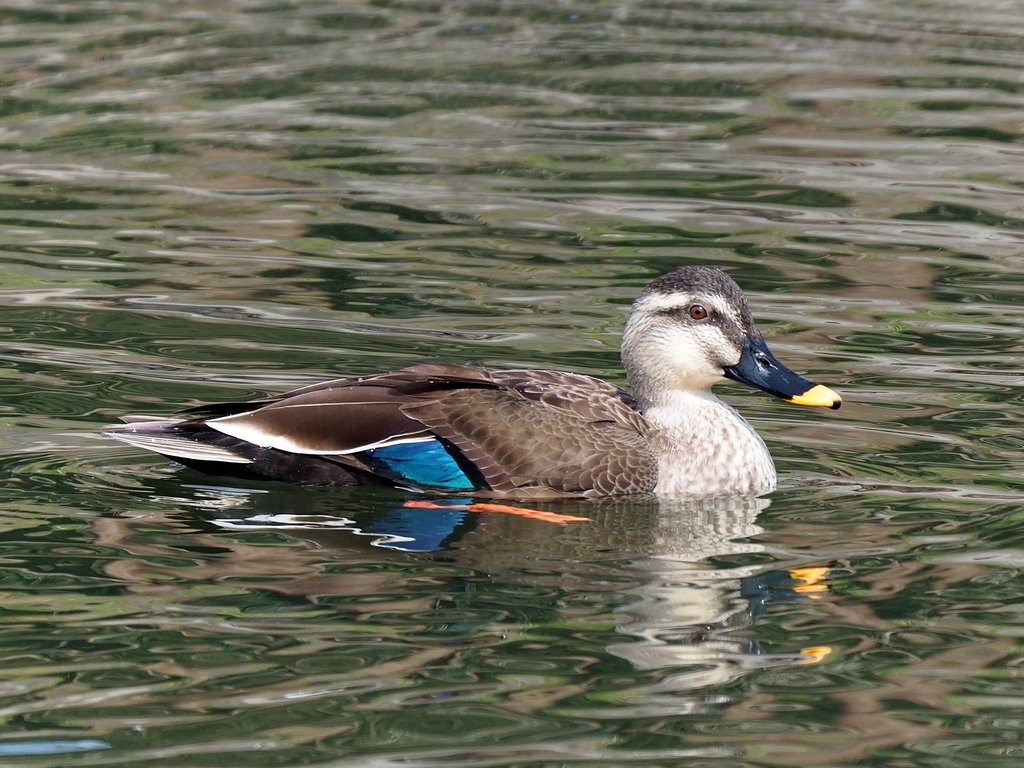
The eastern spot-billed duck or Chinese spot-billed duck (Anas zonorhyncha) is a species of dabbling duck that breeds in East and Southeast Asia. This species was formerly considered a subspecies of the Indian spot-billed duck and both were referred to as the spot-billed duck (A. poecilorhyncha). The name is derived from the yellow spot on the bill.
From the article Eastern spot-billed duck on Wikipedia (CC BY-SA), quoted section by section
Description
This duck is around the same size as a mallard and has a scaly patterned body with a blue speculum. At rest the long neck and the bill with the yellow tip are distinctive. It measures 55–63 cm (22–25 in) in length and 83–95 cm (33–37 in) across the wings, with a body mass of 790–1,500 g (1.74–3.31 lb). These are mainly grey ducks with a paler head and neck and a black bill tipped bright yellow. The wings are whitish with black flight feathers below, and from above show a white-bordered green. The male does not have an eclipse plumage. Juveniles are browner and duller than adults. The legs and feet are bright orange. Both the male and female have calls similar to the mallard, with females producing a loud quack, and males a deeper, quieter sound. The eastern spot-billed duck is darker and browner than the Indian spot-billed duck; its body plumage is more similar to the Pacific black duck. It lacks the red bill spot, and has a blue speculum. Both males and females undergo a complete postnuptial moult, dropping all their wing feathers simultaneously.
Range & habitat
The eastern spot-billed duck is migratory, wintering in southern China and possibly Southeast Asia. It is quite gregarious outside the breeding season and forms small flocks. The populations in Japan and the Russian Far East have expanded their range northwards by more than 500 km since the early 20th century, possibly in reaction to global warming. It is occasionally a rare vagrant to the Aleutian Islands of Alaska. It is a bird of freshwater lakes and marshes in fairly open country and feeds by dabbling for plant food mainly in the evening or at night. The breeding season varies with rainfall and water condition but normally between April and July. It nests on the ground in vegetation near water. The clutch is usually 7–9 eggs. Incubation begins after the last egg is laid (allowing the chicks to hatch simultaneously) and the young hatch after about 24 days. The chicks are black with a yellow back and resemble those of mallards but with a wider eyestripe.
Wikipedia: “Distribution”
Listen
Looking for field recordings…
Where it lives
Recorded sightings
—
geo-referenced records in GBIF, from museums, herbaria and field observers.
Drag the globe to turn it. Dots are where records exist, not a range map; darker means more records.
In the stacks
Searching the stacks…
Every page naming Anas zonorhyncha in the Biodiversity Heritage Library →
This page is assembled live from iNaturalist, GBIF, Wikipedia, the Source Library and the Internet Archive. It is not yet part of the hand-edited codex. iNaturalist taxon 72504.