On eBird ↗
Paradise Shelduck
Live sightings near you, the range map, bar charts of when it is seen, and Macaulay Library photos and recordings.
Paradise Shelduck
Tadorna variegata
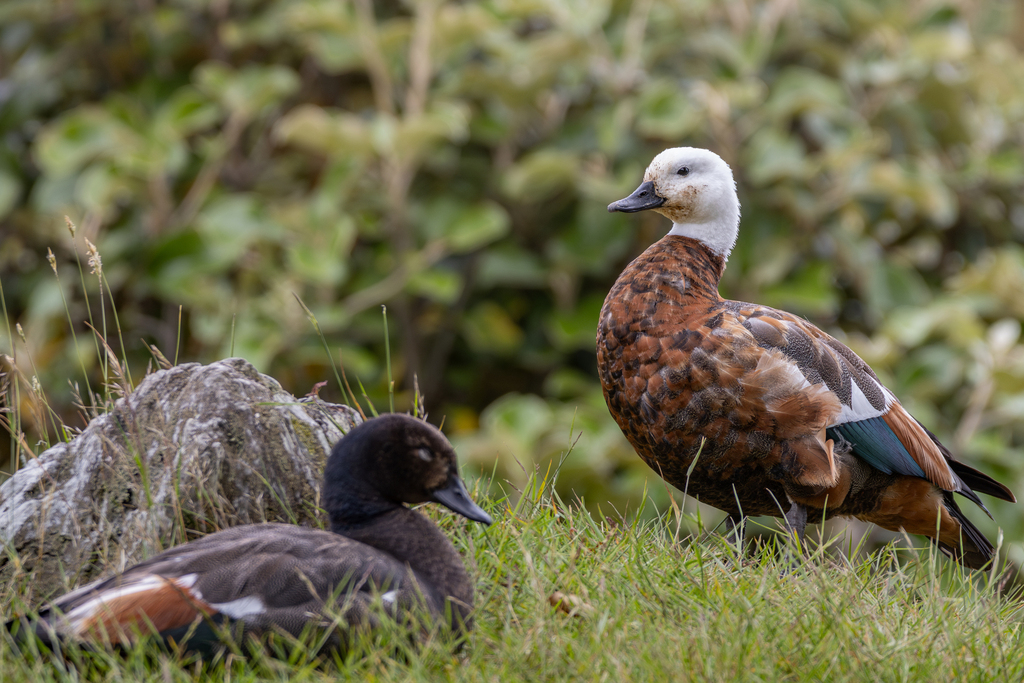
The paradise shelduck (Tadorna variegata), also known as the paradise duck, or pūtangitangi in Māori, is a species of shelduck, a group of goose-like ducks, which is endemic to New Zealand. Johann Friedrich Gmelin placed it in the genus Anas with the ducks, geese, and swans. Both the male and female have striking plumages: the male has a black head and barred black body and the female has a white head with a chestnut body. They weigh between 1.09 and 2 kg (2.4 and 4.4 lb) and are between 63 and 71 cm (25 and 28 in) in length.
Paradise shelducks mate for life and usually live as pairs, and moult their feathers from December to February. They are primarily herbivorous, and mostly graze on pasture grasses and clover, but have been observed eating a wide range of invertebrates. They are seasonally hunted as a game bird throughout New Zealand, and today the IUCN Red List classifies them as a species of least concern.
From the article Paradise shelduck on Wikipedia (CC BY-SA), quoted section by section
Description
The paradise shelduck is a colourful, large-bodied species of duck that differs in features depending on the sex. Both females and males have chestnut-colour undertails, primarily black wing feathers with green secondary wing feathers, and upper wing surface feathers that are white. They have black legs and webbed feet for swimming. Paradise shelducks are the largest of the Tadorna species, measuring 63 to 71 cm (25 to 28 in) in length and between 1.09 and 2 kg (2.4 and 4.4 lb) in weight, averaging 1.72 kg (3.8 lb) in males and 1.29 kg (2.8 lb) in females, with a wingspan of around 90 centimetres (35 in). The adult male has a blue-black head and neck, with a black rump and tail; the back and flank are lightly flecked with a pale yellow colour. The wings of males have contrasting white upper-coverts and black remiges, metallic green speculum feathers, and rusty brown tertials feathers. The male also has a dark grey flecked with pale-yellow breast and abdomen, chestnut undertail and underwing, and black iris, bill, legs, and feet. The female, unlike the male, has an entirely white head and neck with a dark grey back heavily flecked with pale yellow. The rest is very similar to the male with the female's body being dark or light chestnut depending on age and stage of molting. The downy young are white with a brown crown and brown stripes from crown to tail. …
Range & habitat
Paradise shelducks are the most widely distributed waterfowl in New Zealand. They inhabit the North Island, South Island, offshore islands such as Little Barrier Island, Kapiti Island, Great Barrier Island, and Stewart Island. They are most numerous in the North Island, Hawkes Bay, Poverty Bay, Taranaki and in Tongariro National Park, while scattered populations are present in Waikato and Wellington. Paradise Shelducks are uncommonly found on the Canterbury Plains, and generally not found in the high parts of the mountains. Their preferred habitat is pasture, tussock grassland, and wetlands both on the mainland and on offshore islands. They are common around the hilly farmland characterised by fertile riversides, farm dams, and natural pools of the North Island. On the South Island, they can commonly be found in the tussock river valleys and high-country lakes while a small number can be found in the mountain streams, coastal flats, and brackish inlets. Around water bodies are the preferred breeding habitat for which to use as a nursery area for young, the quality or depth of water does not influence the selection, but available vantage points with long views to or from water do influence the selection. Many chosen places have a grassland at the edge of the water and a cover for refuges which is dense, such as reedbeds and forest. …
Wikipedia: “Distribution and habitat”
What it does
The male adopts a threat posture by dropping his head low with the bill horizontal to the ground. If a female notices a threat on the water she responds by stretching out her neck and body while swimming towards the threat, swinging her body back and forth, and making a high-pitched call. On land she will lower her head and charge. Males will respond to the females by charging with her or taking on a "high and erect" posture. In this posture, the male will stretch its neck and head upwards and forwards, raise its feathers on the lower neck, call rapidly, and pivot between facing the threat and the female. When a predator threatens an adult pair with young, the parents will adopt the "broken wing display". The pair will run away from the young in a crouched position, raising and lowering its half-opened wings to distract the predator. Once the predator follows the pair away from the young, one of the adults will return to them.
Breeding. Paradise shelducks first breed in their second or third years. They form long-term pair bonds, often lasting for life, and defend their territories. If one of the pair dies, the other will keep the same territory and will find another mate. They have a long breeding season, lasting from August to December. …
Wikipedia: “Behaviour and ecology”
In human culture
The genus name comes from the French word Tadorne for the common shelduck. The specific epithet variegata is from the Latin variegatus meaning "variegated". Other common names include painted duck, pari, parry, parrie, and pūtangitangi in Māori.
Wikipedia: “Etymology”
Listen
Looking for field recordings…
Where it lives
Recorded sightings
—
geo-referenced records in GBIF, from museums, herbaria and field observers.
Drag the globe to turn it. Dots are where records exist, not a range map; darker means more records.
In the stacks
Searching the stacks…
Every page naming Tadorna variegata in the Biodiversity Heritage Library →
This page is assembled live from iNaturalist, GBIF, Wikipedia, the Source Library and the Internet Archive. It is not yet part of the hand-edited codex. iNaturalist taxon 7072.