 NL·0395
Herbarium of the Nature Library
- Name
- Eudynamys scolopaceus
- Family
- Cuculidae
- Native to
- Pakistan and India through Sri Lanka, Bangladesh and southern China to Southeast Asia and the Greater Sundas
- Habitat
- Urban, Woodland, Farmland
On eBird ↗
Asian Koel
Live sightings near you, the range map, bar charts of when it is seen, and Macaulay Library photos and recordings.
Asian koel
Eudynamys scolopaceus
Also calledKoyal (Urdu/Hindi/Punjabi) · Kokila (Sanskrit) · Kokil (Bengali) · Kuyil (Tamil) · Kōili (Nepali) · Zào juān 噪鹃 (Chinese)
A large cuckoo whose rising, insistent 'ko-EL, ko-EL' is the sound of the South Asian hot season, often heard long before dawn. It lays its eggs in the nests of crows, which raise the koel chicks as their own.
The Asian koel is a member of the cuckoo family of birds, the Cuculidae. It is found in the Indian subcontinent, China, and Southeast Asia. It forms a superspecies with the closely related black-billed koels, and Pacific koels which are sometimes treated as subspecies. The Asian koel, like many of its related cuckoo kin, is a brood parasite that lays its eggs in the nests of crows and other hosts, who raise its young. They are unusual among the cuckoos in being largely frugivorous as adults. The name koel is echoic in origin with several language variants. The bird is a widely used symbol in Indian, Pakistani and Nepali poetry. Wikipedia
What it can do
- iBrood parasite: lays eggs in House crow and Large-billed crow nests in South Asia
- iiMale lures crows away from the nest while the female slips in to lay
- iiiUnusually for cuckoos, adults are largely fruit-eaters, dispersing seeds of figs and other trees
In the field
Field marks
- aMale entirely glossy blue-black with a pale greenish bill and crimson eye
- bFemale brown, heavily spotted and barred with white and buff
- cLong tail and slim, rather crow-like build
- dRed eye in both sexes
- Voice
- Male: a loud, rising 'ko-el, ko-EL, KO-EL', repeated in crescendo; also a bubbling 'kuil-kuil-kuil'. Female: a shrill 'kik-kik-kik'.
- Not to be confused with
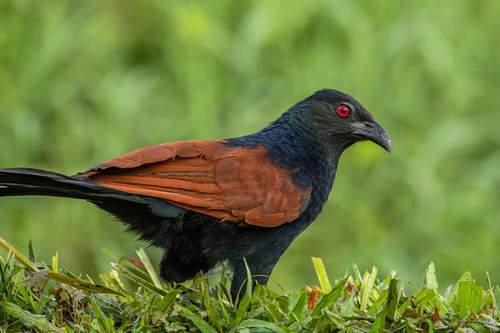
- The black male could be mistaken for a crow or drongo, but has a red eye, pale bill and long rounded tail; Greater coucal is larger with rufous wings.
- Where to see it
- Gardens and avenues across Pakistan and India, from Lahore's Jinnah Garden to Delhi's Lodhi Garden
- When
- Resident in much of its range; most vocal March–August; in northern Pakistan a summer visitor
Listen
Looking for field recordings…
Life & habits
- Diet
- Mainly fruit and berries (figs, peepal, banyan); also insects and caterpillars
- Habitat
- Leafy gardens, orchards, groves and open woodland
- Size
- About 39–46 cm long
Skulks in dense foliage and is heard far more than seen; the male calls repeatedly from cover, each phrase rising in pitch and urgency.
Where it lives
Recorded sightings
—
geo-referenced records in GBIF, from museums, herbaria and field observers.
Native range
Pakistan and India through Sri Lanka, Bangladesh and southern China to Southeast Asia and the Greater Sundas
Drag the globe to turn it. Dots are where records exist, not a range map; darker means more records.
In the stacks
Searching the stacks…
Every page naming Eudynamys scolopaceus in the Biodiversity Heritage Library →
Marginalia
As the kokila it is a symbol of spring and longing in Sanskrit poetry, including Kalidasa, and the koyal remains a byword for a sweet voice in Urdu, Hindi and Punjabi songs.
Curiosity
A koel's voice is sweet only to people: crows recognise the bird as a threat and chase it furiously.
Kinship
Photographs: iNaturalist contributors under the licences shown. Records: GBIF.org. Historical plates: Source Library (CC BY-SA 4.0; originals public domain). Summary text: Nature Library editors and Wikipedia (CC BY-SA). Medicinal and edibility notes are historical and educational, not advice. iNaturalist taxon 204510.