On eBird ↗
Dusky Turtle-Dove
Live sightings near you, the range map, bar charts of when it is seen, and Macaulay Library photos and recordings.
Dusky Turtle-Dove
Streptopelia lugens
The dusky turtle dove (Streptopelia lugens) is a species of bird in the family Columbidae. It is found in Burundi, Democratic Republic of the Congo, Eritrea, Ethiopia, Kenya, Malawi, Rwanda, Saudi Arabia, Somalia, South Sudan, Tanzania, Uganda, Yemen, and Zambia.
From the article Dusky turtle dove on Wikipedia (CC BY-SA), quoted section by section
Description
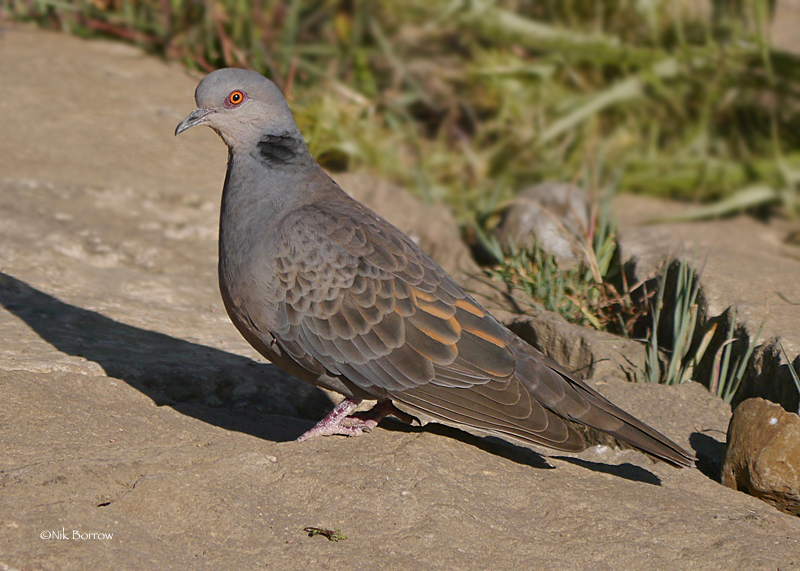
The dusky turtle dove is a very dark or slaty-grey dove, generally 28–30 centimetres long, and weighs 120–205 g; the males (140–205 g) slightly heavier than the females (120–190 g). It has a grey face slightly paler than the body, conspicuous black patches on sides of the neck, and wing coverts and tertials with pale brown or rufous edges. Its eye is orange or orange-yellow with a purplish eye-ring. Its bill is purplish slate-grey. Its legs are red. Juvenile birds are paler and browner than adults.
Range & habitat
The dusky turtle dove is found in East Africa, occurring in Eritrea, Somalia, southern Sudan, Ethiopia, Uganda, Tanzania, Malawi, Burundi, Democratic Republic of the Congo, and with a disjunct population in South Arabia in Yemen and southern Saudi Arabia. It inhabits the Afrotropical Highlands Biome, in montane forest, forest edge, and woodland garden, between 1,800 and 3,200 metres altitude. The preferred habitat is woodland with African juniper, hagenia, and bamboo, but it also uses plantations of exotic trees including eucalyptus and pine, and cultivated land. It is largely sedentary, but with some evidence of vagrancy; in Ethiopia, birds have been recorded as low as 200 m altitude during the rainy season.
Wikipedia: “Distribution and habitat”
What it does
The diet consists of seeds, insects, and molluscs, foraged from the ground. It is active during the day (diurnal) and is usually solitary or in small groups, but outside of the breeding season, in flocks of up to 100. The breeding season is mainly during the dry season, but is long, with nests recorded in all but the wettest periods (in Ethiopia, July and August). It is socially monogamous. The female probably builds the nest, a loose platform of twigs lined with rootlets, usually in a tree, often a juniper, 2-7 m above the ground. The clutch is two eggs. Both male and female incubate the eggs (20 days) and tend the nestlings (possibly 14–16 days).
== References ==
Wikipedia: “Ecology and behaviour”
Listen
Looking for field recordings…
Where it lives
Recorded sightings
—
geo-referenced records in GBIF, from museums, herbaria and field observers.
Drag the globe to turn it. Dots are where records exist, not a range map; darker means more records.
In the stacks
Searching the stacks…
Every page naming Streptopelia lugens in the Biodiversity Heritage Library →
This page is assembled live from iNaturalist, GBIF, Wikipedia, the Source Library and the Internet Archive. It is not yet part of the hand-edited codex. iNaturalist taxon 2989.