On eBird ↗
White-winged Dove
Live sightings near you, the range map, bar charts of when it is seen, and Macaulay Library photos and recordings.
White-winged Dove
Zenaida asiatica
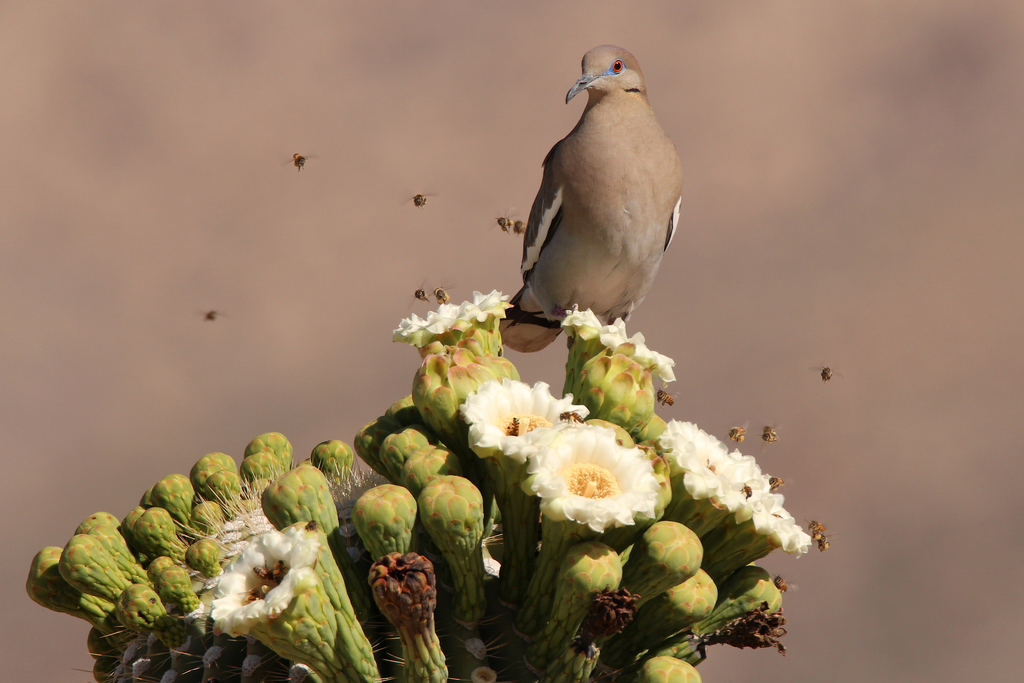
The white-winged dove (Zenaida asiatica) is a dove whose native range extends from the Southwestern United States through Mexico, Central America, and the Caribbean. They are large for doves, and can be distinguished from similar doves by the distinctive white edge on their wings. They have a blue eyering and red eyes. The plumage is brownish-gray to gray. Juveniles are duller in color and have brown eyes. The call is likened to the English phrase "who cooks for you". There are three subspecies. It was first described by George Edwards in 1743, and given its binomial name by Linnaeus in 1756. It was moved into the genus Zenaida in 1838.
They inhabit a variety of environments, including desert, scrub, and urban. Their diet consists mostly of grains, but will also include pollen and nectar, especially from the saguaro cactus, which is a vital source of water.
From the article White-winged dove on Wikipedia (CC BY-SA), quoted section by section
Description
White-winged doves are a plump, medium-sized bird (large for a dove), at 29 cm (11 in) from tip to tail, and a weight of 150 g (5.3 oz). Wingspan ranges from 18.9 to 22.8 in (48–58 cm). They are brownish-gray above and gray below, with a bold white wing patch that appears as a brilliant white crescent in flight, and is also visible at rest. Adults have a ring of blue, featherless skin around each eye and a long, dark mark on the lower face. They have a blue eye ring, and their legs and feet are brighter pink/red. Their eyes are bright crimson, except for juveniles, who have brown eyes. Juveniles are duller and grayer than adults and lack iridescence. Juvenile plumage is usually found between March and October. Differentiating between sexes is difficult, and usually requires examination of the cloaca. Males do have a more iridescent purple color to the crown, neck, and nape, as well as a more distinctive ear spot, though the differences are slight. Males are usually heavier on average, but differences in daily weight due to feeding make this an inaccurate field tool. Thus, most observers cannot accurately differentiate between sexes based on external characteristics alone. The identifying hallmark is its namesake white-edged wing, which similar species lack. It appears similar to the mourning dove, with which it may be easily confused. …
Range & habitat
Some populations of white-winged doves are migratory, wintering in Mexico, Central America, and the Caribbean. They are year-round inhabitants in Texas. San Antonio, Texas, had a year-round population of over a million doves in 2001. The white-winged dove inhabits scrub, woodlands, desert, urban, and cultivated areas. They are found increasingly farther north, now being visitors to most of the United States, and small parts of southern Canada. In recent years with increasing urbanization and backyard feeding, it has expanded throughout Texas, into Oklahoma, Louisiana, and coastal Mississippi. It has also been introduced to Florida. The white-winged dove is expanding outside its historic range into Kansas, Arkansas, Oklahoma, and northern New Mexico. The species is occasionally observed as a vagrant north of its typical range, and birds are being increasingly reported as far north as Canada and Alaska. Within Arizona, populations are effectively divided between agricultural and desert groups. It shares its habitat with that of the mourning dove, but the white winged dove will fly higher. They generally nest at low densities in the desert, but are found in high concentrations near riparian areas. Nesting in riparian zones is referred to as colonial, as opposed to noncolonial behavior in harsher environments. Such colonies are quite variable, but may be very large. …
Wikipedia: “Distribution and habitat”
What it does
Normally, up to 4000 birds are seen migrating, but in Texas, a flock of up to a million birds was recorded. Z. asiatica may fly 25 or more miles to find water, though they can be sustained solely by the water in saguaro cactus fruit.
Breeding and nesting. To impress females, males circle them with tail spread and wings raised, and also fan or flap their tails, or engage in cooing and preening. Males may aggressively defend territory from other males, sparring with wing slaps. Males and females work together in raising the young. The white-winged dove builds a flimsy stick nest in a tree of any kind and lays two cream-colored to white, unmarked eggs. One chick often hatches earlier and stronger, so it will demand the most food from the parents. A dove may nest as soon as 2–3 months after leaving the nest, making use of the summer heat. The dove nests as long as food and enough warmth are available to keep the fledglings warm. In Texas, they nest well into late August. Families and nestmates often stay together for life, perching and foraging together. They return to the same nesting site year after year, sometimes rebuilding a nest in the exact location it was the year before. They have better nesting success when in mesquite or tamarix trees. It is rare for them to build nests on man-made structures. …
Wikipedia: “Behavior and ecology”
In human culture
White-winged doves are popular as game birds for hunting. They are the only North American game species that is also a migratory pollinator. Hunting of the species peaked in the late 1960s, with an annual take around 740,000 birds in Arizona. That has since fallen; in 2008, just under 80,000 birds were taken in Arizona. The national take is larger, 1.6 million were hunted in 2011, with Texas taking 1.3 million. Most of the hunted birds are juveniles, averaging about 63% of the catch. Large numbers of birds were taken before the 1970s, when falling populations led to a tightening of hunting laws. In the 1960s, hunters could legally take up to 25 birds per day in Arizona over a three-week season. The Arizona dove season has since been restricted to two weeks and six birds per day, with shooting only allowed for half of each day. The bag limit in Texas is four birds per day, but the Texas catch remains the largest of any state. They are also popular among birders and photographers. People in many areas provide feeding stations and water in backyards to attract them for observation. The Stevie Nicks song "Edge of Seventeen" features a white-winged dove.
Wikipedia: “In culture”
Listen
Looking for field recordings…
Where it lives
Recorded sightings
—
geo-referenced records in GBIF, from museums, herbaria and field observers.
Drag the globe to turn it. Dots are where records exist, not a range map; darker means more records.
In the stacks
Searching the stacks…
Every page naming Zenaida asiatica in the Biodiversity Heritage Library →
This page is assembled live from iNaturalist, GBIF, Wikipedia, the Source Library and the Internet Archive. It is not yet part of the hand-edited codex. iNaturalist taxon 3460.