On eBird ↗
Mourning Dove
Live sightings near you, the range map, bar charts of when it is seen, and Macaulay Library photos and recordings.
Mourning Dove
Zenaida macroura
The mourning dove (Zenaida macroura) is a member of the dove family, Columbidae. The bird is also known as the American mourning dove, the rain dove, and colloquially as the turtle dove, and it was once known as the Carolina pigeon and Carolina turtledove. It is one of the most abundant and widespread North American birds and a popular gamebird, with more than 20 million birds (up to 70 million in some years) shot annually in the U.S., both for sport and meat. Its ability to sustain its population under such pressure is due to its prolific breeding; in warm areas, one pair may raise up to six broods of two young each in a single year. The wings make an unusual whistling sound upon take-off and landing, a form of sonation. The bird is a strong flier, capable of speeds up to 88 km/h (55 mph).
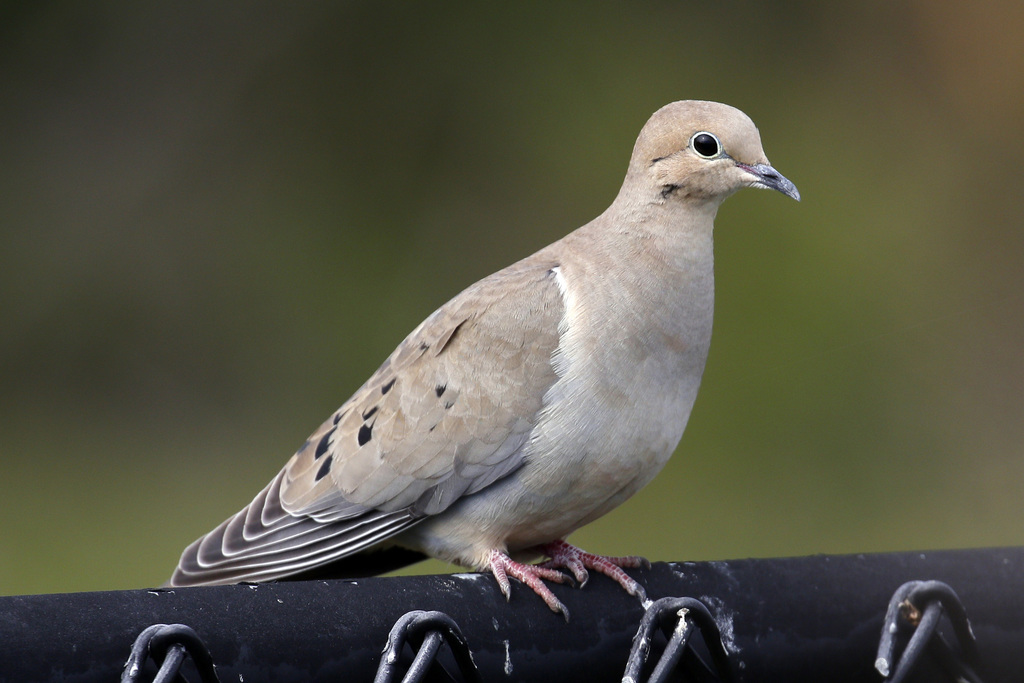
Mourning doves are light gray and brown and generally muted in color. Males and females are similar in appearance. The species is generally monogamous, with two squabs (young) per brood. Both parents incubate and care for the young. Mourning doves eat almost exclusively seeds, but the young are fed crop milk by their parents.
From the article Mourning dove on Wikipedia (CC BY-SA), quoted section by section
Description
The mourning dove is a medium-sized, slender dove approximately 31 cm (12 in) in length. Mourning doves weigh 112–170 g (4.0–6.0 oz), usually closer to 128 g (4.5 oz). The mourning dove has a wingspan of 37–45 cm. The elliptical wings are broad, and the head is rounded. Its tail is long and tapered ("macroura" comes from the Greek words for "large" and "tail"). Mourning doves have perching feet, with three toes forward and one reversed. The legs are short and reddish colored. The beak is short and dark, usually a brown-black hue. The plumage is generally light gray-brown above and lighter and pinkish below. The wings have black spotting, and the outer tail feathers are white, contrasting with the black inners. Below the eye is a distinctive crescent-shaped area of dark feathers. The eyes are dark, with light blue skin surrounding them. The adult male has bright purple-pink patches on the neck sides, with light pink coloring reaching the breast. Adult males possess a distinctly bluish-gray colored crown, which females lack. Females are similar in appearance but have more brown coloring overall and are slightly smaller than males. The iridescent feather patches on the neck above the shoulders are nearly absent but can be quite vivid on males. …
Range & habitat
The mourning dove has a large range of nearly 11,000,000 km2 (4,200,000 sq mi). The species is resident throughout the Greater Antilles, most of Mexico, the Continental United States, southern Canada, and the Atlantic archipelago of Bermuda. Much of the Canadian prairie sees these birds in summer only, and southern Central America sees them in winter only. The species is a vagrant in northern Canada, Alaska, and South America. It has occurred as a vagrant at least nine times in the Western Palearctic with records from the British Isles (5), Sweden (2), the Azores (1), and Iceland (1). The mourning dove also appeared on Socorro Island, off the western coast of Mexico, in 1988, sixteen years after the Socorro dove was extirpated from that island. The mourning dove occupies a wide variety of open and semi-open habitats, such as urban areas, farms, prairie, grassland, and lightly wooded areas. It avoids swamps and thick forest.
Migration. Most mourning doves migrate along flyways over land. Birds in Canada migrate the farthest, probably wintering in Mexico or further south. Those that spend the summer further south are more sedentary, with much shorter migrations. At the southern part of their range, Mourning Doves are present year-round. Spring migration north runs from March to May. …
Wikipedia: “Distribution and habitat”
What it does
Mourning doves sunbathe or rain bathe by lying on the ground or a flat tree limb, leaning over, stretching one wing, and keeping this posture for up to twenty minutes. These birds can also water bathe in shallow pools or birdbaths. Dustbathing is common as well.
Outside the breeding season, mourning doves roost communally in dense deciduous trees or conifers. During sleep, the head rests between the shoulders, close to the body; it is not tucked under the shoulder feathers as in many other species. During the winter in Canada, roosting flights to the roosts in the evening, and out of the roosts in the morning, are delayed on colder days.
Breeding. Courtship begins with a noisy flight by the male, followed by a graceful, circular glide with outstretched wings and head down. After landing, the male will approach the female with a puffed-out breast, bobbing head, and loud calls. Mated pairs will often preen each other's feathers. The male then leads the female to potential nest sites, and the female will choose one. The female dove builds the nest. The male will fly about, gather material, and bring it to her. The male will stand on the female's back and give the material to the female, who then builds it into the nest. The nest is constructed of twigs, conifer needles, or grass blades, and is of flimsy construction. …
Wikipedia: “Behavior and ecology”
Listen
Looking for field recordings…
Where it lives
Recorded sightings
—
geo-referenced records in GBIF, from museums, herbaria and field observers.
Drag the globe to turn it. Dots are where records exist, not a range map; darker means more records.
In the old herbals & bestiaries

In the stacks
Searching the stacks…
Every page naming Zenaida macroura in the Biodiversity Heritage Library →
This page is assembled live from iNaturalist, GBIF, Wikipedia, the Source Library and the Internet Archive. It is not yet part of the hand-edited codex. iNaturalist taxon 3454.