 NL·0358
Herbarium of the Nature Library
- Name
- Cinclus cinclus
- Family
- Cinclidae
- Native to
- Fast rivers of Europe, northwest Africa (Atlas), Turkey, the Caucasus, Iran and Central Asia to the Himalaya and western China
- Habitat
- Rivers, Mountains
On eBird ↗
White-throated Dipper
Live sightings near you, the range map, bar charts of when it is seen, and Macaulay Library photos and recordings.
White-throated dipper
Cinclus cinclus
Also calledDere kuşu (Turkish) · Wasseramsel (German) · Cincle plongeur (French) · Mirlo acuático (Spanish) · Fossekall (Norwegian) · Bronwen y dŵr (Welsh)
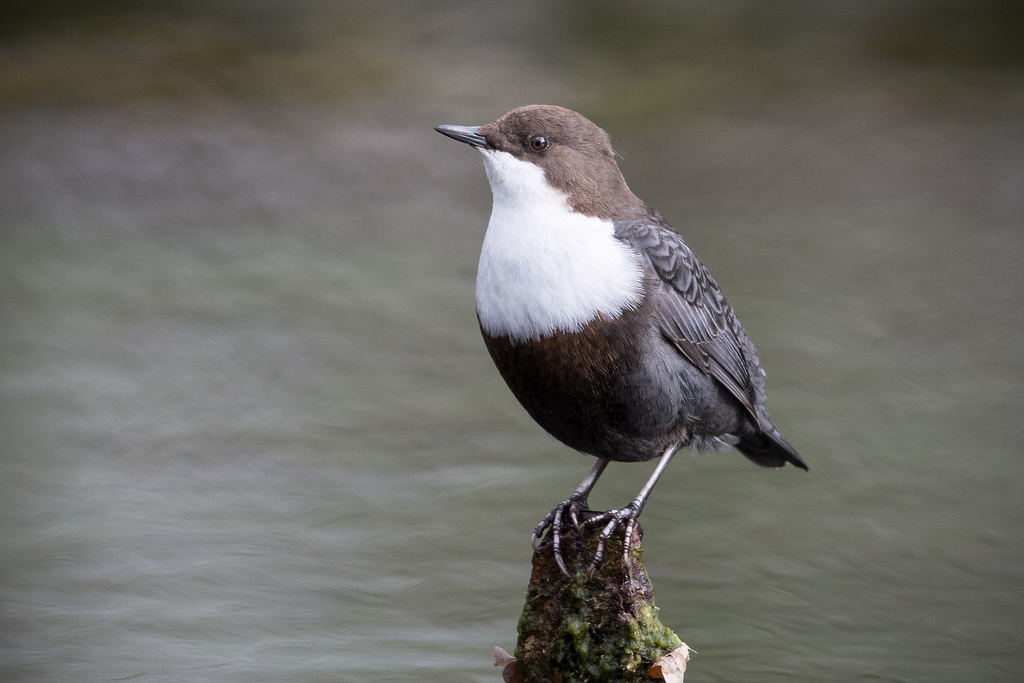
The only European songbird that swims and walks underwater. This chunky, white-bibbed bird bobs on boulders in fast mountain streams before plunging in to hunt insect larvae on the riverbed.
The white-throated dipper, also known as the European dipper or just dipper, is an aquatic, passerine bird found in Europe, the Middle East, Central Asia, and the Indian subcontinent. The species is divided into several subspecies, based primarily on colour differences, particularly of the pectoral band. Wikipedia
What it can do
- iWalks along the stream bed against the current, using its wings to stay down
- iiHas dense plumage and a large preen gland for waterproofing
- iiiCan close its nostrils with flaps of skin when submerged
- ivSings through the winter, even beside frozen torrents
In the field
Field marks
- aPlump, short-tailed, wren-like shape
- bBright white throat and breast
- cDark chocolate-brown head and blackish body; some races have a chestnut belly band
- dWhirring, low flight over water
- Voice
- A sharp, metallic 'zit' in flight; song a sweet, rambling warble heard even in winter.
- Not to be confused with
- Ring ouzel has a white breast crescent but is a thrush of moorland, not water. Brown dipper (Central Asia, Himalaya) is entirely brown with no white bib.
- Where to see it
- Upland streams in Wales, northern England and Scotland, the Alps, Pyrenees, Norwegian rivers and Atlas Mountains.
- When
- Resident; northern birds move to ice-free water in winter
Listen
Looking for field recordings…
Life & habits
- Diet
- Caddisfly, mayfly and stonefly larvae, freshwater shrimps, small fish
- Habitat
- Clear, fast-flowing upland streams and rivers
- Size
- 17–20 cm; 50–76 g
- Lifespan
- Typically 2–3 years
Bobs constantly on a stone in midstream, blinking its white eyelids, before diving in.
Where it lives
Recorded sightings
—
geo-referenced records in GBIF, from museums, herbaria and field observers.
Native range
Fast rivers of Europe, northwest Africa (Atlas), Turkey, the Caucasus, Iran and Central Asia to the Himalaya and western China
Drag the globe to turn it. Dots are where records exist, not a range map; darker means more records.
In the old herbals & bestiaries
No plate in the Source Library names this exact species, so these show its closest relatives as the old naturalists drew them: same genus, or the same kind of animal. Click a plate to read the page it came from, with translation.


In the stacks
Searching the stacks…
Every page naming Cinclus cinclus in the Biodiversity Heritage Library →
Marginalia
Norway made the dipper (fossekall, 'waterfall man') its national bird in 1963, and the Welsh name 'bronwen y dŵr' means 'white breast of the water'.
Curiosity
Studies in Wales found dipper numbers fell on acidified streams, making it an indicator of river health.
Kinship



Photographs: iNaturalist contributors under the licences shown. Records: GBIF.org. Historical plates: Source Library (CC BY-SA 4.0; originals public domain). Summary text: Nature Library editors and Wikipedia (CC BY-SA). Medicinal and edibility notes are historical and educational, not advice. iNaturalist taxon 7647.