On eBird ↗
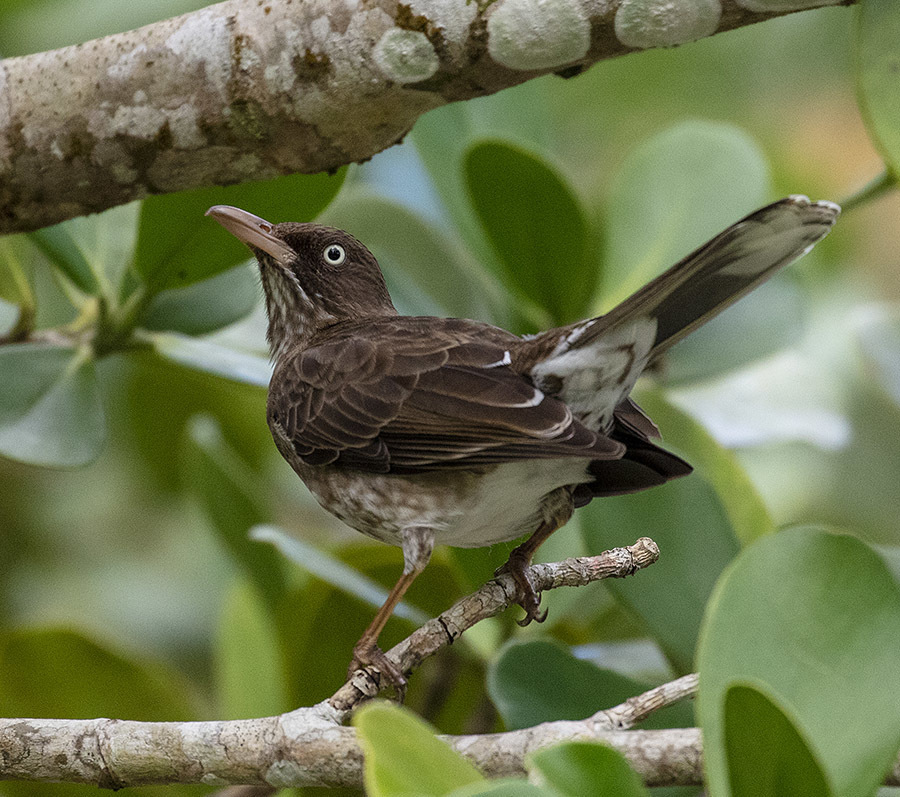
Pearly-eyed Thrasher
Live sightings near you, the range map, bar charts of when it is seen, and Macaulay Library photos and recordings.
Pearly-eyed Thrasher
Margarops fuscatus
The pearly-eyed thrasher (Margarops fuscatus) is a bird in the thrasher family Mimidae. It is found on many Caribbean islands, from the Bahamas in the north to the Grenadines in the south, with an isolated subspecies on Bonaire.
From the article Pearly-eyed thrasher on Wikipedia (CC BY-SA), quoted section by section
Description
The pearly-eyed thrasher is the largest species in the Mimidae, growing to 28 to 30 cm (11 to 11.8 inches) in length.
Range & habitat
The pearly-eyed thrasher has a somewhat disjunct distribution throughout the West Indies: it is found in the Bahamas, Puerto Rico, the Virgin Islands, the Turks and Caicos Islands, the eastern Dominican Republic (as well as Isla Beata), many of the Lesser Antilles (except Barbados and Grenada, where it is extirpated), Saba, Sint Eustatius, and Bonaire. Its main habitat is bushes and trees in mountain forests and coffee plantations. In Puerto Rico, as well as occupying the main island, it is also found on Mona Island. In the Bahamas, it is a breeding species on San Salvador, Exuma, and Long Island, and probably also on Acklins, Mayaguana, and Great Inagua; in addition it is found as a wintering species on Eleuthra and Cat Island. In the Lesser Antilles, it is a breeding species in the SSS islands (the northern part of the Netherlands Antilles), Barbuda, Antigua, Montserrat, Guadeloupe, Dominica, Martinique, St. Lucia, Saint Thomas, and Saint Vincent and the Grenadines. The subspecies M. f. bonairensis was formerly found on La Horquilla, one of the Hermanos Islands off the north coast of Venezuela, but it is now believed to be extirpated from there, having last been reported in 1908.
Wikipedia: “Distribution and habitat”
What it does
The pearly-eyed thrasher is described as an aggressive, opportunistic omnivore that feeds primarily on large insects, but also feeds on fruits and berries, and will occasionally eat lizards, frogs, small crabs and other bird's eggs and nestlings. This species nests in cavities. In Puerto Rico, it is known to compete with the critically endangered Puerto Rican amazon (Amazona vittata) for nesting sites, and may even destroy the parrot's eggs.
Wikipedia: “Ecology”
Listen
Looking for field recordings…
Where it lives
Recorded sightings
—
geo-referenced records in GBIF, from museums, herbaria and field observers.
Drag the globe to turn it. Dots are where records exist, not a range map; darker means more records.
In the stacks
Searching the stacks…
Every page naming Margarops fuscatus in the Biodiversity Heritage Library →
This page is assembled live from iNaturalist, GBIF, Wikipedia, the Source Library and the Internet Archive. It is not yet part of the hand-edited codex. iNaturalist taxon 14984.