 NL·0592
Herbarium of the Nature Library
- Name
- Paradisaea raggiana
- Family
- Paradisaeidae
- Native to
- Southern and north-eastern New Guinea
- Habitat
- Lowland and hill rainforest
On eBird ↗
Raggiana Bird-of-Paradise
Live sightings near you, the range map, bar charts of when it is seen, and Macaulay Library photos and recordings.
Raggiana bird-of-paradise
Paradisaea raggiana
Also calledKumul (Tok Pisin) · Ave del paraíso (Spanish) · Burung cenderawasih (Indonesian/Malay)
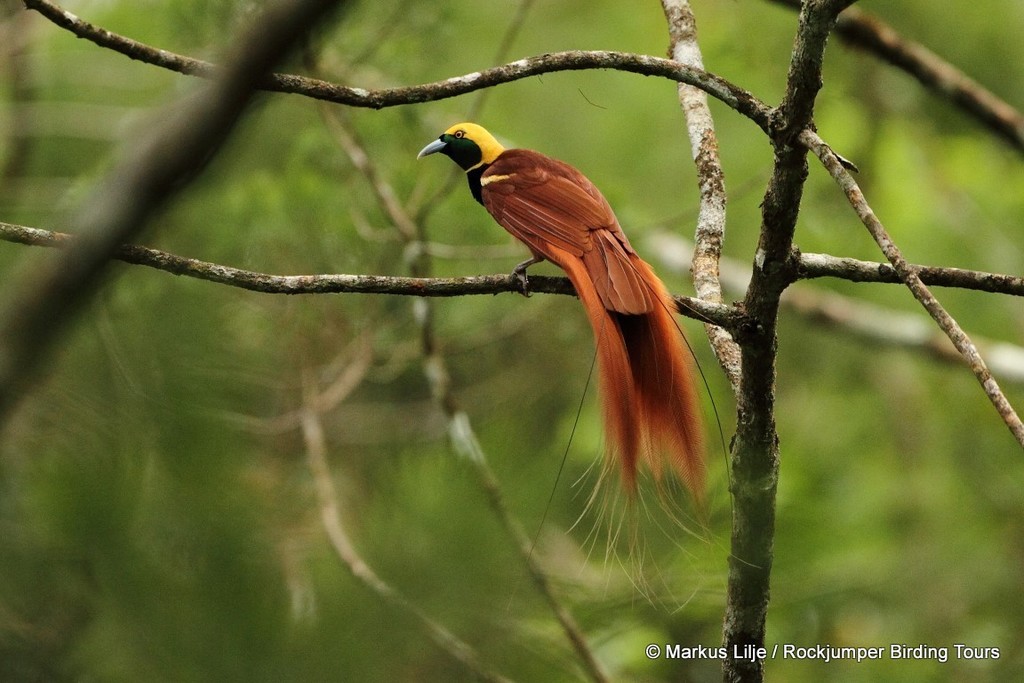
The national bird of Papua New Guinea, shown on its flag. Males gather at forest leks, clapping their wings and shaking their heads as they raise cascades of orange-red flank plumes to court females.
The Raggiana bird-of-paradise, also known as Count Raggi's bird-of-paradise, is a large bird in the bird-of-paradise family Paradisaeidae. Wikipedia
What it can do
- iMales display communally at leks, raising and shaking plumes
- iiRaises plumes into an erect fan while calling loudly
- iiiDisperses seeds of many rainforest trees
- ivHybridises with other Paradisaea species where ranges meet
In the field
Field marks
- aMale: maroon-brown body, yellow crown and collar, dark emerald throat
- bLong red to orange flank plumes
- cTwo long black tail wires
- dFemale drab maroon-brown with no plumes or wires
- Not to be confused with
- Lesser bird-of-paradise has yellow plumes; the two hybridise where they meet. Plume colour varies among Raggiana subspecies from deep red to apricot.
- Where to see it
- Varirata National Park near Port Moresby, Papua New Guinea
- When
- Resident; display at morning leks
Listen
Looking for field recordings…
Life & habits
- Diet
- Fruit, especially figs; also arthropods
- Habitat
- Rainforest and forest edge
- Size
- About 34 cm, plus male tail wires
A dozen or more males display in the same tree, and females visit to choose among them.
Where it lives
Recorded sightings
—
geo-referenced records in GBIF, from museums, herbaria and field observers.
Native range
Southern and north-eastern New Guinea
Drag the globe to turn it. Dots are where records exist, not a range map; darker means more records.
In the old herbals & bestiaries
Woodcuts and engravings matched from the Source Library’s scanned books by name. Plates marked “relative” show a close kin rather than this exact species. Click a plate to read the page it came from, with translation.

History of Animals, Book I: On Viviparous Quadrupeds
Conrad Gessner · 1554 · p.798

Historiae Animalium Liber III: De Avium Natura
Conrad Gesner · 1555 · p.653

The Malay Archipelago: The Land of the Orang-Utan and the Bird of Paradise
Alfred Russel Wallace · 1869 · p.568

The Malay Archipelago: The Land of the Orang-Utan and the Bird of Paradise
Alfred Russel Wallace · 1869 · p.592

Ulyssis Aldrovandi ... Ornithologiae
Aldrovandi, Ulisse · 1610 · p.419

Jean Baptiste Audebert — Histoire naturelle des grimpereaux et des oiseaux de paradis (1802)
Jean Baptiste Audebert · 1802 · p.361

Jean Baptiste Audebert — Histoire naturelle des grimpereaux et des oiseaux de paradis (1802)
Jean Baptiste Audebert · 1802 · p.364

Ornithology: The History of Birds
Ulisse Aldrovandi · 1599 · p.845

Historia naturalis Brasiliae
Willem Piso / Georg Marcgraf · 1648 · p.346

Hokusai Manga (北斎漫画), Vol. 3
Katsushika Hokusai · 1815 · p.32
In the stacks
Searching the stacks…
Every page naming Paradisaea raggiana in the Biodiversity Heritage Library →
Marginalia
Plumes have been worn for centuries in New Guinea headdresses, and traded to Asia; in the 16th century legless skins reached Europe, giving rise to the myth that birds-of-paradise never landed. PNG adopted it as its flag emblem in 1971.
Curiosity
Named after Francesco Raggi, an Italian marquis from Genoa.
Kinship



Fact-checked: 1 correction made to this sheet. Photographs: iNaturalist contributors under the licences shown. Records: GBIF.org. Historical plates: Source Library (CC BY-SA 4.0; originals public domain). Summary text: Nature Library editors and Wikipedia (CC BY-SA). Medicinal and edibility notes are historical and educational, not advice. iNaturalist taxon 8183.