On eBird ↗
Eurasian Bullfinch
Live sightings near you, the range map, bar charts of when it is seen, and Macaulay Library photos and recordings.
Eurasian Bullfinch
Pyrrhula pyrrhula
The Eurasian bullfinch or common bullfinch (Pyrrhula pyrrhula) is a small passerine bird in the finch family, Fringillidae. In Anglophone Europe it is known simply as the bullfinch (English regional, Shropshire: plum bird), as it is the original bird to bear the name bullfinch.
From the article Eurasian bullfinch on Wikipedia (CC BY-SA), quoted section by section
Description
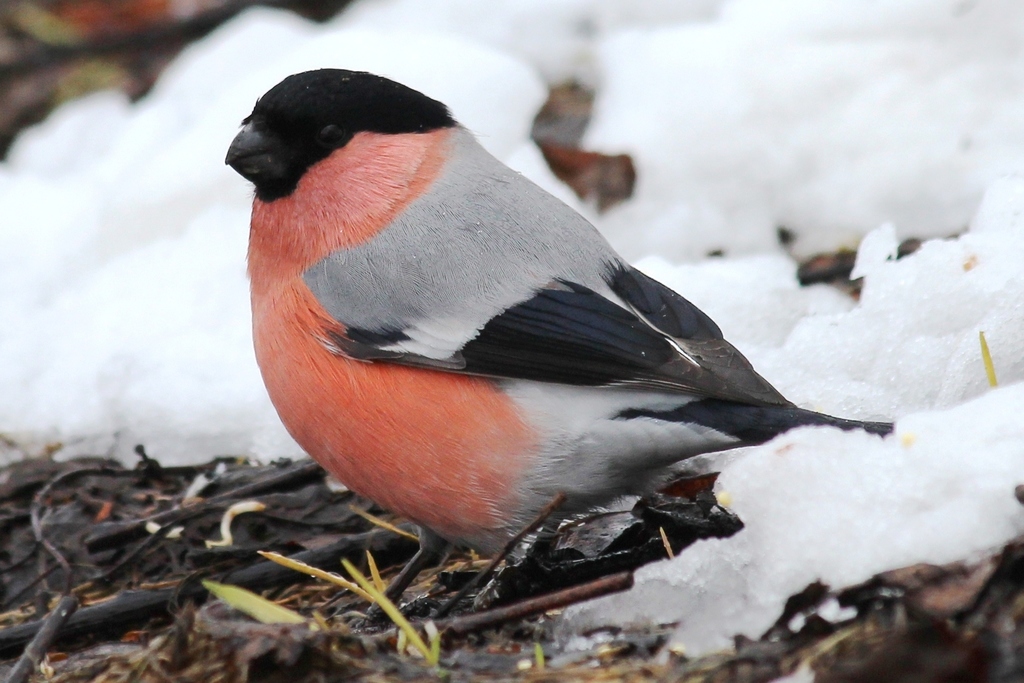
The Eurasian bullfinch is a bulky bull-headed bird. The upper parts of its body are grey; the flight feathers and has a short stocky bill are black; as are the cap and face in adults (they are greyish-brown in juveniles), and the white rump and wing bars are striking in flight. The adult male has a distinctive rich red chest and underparts, but females and young birds have grey-buff feathers instead. It moults between July and October, but males do not have the duller autumn plumage that is typical of some other finches. The song of this unobtrusive bird contains fluted whistles, and is often described as "mournful". This bullfinch's usual call is a quiet, low, melancholy whistled peeu or pew. The song is audible only at close range. It is a weak, scratchy warbling, alternating with soft whistles. Tamed bullfinches can be taught to repeat specific melodies.
Range & habitat
This bird breeds across most of Europe and temperate Asia. It is mainly resident, but many northern birds migrate further south in the winter. Mixed woodland with some conifers is favored for breeding, including parkland and gardens.
Wikipedia: “Distribution and habitat”
What it does
This species does not form large flocks outside the breeding season, and is usually seen as a pair or family group.
Breeding. It builds its nest in a bush, (preferably more than four metres tall and wide), mature stands of scrub, or tree, laying four to seven pale blue eggs which are mottled with red-brown. It is peculiar among the Passeriformes for having spermatozoa with a rounded head and a blunt acrosome. This species produces two or three broods per season, from early May to mid-July. Nesting success increases progressively from April–May to June–July and August.
Wikipedia: “Behaviour and ecology”
At the table
The food is mainly seeds and buds of fruit trees, which can make it a pest in orchards: in England, for centuries every parish paid a bounty for every bullfinch killed. Populations in the UK have declined since the 1970s due to loss of orchards and woodlands. Ash and hawthorn are favoured in autumn and early winter. If wild bird cover is planted for it, kale, quinoa and millet are preferred, next to tall hedges or woodland. Adults will feed chicks with invertebrates.
Wikipedia: “Food and feeding”
Listen
Looking for field recordings…
Where it lives
Recorded sightings
—
geo-referenced records in GBIF, from museums, herbaria and field observers.
Drag the globe to turn it. Dots are where records exist, not a range map; darker means more records.
In the stacks
Searching the stacks…
Every page naming Pyrrhula pyrrhula in the Biodiversity Heritage Library →
This page is assembled live from iNaturalist, GBIF, Wikipedia, the Source Library and the Internet Archive. It is not yet part of the hand-edited codex. iNaturalist taxon 9462.