On eBird ↗
Red-billed Firefinch
Live sightings near you, the range map, bar charts of when it is seen, and Macaulay Library photos and recordings.
Red-billed Firefinch
Lagonosticta senegala
The red-billed firefinch or Senegal firefinch (Lagonosticta senegala) is a small seed-eating bird in the family Estrildidae. This is a resident breeding bird in most of Sub-Saharan Africa with an estimated global extent of occurrence of 10,000,000 km2. It was introduced to Egypt, but the population there has become extinct. It was also introduced to southern Algeria where it is currently expanding northward.
From the article Red-billed firefinch on Wikipedia (CC BY-SA), quoted section by section
Description
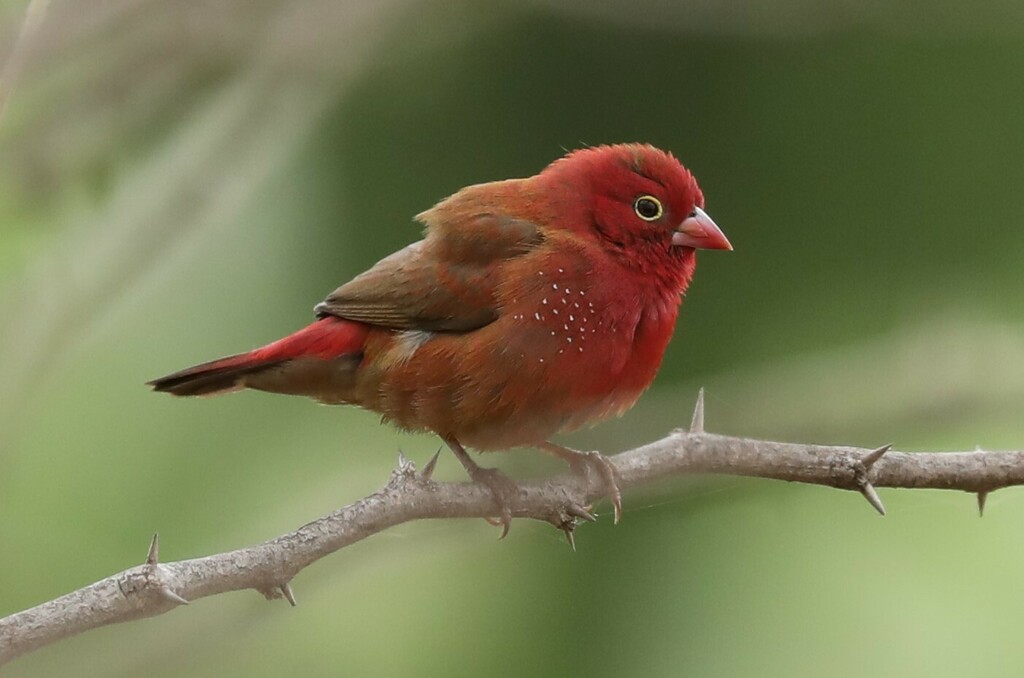
The red-billed firefinch is 10 cm (3.9 in) in length. The adult male has entirely scarlet plumage apart from brown wings. The bill is pink, and there is a yellow eye-ring. Females have uniformly brown upperparts and buff underparts. There is a small red patch in front of both eyes, with the bill also being pink.
Range & habitat
This widespread and abundant species is often found around human habitation, often with other species such as the red-cheeked cordon-bleu. Its soft queet-queet call is a familiar African sound. The song is a rising chick-pea-pea-pea. The red-billed firefinch is a small gregarious bird which feeds mainly on grain and other seeds. It frequents open grassland and cultivation. The nest is a large domed grass structure with a side entrance, built low in a bush, wall or thatch into which three to six white eggs are laid. The nest of this species is parasitised by the village indigobird.
Wikipedia: “Range and habitat”
Listen
Looking for field recordings…
Where it lives
Recorded sightings
—
geo-referenced records in GBIF, from museums, herbaria and field observers.
Drag the globe to turn it. Dots are where records exist, not a range map; darker means more records.
In the stacks
Searching the stacks…
Every page naming Lagonosticta senegala in the Biodiversity Heritage Library →
This page is assembled live from iNaturalist, GBIF, Wikipedia, the Source Library and the Internet Archive. It is not yet part of the hand-edited codex. iNaturalist taxon 14051.