On eBird ↗
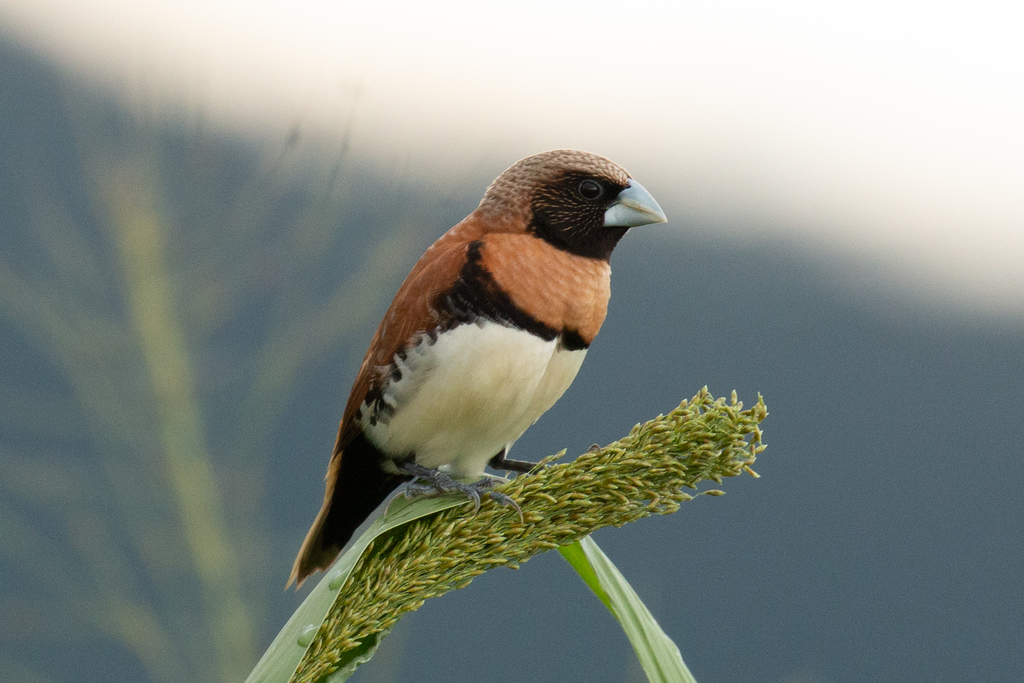
Chestnut-breasted Munia
Live sightings near you, the range map, bar charts of when it is seen, and Macaulay Library photos and recordings.
Chestnut-breasted Munia
Lonchura castaneothorax
The chestnut-breasted mannikin (Lonchura castaneothorax), also known as the chestnut-breasted munia or bully bird (in Australia), is a small brown-backed munia with a black face and greyish crown and nape. It has a broad ferruginous breast bar above a white belly. The species is found in Australia, New Caledonia, Indonesia, and Papua New Guinea. This species has also been introduced to French Polynesia and France.
From the article Chestnut-breasted mannikin on Wikipedia (CC BY-SA), quoted section by section
Range & habitat
In Australia, the chestnut-breasted mannikin is known as a bird of reed beds and rank grasses bordering rivers, in swamp, in grassy country, and mangroves. It is commonly found in cane fields and cereal crops. In dry seasons, it is seen in arid country but always near water. It is also found in grassy woodland. John Gould wrote of it (quoted in Cayley, 1932):
I had not the good fourtune to meet with this bird in a state of nature, but I have been informed that it frequents reed beds bordering the banks of rivers and lagoons on the eastern coast, and that it much resembles the Bearded Tit Panurus biarmicus, of Europe in the alertness with which it passes up and down the upright stems of reeds, from the lower part to the very top, a habit for which the lengthened and curved form of its claws seem well adapted. In New Guinea, the chestnut-breasted mannikin is a bird of drier areas and does not usually seen in jungle roads and clearings where other munias such as grey-headed mannikin are found. In French Polynesia, it is well established as an introduced species, and its habits have developed somewhat differently, indicating the adaptability of the species. It is widespread on the bracken-covered hill slopes, in pastures and gardens (it is not a garden bird in Australia), on cultivated land and wasteland, in forest ecotones and coconut plantations (Lever 1989).
Wikipedia: “Habitat”
At the table
In Australia, during the breeding season chestnut-breasted mannikins are mostly seen in pairs, but in late autumn and winter months it congregates in large flocks, at times eating seeds of cereal crops. Chestnut-breasted mannikin is a highly sociable species, flocking in large number outside the breeding season. Breeding birds will join groups or flocks when foraging. It has a distinct liking for barley seed and thus the local people give it a name "barley bird". The species is also fond of paspalum grass Paspalum longifolium, bullrush millet Pennisetum typhoides and Sorghum species. It has also been recorded that it feeds on feral millet Pannicum maximum and wild sugar cane Saccharum robustum in Papua New Guinea (Bapista 1990).
Wikipedia: “Habits and food”
Listen
Looking for field recordings…
Where it lives
Recorded sightings
—
geo-referenced records in GBIF, from museums, herbaria and field observers.
Drag the globe to turn it. Dots are where records exist, not a range map; darker means more records.
In the stacks
Searching the stacks…
Every page naming Lonchura castaneothorax in the Biodiversity Heritage Library →
This page is assembled live from iNaturalist, GBIF, Wikipedia, the Source Library and the Internet Archive. It is not yet part of the hand-edited codex. iNaturalist taxon 13890.