 NL·0359
Herbarium of the Nature Library
- Name
- Orthotomus sutorius
- Family
- Cisticolidae
- Native to
- Pakistan, India, Sri Lanka, Nepal and Bangladesh to southern China, Southeast Asia and Java
- Habitat
- Gardens, Scrub, Open woodland, Urban
On eBird ↗
Common Tailorbird
Live sightings near you, the range map, bar charts of when it is seen, and Macaulay Library photos and recordings.
Common tailorbird
Orthotomus sutorius
Also calledDarzi (Hindi/Urdu; 'tailor') · Tuntuni (Bengali) · Cháng wěi féng yè yīng 长尾缝叶莺 (Chinese)
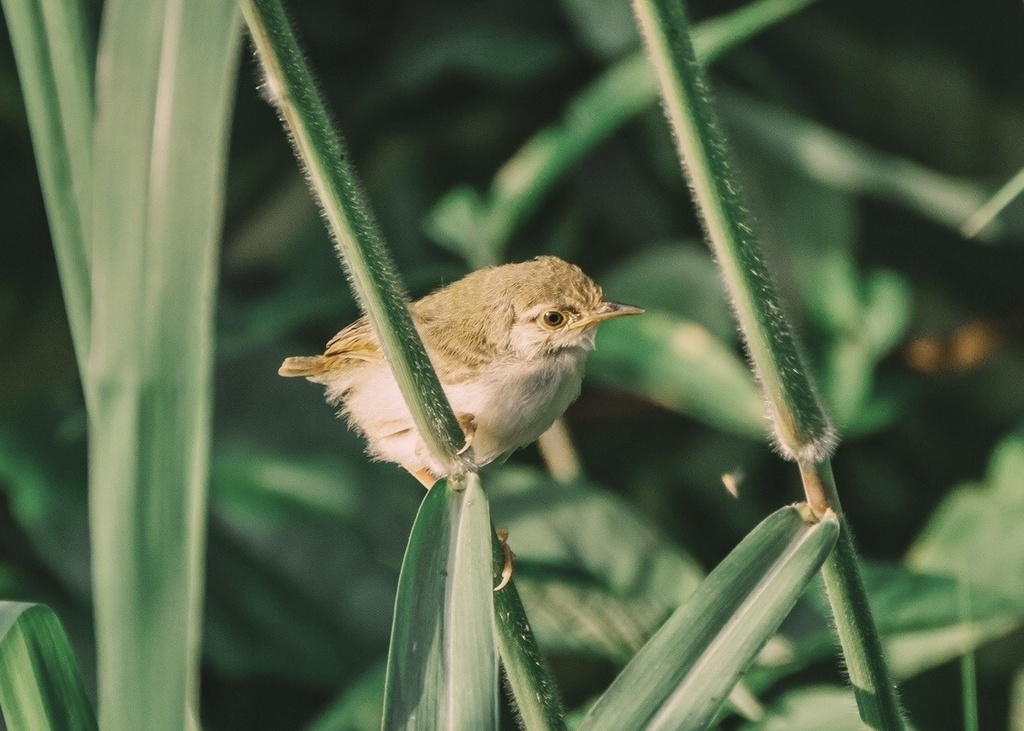
A tiny green warbler with a rusty cap and a cocked tail that literally sews its nest, piercing the edges of large leaves with its bill and stitching them into a cup with spider silk or plant fibre. Its loud call belies its size.
The common tailorbird is a songbird found across tropical and subtropical Asia. Popular for its nest made of leaves "sewn" together and immortalized by Rudyard Kipling as Darzee in his Jungle Book, it is a common resident in urban gardens. Although shy birds that are usually hidden within vegetation, their loud calls are familiar and give away their presence. They are distinctive in having a long upright tail, greenish upper body plumage and rust coloured forehead and crown. This passerine bird is typically found in open farmland, scrub, forest edges and gardens. Tailorbirds get their name from the way their nest is constructed. The edges of a large leaf are pierced and sewn together with plant fibre or spider silk to make a cradle in which the actual nest is built. Wikipedia
What it can do
- iPunches holes along a leaf margin and pulls fibres through, knotting them like rivets
- iiBuilds the nest inside one or more living leaves so it stays green and camouflaged
- iiiThrives in city gardens and potted plants
In the field
Field marks
- aTiny bright olive-green warbler with whitish underparts
- bRufous forecrown
- cLong, thin, slightly curved bill
- dLong tail held upright, sometimes with dark spots near the base of the throat
- Voice
- A loud, repeated 'towit-towit-towit' or 'cheeyup-cheeyup', surprisingly loud for the bird's size
- Not to be confused with
- Dark-necked tailorbird (NE India, SE Asia) has a dark throat patch; prinias are browner with long graduated tails and lack the rufous cap.
- Where to see it
- Garden hedges and shrubs throughout Pakistan and India, e.g. Lahore, Karachi, Delhi and Colombo
- When
- Resident year-round
Listen
Looking for field recordings…
Life & habits
- Diet
- Small insects, larvae and spiders
- Habitat
- Gardens, hedges, scrub, plantations and forest edge
- Size
- About 10–14 cm long; breeding males have longer central tail feathers
Restless, moving through low bushes with its tail cocked and flicking; the stitched leaf-cradle holds a soft cup of plant down.
Where it lives
Recorded sightings
—
geo-referenced records in GBIF, from museums, herbaria and field observers.
Native range
Pakistan, India, Sri Lanka, Nepal and Bangladesh to southern China, Southeast Asia and Java
Drag the globe to turn it. Dots are where records exist, not a range map; darker means more records.
In the stacks
Searching the stacks…
Every page naming Orthotomus sutorius in the Biodiversity Heritage Library →
Marginalia
Rudyard Kipling's 'Rikki-Tikki-Tavi' features Darzee and his wife, a pair of tailorbirds, named with the Hindustani word for tailor.
Curiosity
The 'stitches' are not true sewing: the fibres are pushed through each hole and fluffed out on the outside so they hold like a rivet.
Kinship





Photographs: iNaturalist contributors under the licences shown. Records: GBIF.org. Historical plates: Source Library (CC BY-SA 4.0; originals public domain). Summary text: Nature Library editors and Wikipedia (CC BY-SA). Medicinal and edibility notes are historical and educational, not advice. iNaturalist taxon 15347.