On eBird ↗
Yellow Longbill
Live sightings near you, the range map, bar charts of when it is seen, and Macaulay Library photos and recordings.
Yellow Longbill
Macrosphenus flavicans
The yellow longbill (Macrosphenus flavicans) is a species of Old World warbler in the Macrosphenidae family. It is found in Angola, Cameroon, Central African Republic, Republic of the Congo, Democratic Republic of the Congo, Equatorial Guinea, Gabon, Nigeria, South Sudan, Tanzania, and Uganda. Its natural habitats are subtropical or tropical moist lowland forests and subtropical or tropical moist montane forests.
From the article Yellow longbill on Wikipedia (CC BY-SA), quoted section by section
Description
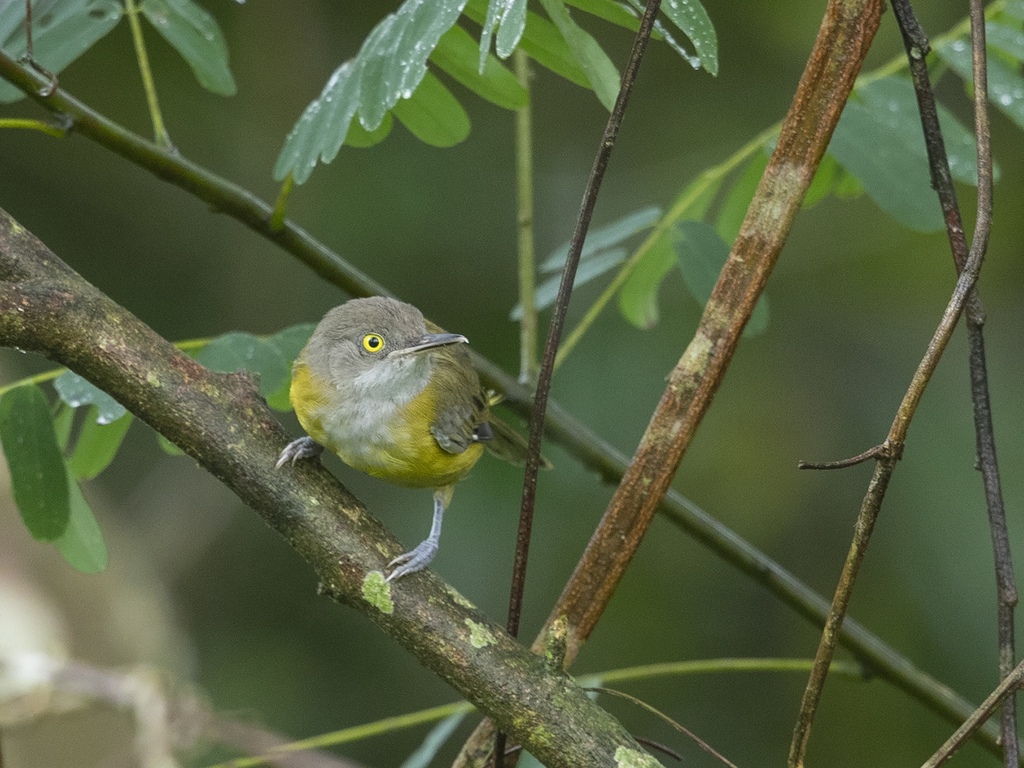
The yellow longbill, on average, measures 13 cm from bill to tail and weighs 11-16g. It is medium in size. It has a short tail and a black long straight bill with a small hook at the tip. It has a yellow iris and greenish-yellow underparts. It is dark olive-gray at the top of its head. Its feathers transition to dark olive-green on the upperparts and upper wing and become yellow-tinged on long loose feathers on the back and rump. Sexes are alike in plumage, male being larger than female. The yellow longbill has a span of life of 3.6 years. The current population trend of the yellow longbill is stable. The number of mature individuals is unknown, as is the continuing decline of mature individuals.
Range & habitat
The yellow longbill's habitat is in the forest, more specifically the subtropical and tropical moist lowland. Lowland habitats are of the lower and middle levels, including the primary and secondary forest. These forest habitat lowlands involve edges, clearings and logged areas. Lowlands range to levels of 1000-1400m in Uganda and to 1800m in the eastern Democratic Republic of Congo. The geographic range for the yellow longbill includes Angola, Cameroon, Central African Republic, the Democratic Republic of the Congo, Equatorial Guinea, Gabon, Nigeria, South Sudan, Sudan, United Republic of Tanzania, and Uganda. Specific distributions for subspecies have been identified. The Macrosphenus flavicans flavicans subspecies is distributed throughout extreme southeast Nigeria, Bioko, and southwest and south Cameroon south to lower River Congo and northwest Angola. The Macrosphenus flavicans hypochondriacus subspecies is distributed throughout southeast Central African Republic, southwest South Sudan (Bengangai Forest), north, central, and east Democratic Republic of the Congo, west and south Uganda and northwest Tanzania (Minziro Forest).
Wikipedia: “Distribution and habitat”
What it does
The diet of a yellow longbill consists of spiders and insects, such as moths, caterpillars, and beetles. Their diet also includes some fruit, making them omnivorous. Yellow longbills forage in pairs or in family groups. Forage groups are sometimes mixed in species. They forage among thick and tangled undergrowth. They also forage in lower canopy areas, especially during the dry season.
Wikipedia: “Diet”
Listen
Looking for field recordings…
Where it lives
Recorded sightings
—
geo-referenced records in GBIF, from museums, herbaria and field observers.
Drag the globe to turn it. Dots are where records exist, not a range map; darker means more records.
In the stacks
Searching the stacks…
Every page naming Macrosphenus flavicans in the Biodiversity Heritage Library →
This page is assembled live from iNaturalist, GBIF, Wikipedia, the Source Library and the Internet Archive. It is not yet part of the hand-edited codex. iNaturalist taxon 15572.