On eBird ↗
Tawny-flanked Prinia
Live sightings near you, the range map, bar charts of when it is seen, and Macaulay Library photos and recordings.
Tawny-flanked Prinia
Prinia subflava
The tawny-flanked prinia (Prinia subflava) is a small passerine bird belonging to the genus Prinia in the family Cisticolidae, a family of Old World warblers. It is widespread and common in most parts of Africa south of the Sahara. The plain prinia (P. inornata) of southern Asia was formerly included in this species but is now usually considered to be a separate species.
From the article Tawny-flanked prinia on Wikipedia (CC BY-SA), quoted section by section
Description
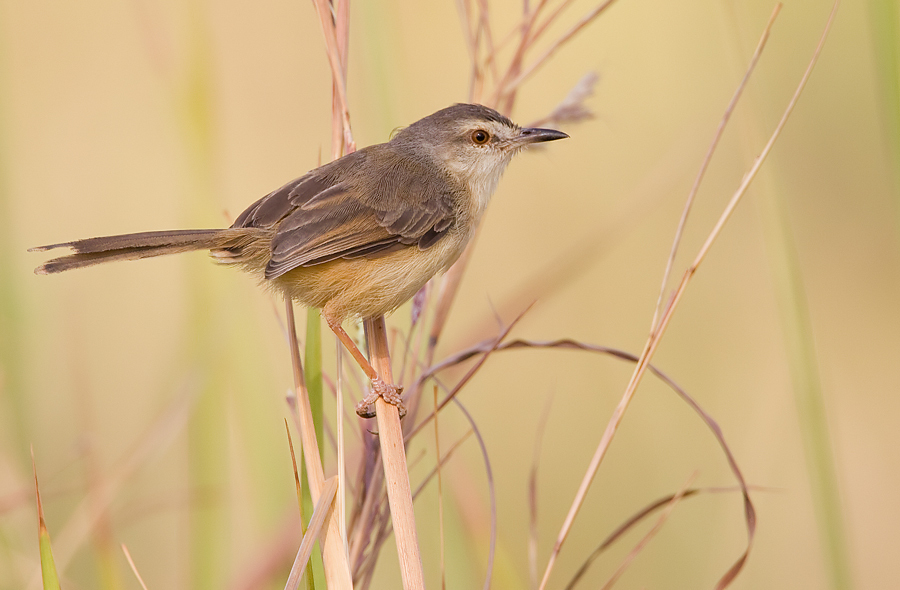
The tawny-flanked prinia is 11–12 cm (4.3–4.7 in) in length with a long, narrow, graduated tail and a fairly long, slender bill. The tail is often held erect or waved from side to side. The upperparts are grey-brown with rufous-brown edges to the flight feathers and a rufous tinge to the rump. The throat and breast are whitish while the flanks and vent are warm buff. There is a whitish stripe over the eye and the lores are dark. The tail feathers have a white tip and a dark subterminal band. The sexes are similar in appearance. Non-breeding birds have a longer tail than breeding birds. Juveniles have pale yellow underparts and a yellowish bill. There are many recognised subspecies. The call is short, wheezy and rapidly repeated. The song is a monotonous series of shrill notes. The male often sings from an exposed perch. The pale prinia (P. somalica) of North-east Africa is similar but paler and greyer with whitish flanks. It inhabits drier, more open habitats than the tawny-flanked prinia. The river prinia (P. fluviatilis) of West Africa is also paler and greyer and has a longer tail. It is restricted to waterside vegetation.
Range & habitat
There are ten subspecies distributed across most parts of sub-Saharan Africa except for the driest and wettest areas. It is absent from much of the Congo Basin, southern Namibia, south-west Botswana and the western half of South Africa. It is found amongst shrubs and grass in a variety of habitats including woodland, savanna and cultivated areas. It adapts well to man-made habitats and is not considered to be threatened.
Wikipedia: “Distribution and habitat”
What it does
It feeds on insects and other invertebrates. It forages in small flocks which move through shrubs and undergrowth. The nest is purse-shaped and made of strips of grass woven together. It is built one to two metres above the ground. Two to four eggs are laid; they are variable in ground colour and usually have brown or purple spots or blotches.
Wikipedia: “Behaviour”
Listen
Looking for field recordings…
Where it lives
Recorded sightings
—
geo-referenced records in GBIF, from museums, herbaria and field observers.
Drag the globe to turn it. Dots are where records exist, not a range map; darker means more records.
In the stacks
Searching the stacks…
Every page naming Prinia subflava in the Biodiversity Heritage Library →
This page is assembled live from iNaturalist, GBIF, Wikipedia, the Source Library and the Internet Archive. It is not yet part of the hand-edited codex. iNaturalist taxon 7729.