On eBird ↗
Chipping Sparrow
Live sightings near you, the range map, bar charts of when it is seen, and Macaulay Library photos and recordings.
Chipping Sparrow
Spizella passerina
The chipping sparrow (Spizella passerina) is a species of American sparrow, a passerine bird in the family Emberizidae. It is widespread, fairly tame, and common across most of its North American range. There are two subspecies, the eastern chipping sparrow and the western chipping sparrow. This bird is a partial migrant with northerly populations flying southwards in the fall to overwinter in Mexico and the southern United States, and flying northward again in spring. It molts...
From the article Chipping sparrow on Wikipedia (CC BY-SA), quoted section by section
Description
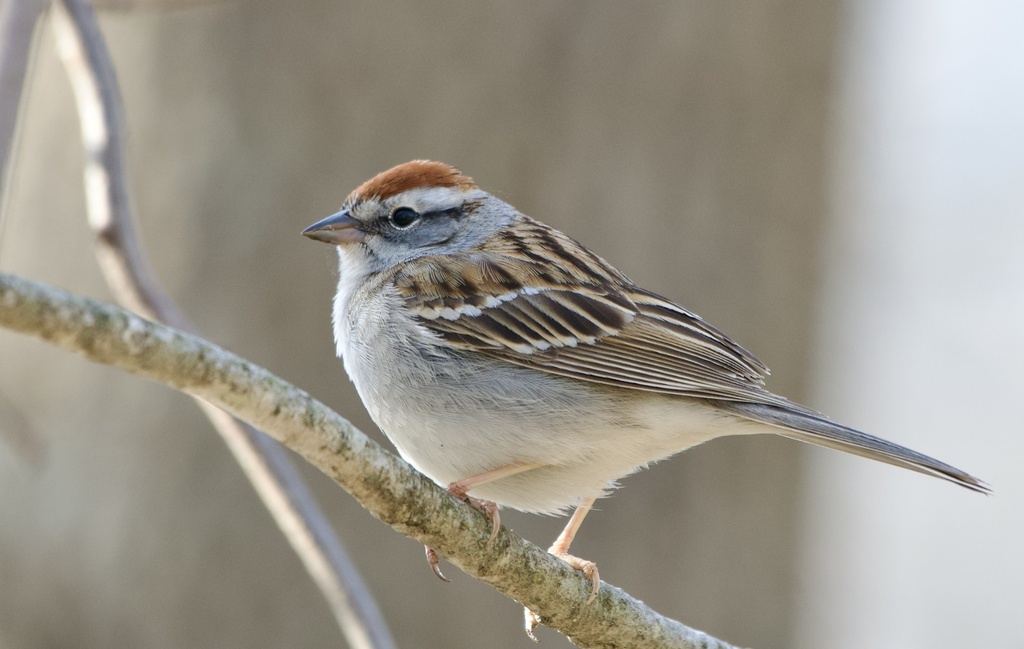
Throughout the year, adults are gray below and an orangish-rust color above. Adults in alternate (breeding) plumage have a reddish cap, a nearly white supercilium, and a black trans-ocular line (running through the eye). Adults in basic (nonbreeding) plumage are less prominently marked, with a brownish cap, a dusky eyebrow, and a dark eye-line. Juvenile chipping sparrows are prominently streaked below. Like non-breeding adults, they show a dark eye-line, extending both in front of and behind the eye. The brownish cap and dusky eyebrow are variable but generally obscure in juveniles. Measurements:
Length: 4.7–5.9 in (12–15 cm) Weight: 0.4–0.6 oz (11–17 g) Wingspan: 8.3 inches (21 cm)
What it does
It molts twice a year. In its breeding plumage it has orangish-rust upper parts, gray head and underparts and a distinctive reddish cap. In non-breeding plumage, the cap is brown and the facial markings are less distinct. The song is a trill and the bird has a piercing flight call that can be heard while it is migrating at night. In the winter, Chipping Sparrows are gregarious and form flocks, sometimes associating with other bird species. They mostly forage on the ground for seeds and other food items, as well as clambering on plants and trees, feeding on buds and small arthropods. In the west of their range they breed mainly in coniferous forests, but in the east, they choose woodland, farmland, parks and gardens. Breeding starts in late April and May and the nest is often built in a tree. This bird filled much the same niche as house sparrows now do before their introduction to North America, inhabiting cities in large numbers, and they continue to be associated with human habitations and relatively unafraid of people in areas where house sparrows are not present.
Wikipedia: “Behavior”
Listen
Looking for field recordings…
Where it lives
Recorded sightings
—
geo-referenced records in GBIF, from museums, herbaria and field observers.
Drag the globe to turn it. Dots are where records exist, not a range map; darker means more records.
In the stacks
Searching the stacks…
Every page naming Spizella passerina in the Biodiversity Heritage Library →
This page is assembled live from iNaturalist, GBIF, Wikipedia, the Source Library and the Internet Archive. It is not yet part of the hand-edited codex. iNaturalist taxon 9135.