On eBird ↗
Yellowhammer
Live sightings near you, the range map, bar charts of when it is seen, and Macaulay Library photos and recordings.
Yellowhammer
Emberiza citrinella
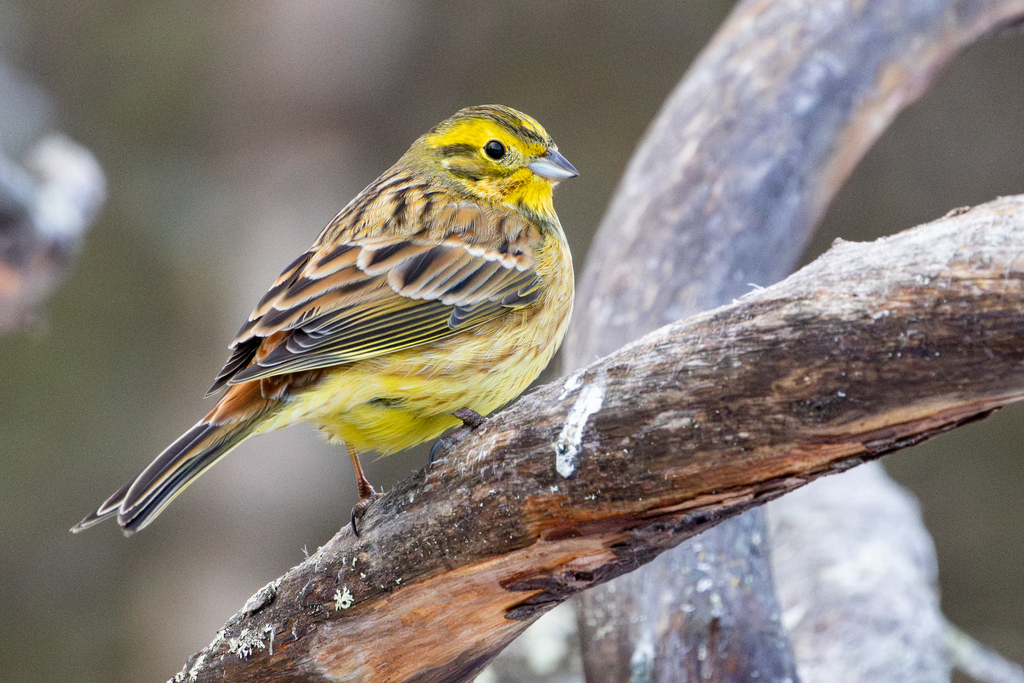
The yellowhammer (Emberiza citrinella) is a passerine bird in the bunting family that is native to Eurasia and has been introduced to New Zealand and Australia. Most European birds remain in the breeding range year-round, but the eastern subspecies is partially migratory, with much of the population wintering further south. The male yellowhammer has a bright yellow head, streaked brown back, chestnut rump, and yellow under parts. Other plumages are duller versions of the same pattern. The yellowhammer is common in open areas with some shrubs or trees, and forms small flocks in winter. Its song has a rhythm like "A little bit of bread and no cheese". The song is very similar to that of its closest relative, the pine bunting, with which it interbreeds.
Breeding commences mainly in April and May, with the female building a lined cup nest in a concealed location on or near the ground. The three to five eggs are patterned with a mesh of fine dark lines, giving rise to the old name for the bird of "scribble lark" or "writing lark". The female incubates the eggs for 12–14 days prior to hatching, and broods the altricial downy chicks until they fledge 11–13 days later. Both adults feed the chicks in the nest and raise two or three broods each year. The nest may be raided by rodents or corvids, and the adults are hunted by birds of prey. Yellowhammers feed on the ground, usually in flocks outside the breeding season. Their diet is mainly seeds, supplemented by invertebrates in the breeding season.
From the article Yellowhammer on Wikipedia (CC BY-SA), quoted section by section
Description
The yellowhammer is a large bunting, 16–16.5 cm (6.3–6.5 in) long, with a 23–29.5 cm (9.1–11.6 in) wingspan; it weighs 20–36.5 g (0.71–1.29 oz). The male of the nominate subspecies E. c. citrinella has a bright yellow head, heavily streaked brown back, rufous rump, yellow under parts, and white outer tail feathers. The female is less brightly coloured, and more streaked on the crown, breast, and flanks. Both sexes are less strongly marked outside the breeding season, when the dark fringes on new feathers obscure the yellow plumage. The juvenile is much duller and less yellow than the adults, and often has a paler rump. After breeding, adults have a complete moult, which takes at least eight weeks; males acquire more yellow in the plumage each time they moult. Juveniles have a partial moult not long after fledging, replacing the head, body, and some covert feathers. Differences between the subspecies are small and geographically gradual. On average, the male of E. c. caliginosa is slightly smaller and darker than the same sex of the nominate subspecies, and also has more streaking on its back, a greenish tint to the yellow of the head and more chestnut on the flanks. The male of the eastern form, E. c. erythrogenys, is paler and less streaked than E. c. citrinella. Its flanks, undertail and wing bars are usually whiter, and its crown and throat are brighter yellow. …
Range & habitat
The yellowhammer breeds across the Palearctic between the 16–20 °C (61–68 °F) July isotherms. It is the commonest and most widespread European bunting, although it is absent from high mountains, Arctic regions, the western Netherlands, most of Iberia and Greece, and low-lying regions of other countries adjoining the Mediterranean Sea. It breeds in Russia east to Irkutsk, and in most of Ukraine. The Asian range extends into northwest Turkey, the Caucasus, and northern Kazakhstan. Most European yellowhammers winter within their breeding range, only the far north being vacated, although some birds move south of their breeding range in Spain, Italy, and other Mediterranean countries. Distances travelled can be up to 500 km (310 mi) for northern birds. Asian birds are more strongly migratory, deserting much of the north to winter in Iraq, Iran, and southern Central Asia. The yellowhammer has occurred as a vagrant in the United Arab Emirates, Egypt, Kuwait, Morocco, Malta, the Himalayas (winter vagrant from northern Afghanistan to central Nepal), the Balearic Islands, Iceland, and the Faroes. Yellowhammers of the British and Irish race, E. c. caliginosa, were introduced to New Zealand by local acclimatisation societies in 1862, and soon spread over the main islands. …
Wikipedia: “Distribution and habitat”
What it does
Foraging is mainly on the ground, and the bird's diet consists mainly of seeds. Oily seeds, such as those of brassicas, are ignored in favour of more starchy items. Typical food plants include common nettle, docks, common knotgrass, fat hen, common chickweed, and yarrow. Grasses are also important, particularly cereals, and grain makes up a significant part of the food consumed in autumn and winter, wheat and oats being preferred to barley. When not breeding, yellowhammers forage in flocks that can occasionally number hundreds of birds, and often contain other buntings and finches. The yellowhammer adds invertebrates to its diet in the breeding season, particularly as food for its growing chicks. A wide range of species is taken, including springtails, grasshoppers, flies, beetles, caterpillars, earthworms, spiders, and snails. During the first few days, chicks are exclusively fed invertebrate prey, but from day three they are also fed cereal grains, which the chicks can digest efficiently. This is thought to be intentional by the parents to allow the nestlings to adjust their physiology to eating seed.
Wikipedia: “Feeding”
In human culture
The yellowhammer is a conspicuous, vocal, and formerly common country bird, and has attracted human interest. Yellowham Wood and Yellowham Hill, near Dorchester England, both derive their names from the bird. Robbie Burns' poem "The Yellow, Yellow Yorlin'" gets its title from a Scottish name for the yellowhammer, which is given an obvious sexual connotation: "I met a pretty maid, an' unto her I said,/ 'I wad fain fin' your yellow, yellow yorlin'.' " More factual descriptions of the bird and its behaviour can be found in John Clare's "The Yellowhammer's Nest" and "The Yellowhammer", whose final lines read:
Enid Blyton helped to popularize the bird's song as "little bit of bread and no cheese" in books such as The Ship of Adventure and Five Go Off in a Caravan, and wrote a poem called "The Yellow-hammer".
Beethoven's student, Carl Czerny, and biographer Anton Schindler, both suggested that the composer got the idea for the first four notes of his 5th symphony from the yellowhammer's call, although more likely the opening of the 4th Piano Concerto was actually the work in question. Beethoven also used the yellowhammer theme in two piano sonatas, no. 21 in C major (the "Waldstein", Op.53) and No. …
Wikipedia: “In culture”
Listen
Looking for field recordings…
Where it lives
Recorded sightings
—
geo-referenced records in GBIF, from museums, herbaria and field observers.
Drag the globe to turn it. Dots are where records exist, not a range map; darker means more records.
In the stacks
Searching the stacks…
Every page naming Emberiza citrinella in the Biodiversity Heritage Library →
This page is assembled live from iNaturalist, GBIF, Wikipedia, the Source Library and the Internet Archive. It is not yet part of the hand-edited codex. iNaturalist taxon 9195.