On eBird ↗
Variable Seedeater
Live sightings near you, the range map, bar charts of when it is seen, and Macaulay Library photos and recordings.
Variable Seedeater
Sporophila corvina
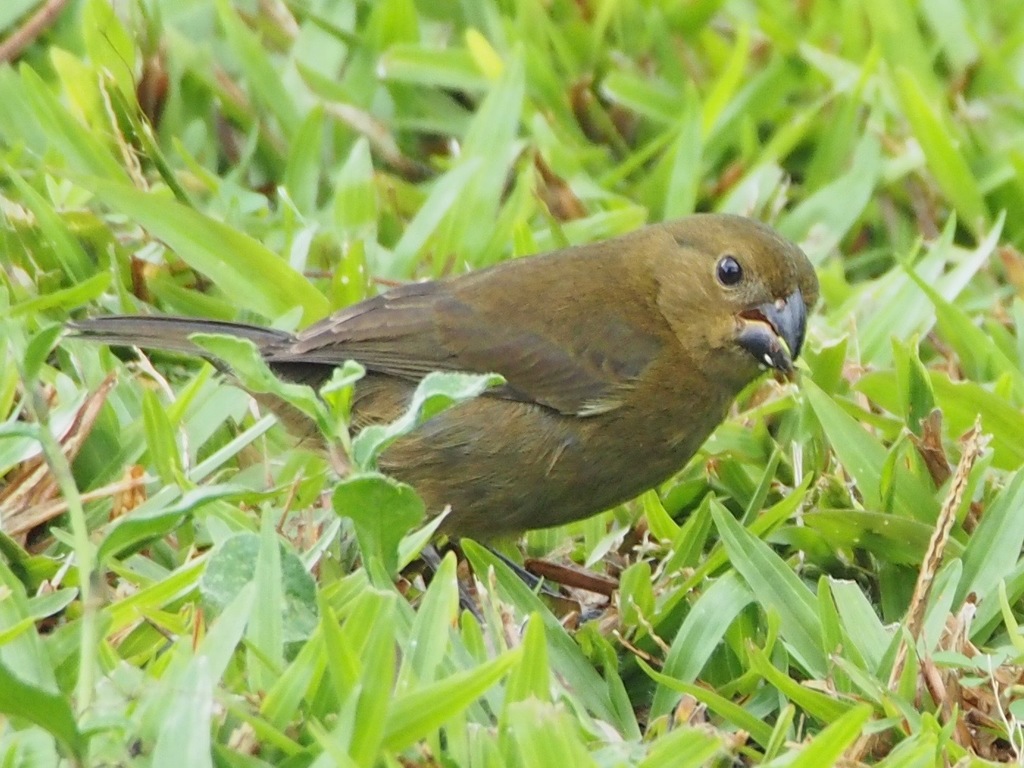
The variable seedeater (Sporophila corvina) is a passerine bird which breeds from southern Mexico through Central America to the Chocó of northwestern South America. The taxonomy is confusing, and it was formerly considered a subspecies of Sporophila americana (see Taxonomy). Even within the variable seedeater as presently defined, there are great variations in plumage.
From the article Variable seedeater on Wikipedia (CC BY-SA), quoted section by section
Description
The variable seedeater is a small, robust bird with a black conical bill. It is 10.5 cm (4.1 in) long and weighs 11 g (0.39 oz). There are four subspecies, which differ primarily in the plumage of the male:
S. c. corvina – (P.L. Sclater, 1860): (nominate), found from southern Mexico and along the Caribbean slope from Belize south to Panama. Adult males are entirely black apart from a small white wing-speculum and white wing linings. S. c. hoffmannii – Cabanis, 1861: found on the Pacific slope of Costa Rica and Panama. Males resemble males S. c. corvina, but with white half-collar, rump and belly (the rump often intermixed with grey and the flanks retain some black mottling or barring). S. c. hicksii – (Lawrence, 1865): found in eastern Panama and adjacent north-western Colombia. Males resemble S. c. hoffmannii, but, except for a small black chin and/or malar, the entire throat is white. S. c. ophthalmica – (P.L. Sclater, 1860): found in southwestern Colombia, western Ecuador, and far north-western Peru. Males are very similar to males of S. c. …
What it does
This seedeater is a common to abundant bird in lowlands and foothills up to 1,500 m (4,900 ft) altitude in semi-open areas such as forest edges, roadsides, low scrub and gardens. It also flocks with other species of seedeaters in pasture, weedy fields and other grassland. This species feeds mainly on grass seeds but also takes other seeds, berries and some insects. The flimsy cup nest, built by the female, is made of coarse plant material and lined with a few finer fibres. It is placed in a tree 0.4 to 6 m (1.3 to 19.7 ft) up, occasionally higher, in the fork of a twig. The clutch is two or three brown-speckled pale grey eggs, which are incubated by the female alone for 12–14 days to hatching. The variable seedeater has a harsh chur call. The male's song consists of a mixture of warbles, whistles, and twitters, and is more elaborate on the Pacific slope.
Wikipedia: “Ecology”
Listen
Looking for field recordings…
Where it lives
Recorded sightings
—
geo-referenced records in GBIF, from museums, herbaria and field observers.
Drag the globe to turn it. Dots are where records exist, not a range map; darker means more records.
In the stacks
Searching the stacks…
Every page naming Sporophila corvina in the Biodiversity Heritage Library →
This page is assembled live from iNaturalist, GBIF, Wikipedia, the Source Library and the Internet Archive. It is not yet part of the hand-edited codex. iNaturalist taxon 54980.