On eBird ↗
Fieldfare
Live sightings near you, the range map, bar charts of when it is seen, and Macaulay Library photos and recordings.
Fieldfare
Turdus pilaris
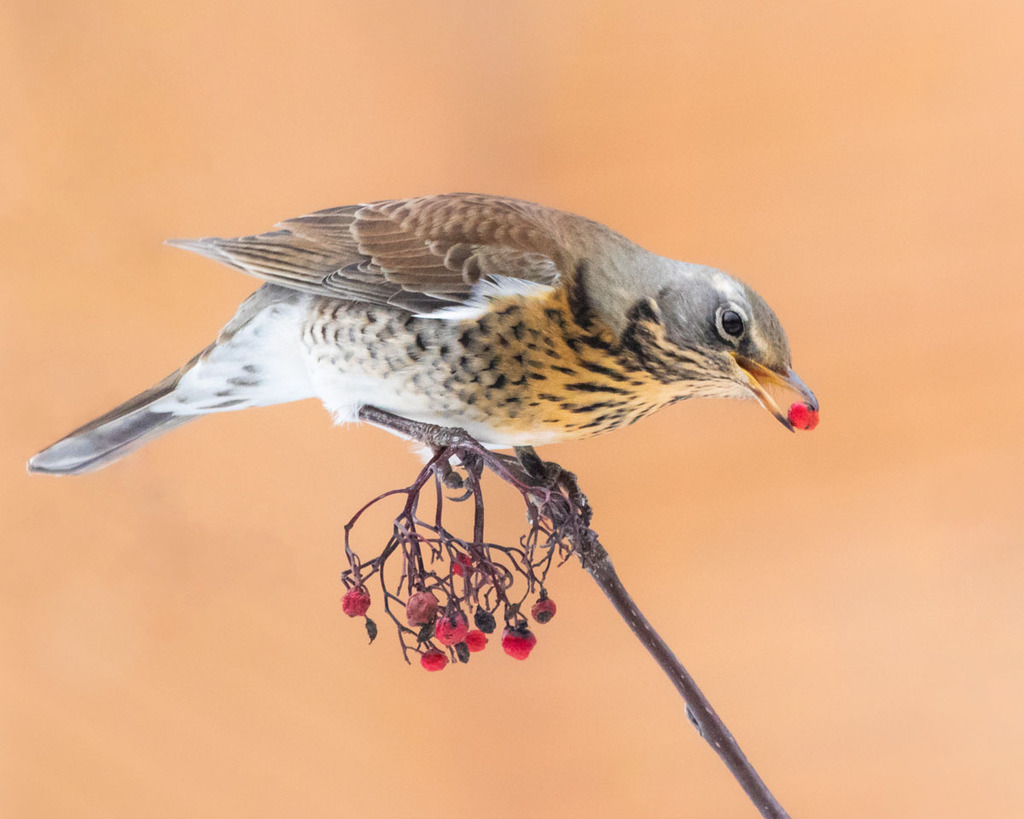
The fieldfare (Turdus pilaris) is a member of the thrush family Turdidae. It breeds in woodland and scrub in northern Europe and across the Palearctic. It is strongly migratory, with many northern birds moving south during the winter. It is a very rare breeder in the British Isles, but winters in large numbers in the United Kingdom, Southern Europe, North Africa and the Middle East. It is omnivorous, eating a wide range of molluscs, insects and earthworms in the summer, and berries, grain and seeds in the winter.
Fieldfares often nest in small colonies, possibly for protection from predators. The nest is built in a tree where five or six eggs are laid. The chicks are fed by both parents and leave the nest after a fortnight (a period of two weeks). There may be two broods in southern parts of the range but only one further north. Migrating birds and wintering birds often form large flocks, often in the company of redwings.
From the article Fieldfare on Wikipedia (CC BY-SA), quoted section by section
Description
The fieldfare is easily recognisable with its slate-grey head, nape and rump, dark brown back, blackish tail and boldly speckled breast. In flight, its white under wing-coverts and axillaries are conspicuous. The harsh flight call "tsak tsak" is also distinctive. The forehead and crown of the male are bluish-grey and each feather has a central brownish-black band. The lores and under-eye regions are black and there are faint, pale streaks above the eyes. The ear-coverts, nape, hind neck and rump are bluish-grey, usually with a white streak near the shaft of each rump feather. The scapulars and mantle feathers are dark chestnut-brown with dark central streaks and pale tips. There are fourteen tail feathers each with a pointed tip, the outer two slightly shorter than the others giving a rounded tail. They are brownish-black, with inconspicuous darker bars visible in some lights. The outer edge of each tail feather is fringed with grey near the base and the outer pair of feathers have a narrow white border on the inner edge. The chin, throat and upper breast are creamy-buff with bold streaks and speckles of brownish-black. The lower breast is creamy-white with a diminishing buff tinge and fewer speckles and the belly is similarly creamy-white, with the speckles restricted to the uppermost parts. …
Range & habitat
The fieldfare is a migratory species with a palearctic distribution. It breeds in northern Norway, northern Sweden, Finland, Belgium, Germany, Switzerland, Austria, the Czech Republic, Slovakia, Hungary, Poland and Siberia as far east as Transbaikal, the Aldan River and the Tian Shan Mountains in North West China. Its winter range extends through western and southern Europe to North Africa, though it is uncommon in the Mediterranean region. Eastern populations migrate to Anatolia, Lebanon, Iran and Northwest India, and occasionally Northeast India. It is a vagrant to Iceland, Greenland, Spitsbergen, the Canary Islands, the Balearic Islands, Madeira, Corsica, Sardinia, Sicily, the United States, Malta and Cyprus. The flight of the fieldfare is slow and direct. It takes several strong beats then closes its wings briefly before flapping on. It is highly gregarious, quite shy and easily scared in the winter and bold and noisy in the breeding season. When a group is in a tree they all tend to face in the same direction, keeping up a constant chatter. When foraging on the ground, often in association with redwings, the group works its way up wind, each bird pausing every so often to stand erect and gaze around before resuming feeding. When alarmed they fly off down wind and the feeding group reforms elsewhere. …
Wikipedia: “Distribution and habitat”
What it does
The fieldfare is omnivorous. Animal food in the diet includes snails and slugs, earthworms, spiders and insects such as beetles and their larvae, flies and grasshoppers. When berries ripen in the autumn these are taken in great number. Hawthorn, holly, rowan, yew, juniper, dog rose, Cotoneaster, Pyracantha and Berberis are all relished. Later in the winter windfall apples are eaten, swedes attacked in the field and grain and seeds eaten. When these are exhausted, or in particularly harsh weather, the birds may move to marshes or even the foreshore where molluscs are to be found.
Wikipedia: “Food and feeding”
Listen
Looking for field recordings…
Where it lives
Recorded sightings
—
geo-referenced records in GBIF, from museums, herbaria and field observers.
Drag the globe to turn it. Dots are where records exist, not a range map; darker means more records.
In the stacks
Searching the stacks…
Every page naming Turdus pilaris in the Biodiversity Heritage Library →
This page is assembled live from iNaturalist, GBIF, Wikipedia, the Source Library and the Internet Archive. It is not yet part of the hand-edited codex. iNaturalist taxon 12707.