On eBird ↗
Large-billed Lark
Live sightings near you, the range map, bar charts of when it is seen, and Macaulay Library photos and recordings.
Large-billed Lark
Galerida magnirostris
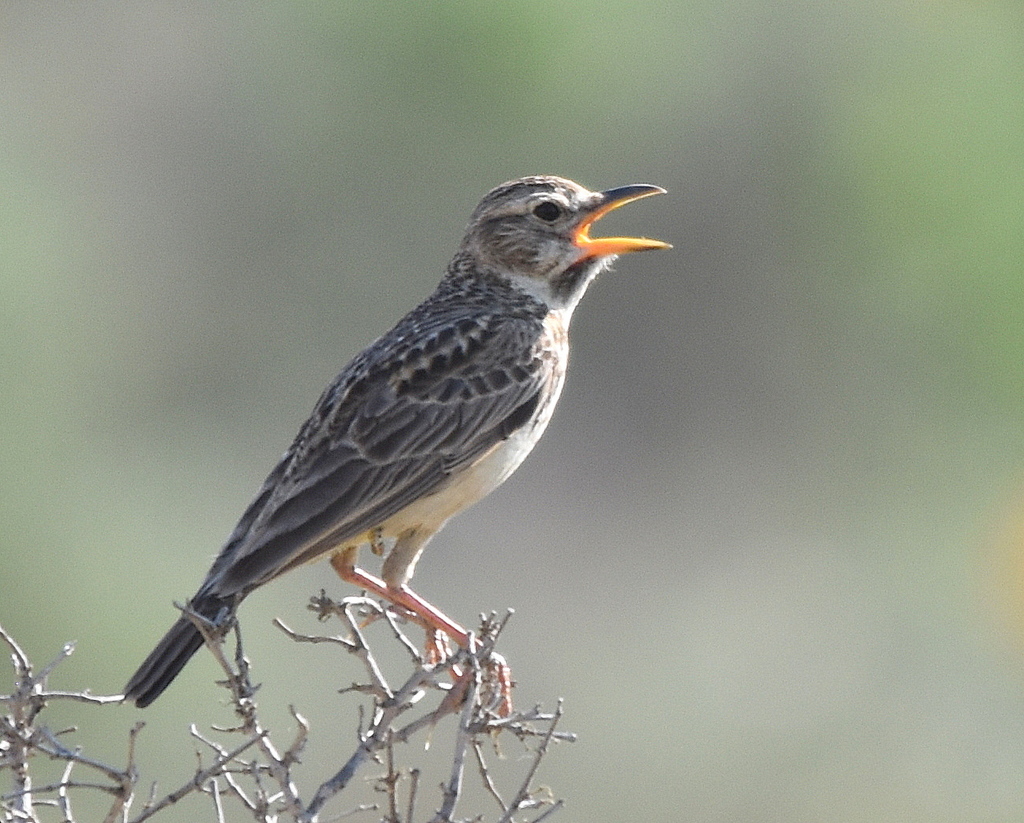
The large-billed lark or southern thick-billed lark (Galerida magnirostris) is a small passerine bird found in southern Africa. The name "large-billed lark" may also refer to Bradfield's lark. The name "thick-billed lark" more commonly refers to the species of the same name (i.e. Rhamphocoris clotbey).
From the article Large-billed lark on Wikipedia (CC BY-SA), quoted section by section
Description
The large-billed lark is 18 cm in length. It is relatively short-tailed and has a thick bill with a yellow base to the lower mandible. It has streaked brown-grey upperparts, and a long white supercilium. Like other species in the genus, it has a crest that can be raised in display or alarm. The underparts are cream-coloured with heavy dark streaking on the breast. The heavy bi-coloured bill distinguishes this species from all other African larks. The call of this very vocal species is a soft creaking "treeeeleeeeleee".
Range & habitat
The large-billed lark is a resident breeder in southern South Africa, Lesotho and southernmost Namibia. Its natural habitat is fynbos, karoo scrub and mountain grassland. The large-billed lark is also found in cultivated and fallow agricultural land.
Wikipedia: “Distribution and habitat”
What it does
Like other larks, the large-billed lark nests on the ground. Its food is seeds and insects, the latter especially in the breeding season.
Wikipedia: “Behaviour and ecology”
Listen
Looking for field recordings…
Where it lives
Recorded sightings
—
geo-referenced records in GBIF, from museums, herbaria and field observers.
Drag the globe to turn it. Dots are where records exist, not a range map; darker means more records.
In the stacks
Searching the stacks…
Every page naming Galerida magnirostris in the Biodiversity Heritage Library →
This page is assembled live from iNaturalist, GBIF, Wikipedia, the Source Library and the Internet Archive. It is not yet part of the hand-edited codex. iNaturalist taxon 7358.