On eBird ↗
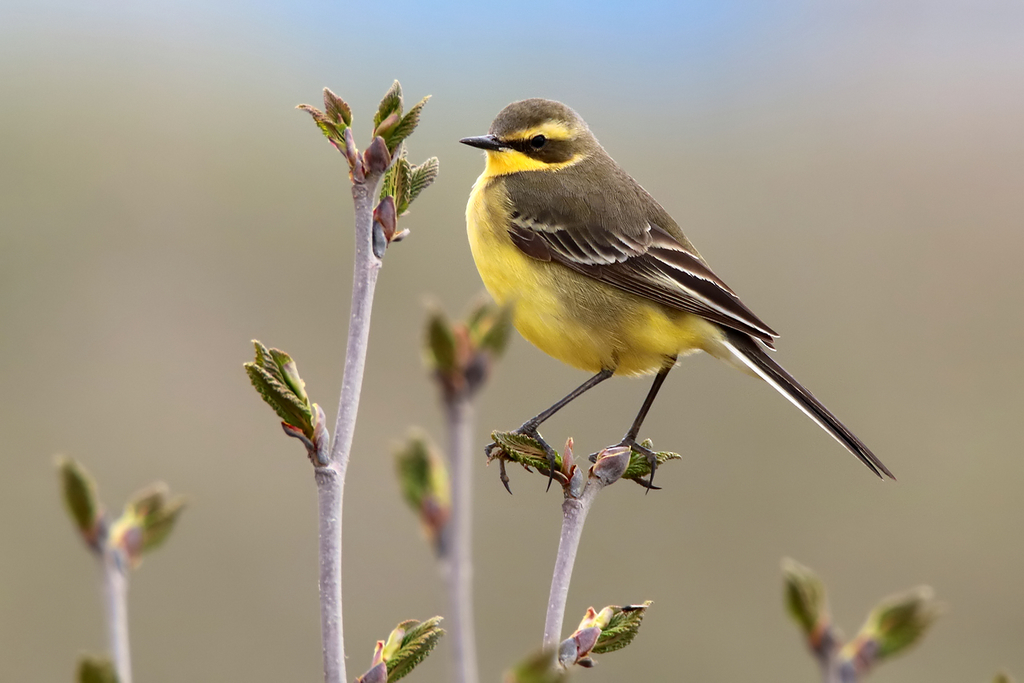
Eastern Yellow Wagtail
Live sightings near you, the range map, bar charts of when it is seen, and Macaulay Library photos and recordings.
Eastern Yellow Wagtail
Motacilla tschutschensis
The eastern yellow wagtail (Motacilla tschutschensis) is a small passerine in the wagtail family Motacillidae, which also includes the pipits and longclaws. It was formerly usually classified as a subspecies of the western yellow wagtail, but was split from it in 2003 when genetic data showed this classification to be paraphyletic with respect to the citrine wagtail. It breeds in the eastern Palearctic and Alaska and migrates to South Asia and Australia.
From the article Eastern yellow wagtail on Wikipedia (CC BY-SA), quoted section by section
Description
It is a slender 15–16 cm long bird, with the characteristic long, constantly wagging tail of its genus. The breeding adult male is basically olive-green above and yellow below. In other plumages, particularly first-winter birds but also many females, the yellow may be diluted by white. The heads of breeding males come in a variety of colours and patterns depending on subspecies. The bill and legs are black; the hind claw is long and not strongly curved, which distinguishes it reliably from western yellow wagtail which has a shorter, more strongly curved hind claw (though this is often difficult to observe on birds in grass). The call is a characteristic high-pitched zrri or jeet, shriller and more rasping than the call of western yellow wagtails.
Range & habitat
This species breeds in the East Palearctic and has a foothold in North America in Alaska. Most migrate to south-east Asia and Australia in the winter but the non-breeding range extends as far west as eastern India and Sri Lanka. Vagrant individuals can occur away the winter quarters at migration time. For example, on Palau in Micronesia migrant flocks of this species – apparently of the Bering Sea yellow wagtail, and including many adult males – are regularly seen, while further north on the Marianas, only the occasional stray individuals (usually females or immatures) are encountered. Since the advent of easier DNA testing of droppings and clarification of its identification features, it has proved to be a surprisingly frequent late autumn and winter vagrant in western and northwestern Europe, with ten or more records in some autumns in both Britain and Sweden, and multiple cases of birds overwintering.
Wikipedia: “Distribution and habitat”
What it does
This insectivorous bird inhabits open country near water, such as wet meadows. It nests in tussocks, laying 4–8 speckled eggs. The Acanthocephalan parasite Apororhynchus paulonucleatus was discovered in the colon and cloaca of the eastern yellow wagtail.
Wikipedia: “Behaviour”
Listen
Looking for field recordings…
Where it lives
Recorded sightings
—
geo-referenced records in GBIF, from museums, herbaria and field observers.
Drag the globe to turn it. Dots are where records exist, not a range map; darker means more records.
In the stacks
Searching the stacks…
Every page naming Motacilla tschutschensis in the Biodiversity Heritage Library →
This page is assembled live from iNaturalist, GBIF, Wikipedia, the Source Library and the Internet Archive. It is not yet part of the hand-edited codex. iNaturalist taxon 145207.