On eBird ↗
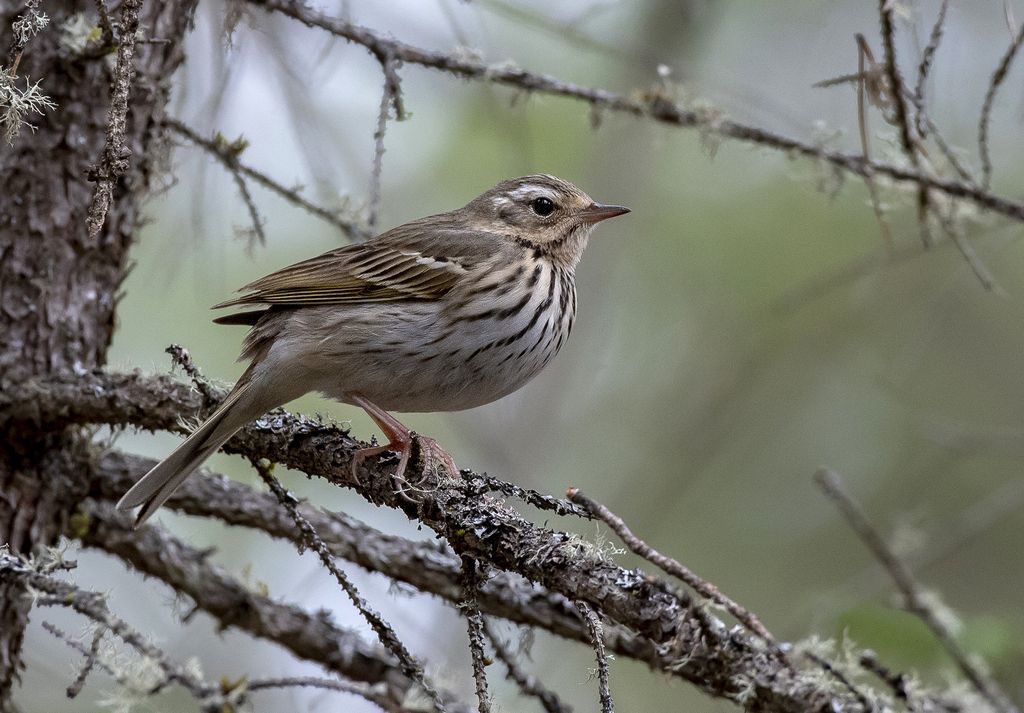
Olive-backed Pipit
Live sightings near you, the range map, bar charts of when it is seen, and Macaulay Library photos and recordings.
Olive-backed Pipit
Anthus hodgsoni
The olive-backed pipit (Anthus hodgsoni) is a small passerine bird of the pipit (Anthus) genus, which breeds across southern, north central and eastern Asia, as well as in the north-eastern European Russia. It is a long-distance migrant moving in winter to southern Asia and Indonesia. Sometimes it is also called Indian pipit or Hodgson's pipit, as well as tree pipit owing to its resemblance with the tree pipit. However, its back is more olive-toned and less streaked than that species, and its head pattern is different with a better-marked supercilium.
The genus name Anthus is from Latin and is the name for a small bird of grasslands. The specific hodgsoni commemorates English diplomat and collector Brian Houghton Hodgson.
From the article Olive-backed pipit on Wikipedia (CC BY-SA), quoted section by section
Description
Size: Sparrow+ (ca. 15 cm (5.9 in)) Appearance: Greenish brown streaked with darker brown above. Supercilium, double wingbar and outer rectrices whitish. Whitish to buff below streaked with dark brown on breast and flanks. Sexes alike. Habits: Seen singly or pairs. Runs about on the ground in search of food and flies up into trees when disturbed. Flight jerky and undulating. Call: Song lark-like and uttered on the wing, similar to the tree pipit, but faster and higher pitched. A single tseep or spek, also similar to the tree pipit. Food: Insects, grass and weed seeds. Food: Largely insects, but will also take seeds.
Range & habitat
Summer: from Himalayan Pakistan and India, westward through Nepal, into China, north to Gansu province, and eastwards through Korea to Japan, and north through north central Asia into north-eastern Europe (European Russia). Occasionally a rare vagrant in western Europe. Breeds up to 4,500 m (14,800 ft) in eastern Nepal. Winter: Broad southern region across Asia, from peninsular India, east to Southeast Asia and the Philippines. Habitat: Affects open country. Wintering in evergreen woodland, Summers in groves and wooded biotope.
Wikipedia: “Distribution”
Listen
Looking for field recordings…
Where it lives
Recorded sightings
—
geo-referenced records in GBIF, from museums, herbaria and field observers.
Drag the globe to turn it. Dots are where records exist, not a range map; darker means more records.
In the stacks
Searching the stacks…
Every page naming Anthus hodgsoni in the Biodiversity Heritage Library →
This page is assembled live from iNaturalist, GBIF, Wikipedia, the Source Library and the Internet Archive. It is not yet part of the hand-edited codex. iNaturalist taxon 13724.