On eBird ↗
Ovenbird
Live sightings near you, the range map, bar charts of when it is seen, and Macaulay Library photos and recordings.
Ovenbird
Seiurus aurocapilla
The ovenbird (Seiurus aurocapilla) is a small songbird of the New World warbler family Parulidae. It is the only species placed in the genus Seiurus. This migratory bird breeds in eastern North America and winters in Central America, many Caribbean islands, Florida and northern Venezuela.
Despite its name, it is not in the ovenbird family of birds.
From the article Ovenbird on Wikipedia (CC BY-SA), quoted section by section
Description
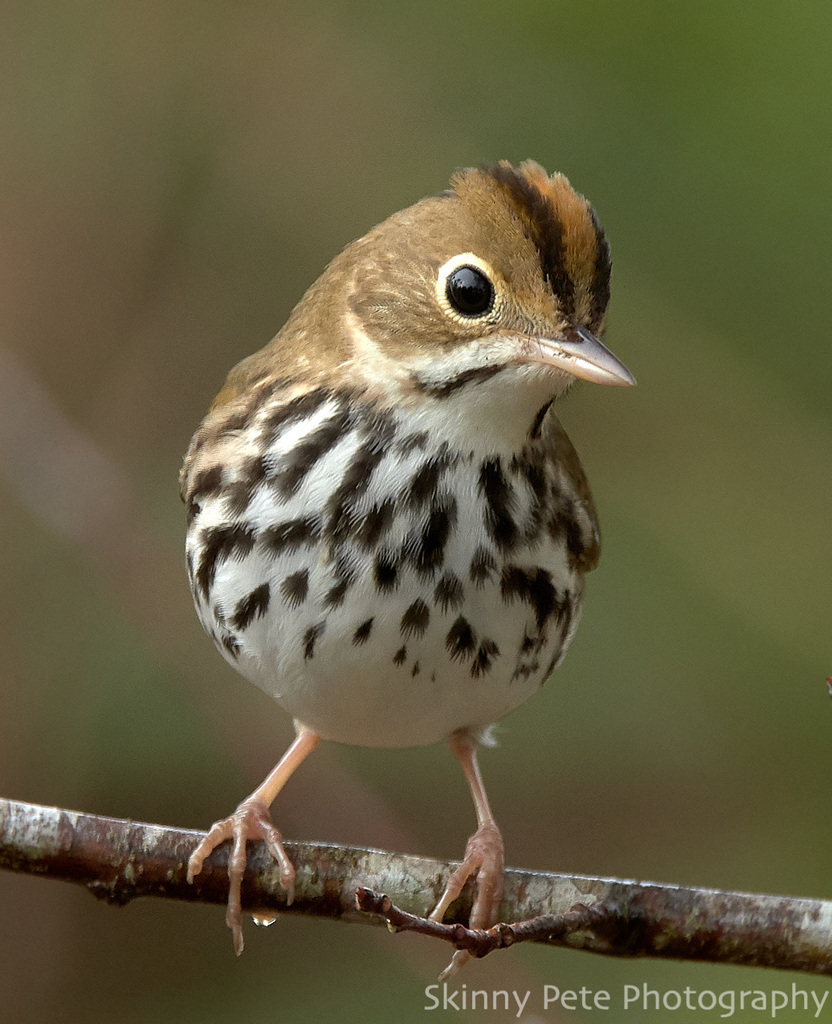
Ovenbirds are large wood warblers and may sometimes be confused by the untrained for a thrush. Adults measure 11–16 cm (4.3–6.3 in) long and span 19–26 cm (7.5–10.2 in) across the wings. They weigh 19 g (0.67 oz) on average, with a range of 14–28.8 g (0.49–1.02 oz). Among standard measurements, the wing chord is 6.8 to 8.3 cm (2.7 to 3.3 in), the tail is 5 to 5.8 cm (2.0 to 2.3 in), the bill is 1.1 to 1.3 cm (0.43 to 0.51 in) and the tarsus is 2 to 2.3 cm (0.79 to 0.91 in). They tend to be heavier in winter and particularly at the start of their migration. They have olive-brown upperparts and white underparts heavily streaked with black; the flanks have an olive hue. A white ring surrounds the eyes, and a black stripe runs below the cheek. They have a line of orange feathers with olive-green tips running along the top of their head, bordered on each side with blackish-brown. The orange feathers can be erected to form a small crest. The eyes and the upper part of the thin pointed beak are dark, while the lower beak is horn-colored and the legs and feet are pinkish. Males and females look alike. Immature birds have tawny fringes to the tertiary remiges and sometimes buff-tipped outer primary wing coverts. …
Range & habitat
Their breeding habitats are mature deciduous and mixed forests, especially sites with little undergrowth, across Canada and the eastern United States. For foraging, it prefers woodland with abundant undergrowth of shrubs; essentially, it thrives best in a mix of primary and secondary forest. Ovenbirds migrate to the southeastern United States, the Caribbean, and from Mexico to northern South America. The birds are territorial all year round, occurring either singly or (in the breeding season) as mated pairs, for a short time accompanied by their young. During migration, they tend to travel in larger groups however, dispersing again once they reach their destination. In winter, they dwell mainly in lowlands, but may ascend up to 1,500 m (4,900 ft) ASL e.g. in Costa Rica. The first migrants leave in late August and appear on the wintering grounds as early as September, with successive waves arriving until late October or so. They depart again to breed between late March and early May, arriving on the breeding grounds throughout April and May. Migration times do not seem to have changed much over the course of the 20th century. This bird is an infrequent vagrant of Europe, with five individuals reported this century on the Azores and a handful of records in Norway, Ireland, Romania, and Great Britain. …
Wikipedia: “Distribution and habitat”
What it does
Ovenbirds forage on the ground in dead leaves, sometimes hovering or catching insects in flight. This bird frequently tilts its tail up and bobs its head while walking; at rest, the tail may be flicked up and slowly lowered again, and alarmed birds flick the tail frequently from a half-raised position. These birds mainly eat terrestrial arthropods and snails, and also include fruit in their diet during winter.
Wikipedia: “Food and feeding”
Listen
Looking for field recordings…
Where it lives
Recorded sightings
—
geo-referenced records in GBIF, from museums, herbaria and field observers.
Drag the globe to turn it. Dots are where records exist, not a range map; darker means more records.
In the stacks
Searching the stacks…
Every page naming Seiurus aurocapilla in the Biodiversity Heritage Library →
This page is assembled live from iNaturalist, GBIF, Wikipedia, the Source Library and the Internet Archive. It is not yet part of the hand-edited codex. iNaturalist taxon 62550.