On eBird ↗
South Island Robin
Live sightings near you, the range map, bar charts of when it is seen, and Macaulay Library photos and recordings.
South Island Robin
Petroica australis
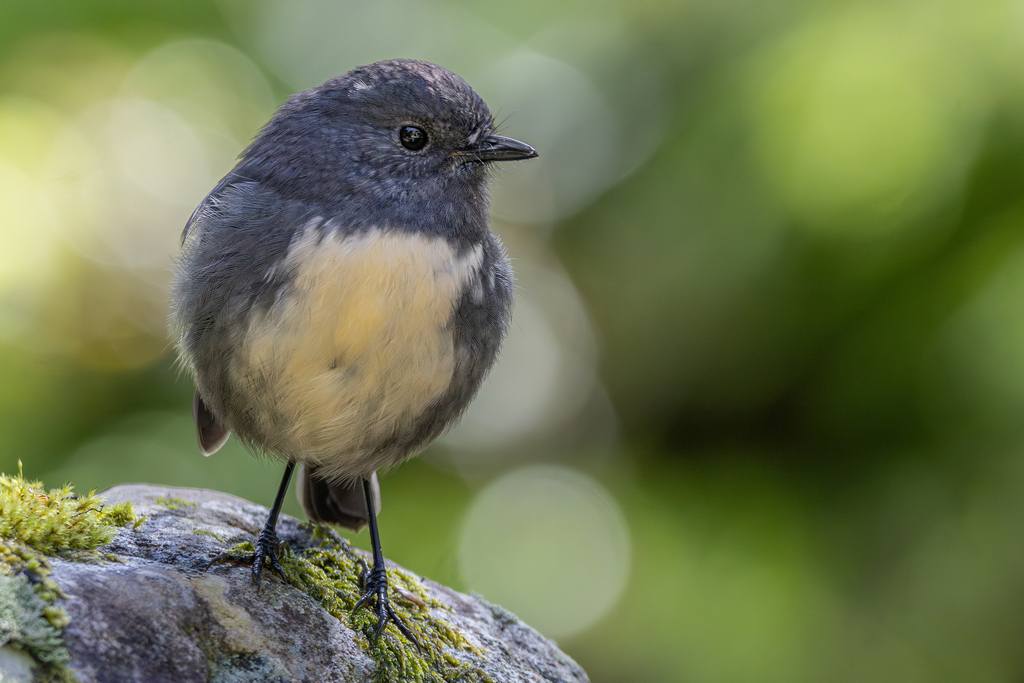
The South Island robin (Petroica australis; also known in Māori as the kakaruai) is a sparrow-sized bird found only in New Zealand, where it has the status of a protected endemic species. The birds are sparsely distributed through the South Island and Stewart Island / Rakiura, although the distribution is not continuous. The nominate, and the Stewart Island robin (P. australis rakiura) are the two subspecies. The species is closely related to the North Island robin (formerly P. australis longipes, now considered a distinct species), and also to the extremely rare black robin (P. traversi) of the Chatham Islands.
From the article South Island robin on Wikipedia (CC BY-SA), quoted section by section
Description
The South Island robin is a small passerine, 10–18 cm in length and weighing around 35 g. North Island robins do resemble both females and juveniles of the South Island robins, as well as all the Stewart Island robins, which can sometimes make it difficult to distinguish between the three. The females and juveniles within a particular group of robins look similar to each other, although newly independent juveniles may not yet have the more lightly coloured breast patch. However, male North Island robins are almost black with a white spot just above the beak, as well as the greyish-white lower breast. Females and juveniles are greyer with more variable pale patches on their breasts and throats. Male South Island robins are dark grey, except for the distinct yellowish-white lower chest, while females and juveniles are again lighter grey with a less distinct breast. Finally, Stewart Island robins look similar to North Island robins (both males and females). New Zealand robins are relatively long-lived; life-spans of at least 14 years have been recorded in the wild.
Range & habitat
Historically, the South Island robin inhabited much of the lowland of New Zealand's South Island, but its distribution has become much more patchy in the last century due to habitat loss and introduced predation. There are two populations on the east coast of the South Island, and they are slightly more common in the north and west. It has fared slightly better than the Stewart Island robin, which has been relegated to 3 subpopulations, all of which are in Leptospermum swamp scrubland—although this is not their preferred habitat, it is less heavily populated by mammalian predators. The total population was lower than 500 individuals at one point. A programme of translocation to predator-free islands (such as Ulva Island, Motuara Island, and Nukuwaiata Island) was instituted and proved relatively successful at establishing new populations (around 600 individuals on Motuara alone). In the South Island, P. australis has a strong affinity for Douglas fir plantations, instead of the native forests (kanuka trees) or Monterey pine plantations. This is apparently due to forest structure rather than strict food availability or viable nesting sites, as the species prefers structurally simple forests with dense, even canopies, and ground covered with leaf litter. …
Wikipedia: “Distribution”
What it does
Invertebrates, including earthworms, beetles, and other arthropods foraged from the leaf litter comprise most of the South Island robins' diet. Invertebrate prey may be cached whole or in portions. Single items are cached at separate sites. Prey is typically stored within 10 metres of where it was procured, even if the bird is outside its own territory. In the winter the primary cache is earthworms, while during the summer the trend is toward cicadas. South Island robins have a very good memory of their storage sites; a male was observed to empty as many as five consecutive caches before returning the stores to his mate during incubation. The birds have demonstrated an ability to differentiate and prioritise caches of varying sizes, up to 12 total items, without any training, which appears to be the highest recorded numerical competency of any wild animal. Because of its high metabolic rate, a robin might spend as much as 90% of its day foraging or storing during the winter. South Island robins have also been observed to eat berries on occasion; however, these are not cached.
Wikipedia: “Feeding”
Toxicity
Robins have generally responded well to pest control programmes using aerial 1080 operations, with increased chick and adult survival, and increases in population size. A 2012 scientific study of a marked population by the University of Otago during a contemporary 1080 poison operation using cereal baits showed no negative impact on robins, and suggested a likely population increase by reducing predation pressure from introduced mammals. However, some robin deaths have been recorded as a result of accidental 1080 poisoning following pest control operations. Most of these were associated with four specific operations in the 1980s that used poor-quality carrot baits.
Wikipedia: “South Island robins and 1080 poison”
Listen
Looking for field recordings…
Where it lives
Recorded sightings
—
geo-referenced records in GBIF, from museums, herbaria and field observers.
Drag the globe to turn it. Dots are where records exist, not a range map; darker means more records.
In the stacks
Searching the stacks…
Every page naming Petroica australis in the Biodiversity Heritage Library →
This page is assembled live from iNaturalist, GBIF, Wikipedia, the Source Library and the Internet Archive. It is not yet part of the hand-edited codex. iNaturalist taxon 14170.