On eBird ↗
Tomtit
Live sightings near you, the range map, bar charts of when it is seen, and Macaulay Library photos and recordings.
Tomtit
Petroica macrocephala
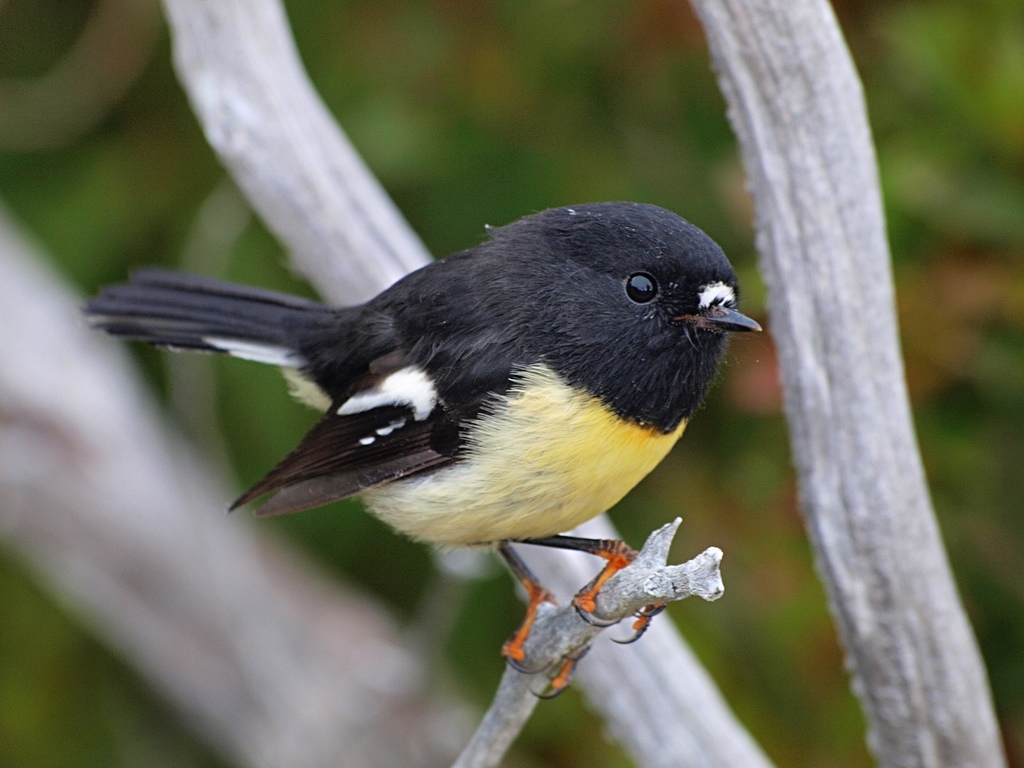
The tomtit (Petroica macrocephala) is a small passerine bird in the family Petroicidae, the Australasian robins. It is endemic to the islands of New Zealand, ranging across the main islands as well as several of the outlying islands. In the Māori language, the North Island tomtit is known as miromiro and the South Island tomtit is known as ngirungiru. This bird has several other Māori and English names as well. There are several subspecies showing considerable variation in plumage and size. The species is not threatened and has adapted to the changes made to New Zealand's biodiversity.
From the article Tomtit on Wikipedia (CC BY-SA), quoted section by section
Description
The tomtit is a small (13 cm, 11 g) bird with a large head and a short bill. The male North Island subspecies has black head, back, wings (with a white wing-bar), and a white belly. The subspecies from South Island, the Chatham Islands, and Auckland Islands are similar, but have a yellow band across the breast between the black head and white belly. The females are brown instead of black. The Snares Island subspecies is entirely black, and is known as the black tit. The island subspecies of tomtits show a striking variation in body size, being considerably larger than their mainland relatives, a tendency known as the Foster's rule or the island effect. Birds from the main islands weigh around 11g, compared with birds from Snares Island, which weigh in at 20 g.
What it does
The tomtit is mostly an insectivore, feeding on small invertebrates, such as beetles, caterpillars, spiders, moths, wētā, earthworms, and flies. Fruit is taken during the winter and autumn. Most subspecies feed in vegetation, waiting on a perch and watching for prey. Insects are also gleaned from branches and leaves. The Snares subspecies feeds on the ground as well, in a similar fashion to the North or South Island robins.
Wikipedia: “Food and feeding”
In human culture
The miromiro features in Māori traditional stories. Te Arawa tradition tells how Te Rongorere used a pet miromiro to help him search for his mother, Te Aotepairu, who had been carried away from the Bay of Plenty to Whangaruru in Northland.
Wikipedia: “Cultural depictions”
Listen
Looking for field recordings…
Where it lives
Recorded sightings
—
geo-referenced records in GBIF, from museums, herbaria and field observers.
Drag the globe to turn it. Dots are where records exist, not a range map; darker means more records.
In the stacks
Searching the stacks…
Every page naming Petroica macrocephala in the Biodiversity Heritage Library →
This page is assembled live from iNaturalist, GBIF, Wikipedia, the Source Library and the Internet Archive. It is not yet part of the hand-edited codex. iNaturalist taxon 14175.