On eBird ↗
Crested Myna
Live sightings near you, the range map, bar charts of when it is seen, and Macaulay Library photos and recordings.
Crested Myna
Acridotheres cristatellus
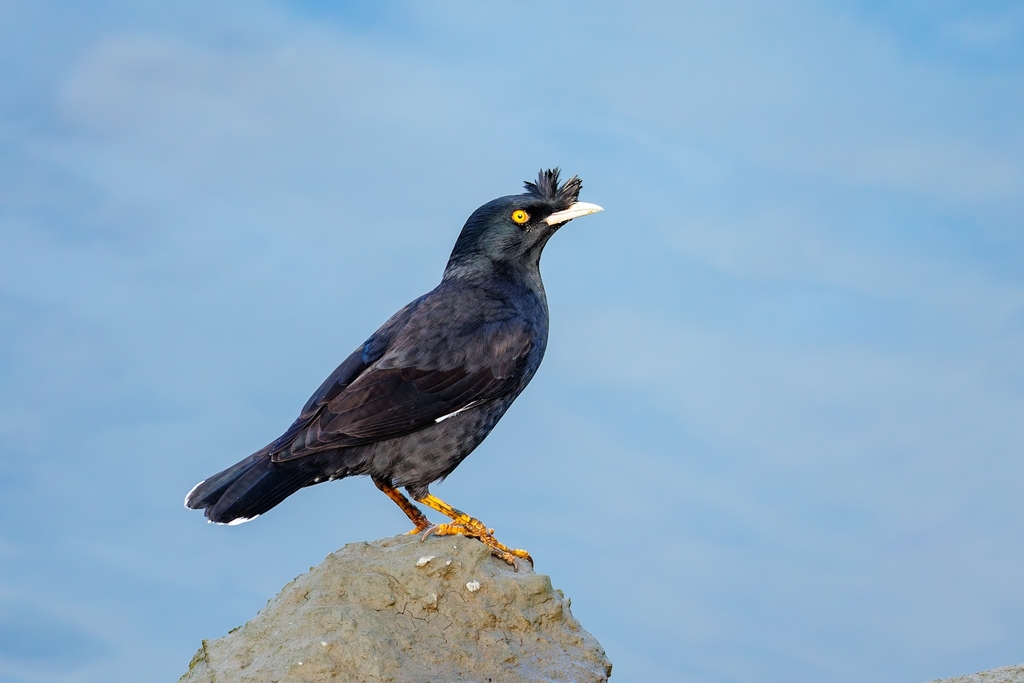
The crested myna (Acridotheres cristatellus), also known as the Chinese starling, is a species of starling in the genus Acridotheres native to southeastern China and Indochina. It is named after the tuft of feathers on its forehead that resembles a crest.
The crested myna is typically found in open spaces near urban and agricultural areas. It is a popular cage bird and, as a result, has been accidentally released in a few places outside of its usual range. For example, this species was introduced around 1890 into the Vancouver region of British Columbia. It was initially successful, reaching a population in the thousands, however, it has since then gone locally extinct in the area.
From the article Crested myna on Wikipedia (CC BY-SA), quoted section by section
Description
The crested myna is named after the tuft of feathers that form a crest-like structure on its forehead that covers the bird's nostrils. It is mostly black with a slight green sheen. It has a couple of white wing patches under its wings which are more visible during flight. The tips and the base of the primaries are white. The tail feathers also have white tips with the exception of the middle pair. The under-tail coverts are black with a white tip. The adult's eyes are orange, its bill is pale yellow, and its legs are a dull dark yellow. Its bill is slender and very sharp. The males are slightly larger than the females. The female's crest is slightly less well-developed. Otherwise, there is no sexual dimorphism. The subspecies A. c. brevipennis, has proportionally smaller wings and a smaller bill. The feathers that form the crest are narrower than the ones from the nominate subspecies. A. c. formosanus is slightly smaller than the nominate subspecies and its bill is greenish-yellow. Its under-tail coverts are white and it has a more developed crest. The hatchlings are born naked except for of a short gray down found on certain parts of the bird. In about 18 to 20 days, the juveniles become fully covered with brown feathers. The crest is usually not well developed at this stage. Immature crested mynas have blue-gray eyes.
Range & habitat
The crested myna can be found in a wide range of habitats from urban to rural areas. In cities, it can be seen in the eaves of buildings, along roads and alleys, near gardens and parks, in parking lots. It can be found under bridges, in trees, in chimneys, and on roofs. In rural areas, it can be spotted on agricultural fields, in orchards and farmyards, near manure piles. It can be seen near plowed fields to take advantage of the invertebrates found in the tilled soil. It is often seen near cattle as it eats the insects around them. It is also commonly distributed in grasslands, fields and at the edge of forests. The range spans from southeastern and central China to northern Indochina. It is found in the Yangtze valley and the southeastern Jiangxi Province in China. The crested myna has also been recorded in Burma, Taiwan and Hainan.
As a popular cage bird, it is often transported outside of its normal range and, on occasion, can be accidentally released and introduced in a new area. For example, in the late 1800s, it was introduced to Vancouver, British Columbia. It was able to proliferate and its population grew to around 20,000 to 30,000 individuals. It could be found anywhere from the south of the province to Washington and Oregon. By the mid-20th century, the numbers began declining, and the bird is now extirpated in North America. …
Wikipedia: “Distribution and habitat”
What it does
The crested myna is an omnivorous bird. Although it eats mainly insects, this bird can eat a wide variety of items including fruit, grains, meat, manure and garbage. Its diet varies seasonally. On average, 40% of the adult bird's diet is meat and 60% is vegetation. However, in September, the proportion of meat in its diet increases to around 50–60%, where almost half of it is flies. In the winter months, as insects and fruit are less common, the crested myna eats a lot more garbage (representing about 15% of its diet). Its diet also varies with the life stages of the bird. Juveniles eat proportionally more animal matter than adults Approximately 75% of their diet is made of meat (50% of which is from insects). Similarly to adult crested mynas, the proportion of insects and fruit that the juveniles eat increases with availability and abundance.
Wikipedia: “Diet”
Listen
Looking for field recordings…
Where it lives
Recorded sightings
—
geo-referenced records in GBIF, from museums, herbaria and field observers.
Drag the globe to turn it. Dots are where records exist, not a range map; darker means more records.
In the stacks
Searching the stacks…
Every page naming Acridotheres cristatellus in the Biodiversity Heritage Library →
This page is assembled live from iNaturalist, GBIF, Wikipedia, the Source Library and the Internet Archive. It is not yet part of the hand-edited codex. iNaturalist taxon 14872.