 NL·0727
Herbarium of the Nature Library
- Name
- Acridotheres tristis
- Family
- Sturnidae
- Native to
- Iran and Central Asia through Afghanistan, Pakistan, India, Nepal, Bangladesh and Sri Lanka to Myanmar; introduced to Australia, South Africa, the Arabian Peninsula, Hawaii, Florida and many islands
- Habitat
- Urban, Farmland, Open woodland
On eBird ↗
Common Myna
Live sightings near you, the range map, bar charts of when it is seen, and Macaulay Library photos and recordings.
Common myna
Acridotheres tristis
Also calledMaina (Hindi/Urdu) · Bhat shalik (Bengali) · Jiā bāgē 家八哥 (Chinese) · Indian myna
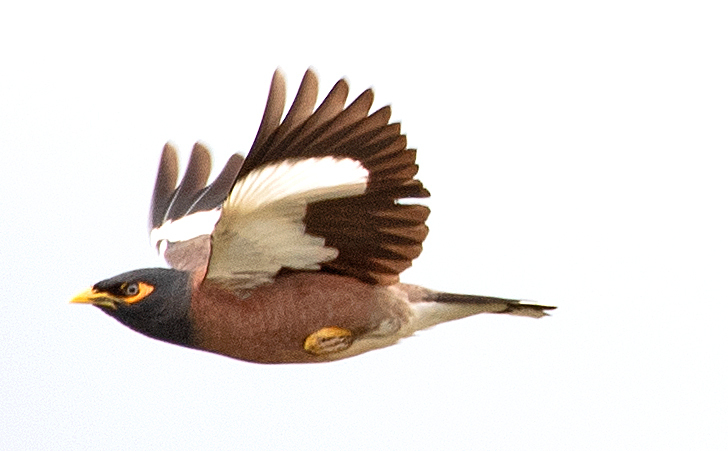
A swaggering brown starling with a black hood and a bare yellow patch of skin behind each eye, at home on every South Asian lawn, market and railway platform. Taken around the world to eat crop pests, it has become one of the most widespread and controversial birds on Earth.
The common myna or Indian myna, sometimes spelled mynah, is a bird in the family Sturnidae, native to Asia. An omnivorous open woodland bird with a strong territorial instinct, the common myna has adapted extremely well to urban environments. Wikipedia
What it can do
- iThrives in cities, nesting in wall cavities, street lights and buildings
- iiImitates other birds and, in captivity, human speech
- iiiGathers in communal roosts of hundreds to thousands of birds at dusk
- ivAggressively evicts other hole-nesting birds from nest sites
In the field
Field marks
- aWarm brown body with glossy black head and breast
- bBare yellow skin around and behind the eye; yellow bill and legs
- cLarge white wing patch obvious in flight
- dWhite under-tail and white tail tip
- Voice
- Very varied: gurgles, chattering 'kok-kok-kok', squawks and liquid whistles; alarm a harsh 'chake-chake'
- Not to be confused with
- Bank myna is greyer with a brick-red (not yellow) bare face patch; Jungle myna is slate-grey with a tuft of feathers at the bill base and no bare face patch; Asian pied starling is black-and-white.
- Where to see it
- Every town and village in Pakistan, India and Sri Lanka, e.g. Lahore, Karachi, Delhi and Colombo parks
- When
- Resident year-round
Listen
Looking for field recordings…
Life & habits
- Diet
- Omnivore: insects (especially grasshoppers), fruit, grain, food scraps
- Habitat
- Towns, villages, farmland and open country near people
- Size
- About 23–25 cm long
Walks rather than hops, striding across lawns; pairs bob their heads and fluff their plumage at each other in noisy displays, and flocks converge on huge evening roosts with deafening chatter.
Where it lives
Recorded sightings
—
geo-referenced records in GBIF, from museums, herbaria and field observers.
Native range
Iran and Central Asia through Afghanistan, Pakistan, India, Nepal, Bangladesh and Sri Lanka to Myanmar; introduced to Australia, South Africa, the Arabian Peninsula, Hawaii, Florida and many islands
Drag the globe to turn it. Dots are where records exist, not a range map; darker means more records.
In the stacks
Searching the stacks…
Every page naming Acridotheres tristis in the Biodiversity Heritage Library →
Marginalia
Long kept as a talking cage-bird across the subcontinent. Introduced to Mauritius in the 1760s to control locusts and later to Australia and Hawaii, it is now listed among the IUCN Invasive Species Specialist Group's '100 of the World's Worst Invasive Alien Species'.
Curiosity
It is one of only three birds on the IUCN '100 worst invasive species' list; the Red-vented bulbul and the Common starling are the other two.
Kinship

Fact-checked: 1 correction made to this sheet. Photographs: iNaturalist contributors under the licences shown. Records: GBIF.org. Historical plates: Source Library (CC BY-SA 4.0; originals public domain). Summary text: Nature Library editors and Wikipedia (CC BY-SA). Medicinal and edibility notes are historical and educational, not advice. iNaturalist taxon 204454.