On eBird ↗
Silver-throated Tanager
Live sightings near you, the range map, bar charts of when it is seen, and Macaulay Library photos and recordings.
Silver-throated Tanager
Tangara icterocephala
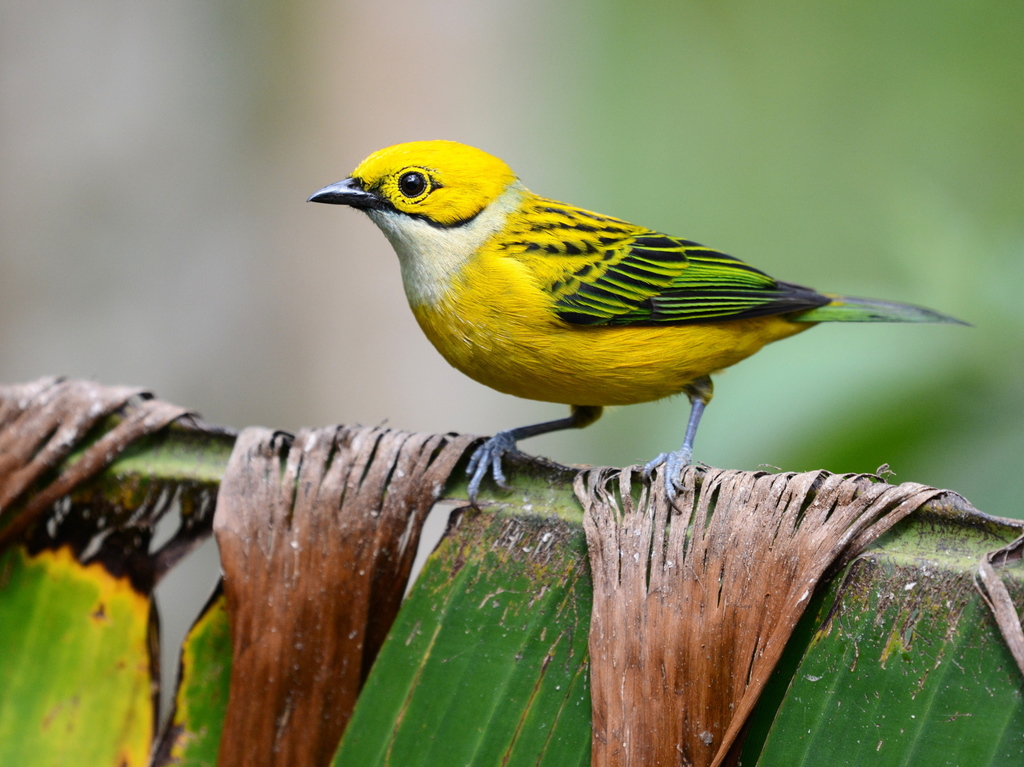
The silver-throated tanager (Tangara icterocephala) is a species of passerine bird in the tanager family Thraupidae. It is found in Costa Rica, Panama, Colombia, Ecuador, and northeastern Peru. It inhabits mossy forests, montane forests, tropical lowland evergreen forests and forest edges, along with tall secondary forests and disturbed habitat with remnant trees and forest. It is 13 centimetres (5.1 in) long and weighs 22 grams (0.78 oz) on average, and shows slight sexual dimorphism, with duller female plumage. Adult males are mainly bright yellow, with a silvery-white throat bordered above with a black stripe on the cheeks, black streaking on the back, and green edges to the wings and tail. Juveniles are duller and greener.
The silver-throated tanager is omnivorous, and mainly feeds on fruits, especially melastomes, supplemented with arthropods. Breeding occurs from April–September, and two broods are raised in a single breeding season. Cup nests are built by females out of moss, leaves, and spider webs in forests or isolated trees. Eggs are laid in clutches of two and incubated by females. Nestlings leave the nest at around 15 days old. The silver-throated tanager is listed as being of least concern by the International Union for Conservation of Nature (IUCN) on the IUCN Red List, but is threatened by habitat destruction.
From the article Silver-throated tanager on Wikipedia (CC BY-SA), quoted section by section
Description
The silver-throated tanager is an average-sized Tangara tanager, being 13 centimetres (5.1 in) long and weighing 22 grams (0.78 oz) on average. The species shows slight sexual dimorphism, with females being duller than males. The male is mainly bright yellow, with a silvery-white throat bordered above with a black stripe on the cheeks. The back is yellow with black streaking, and the wings and tail are yellow with green edges. The iris is brown, the beak is black, and the feet are gray. Adult females look similar to males, but have duller and greener plumage, and occasional faint dark mottling on the crown. Immatures are much duller and greener, with dusky wings, tail, back streaks and cheek stripe, a grey throat and darker green wing edging. This subadult plumage is kept through to the end of the first breeding season.
Vocalizations. The silver-throated tanager's calls are insect-like buzzes. When foraging or flying, the species has been recorded giving a harsh, buzzy jjeut, or a high-pitched bzeeet. It also gives a high-pitched tic. Its songs have not been described.
Range & habitat
It is found from northern Costa Rica through Panama, Colombia, and Peru to southern Ecuador, mainly at elevations of 600–1,800 m (2,000–5,900 ft), but occasionally from 0–2,300 m (0–7,546 ft). It inhabits mossy forests, montane forests, tropical lowland evergreen forests and forest edges, along with tall secondary forests. It also inhabits disturbed habitats with remnant trees and forest. It has been observed in clearings with fruit trees next to forests in Costa Rica, but rarely leaves forested habitat in Colombia.
Wikipedia: “Distribution and habitat”
What it does
Silver-throated tanagers forage in pairs, small groups, or as part of a mixed-species feeding flock. Flocks of silver-throated tanagers consist of 3–5 individuals, and up to 12 individuals may be present in mixed-species flocks with other tanagers, vireos, and wood warblers. Mated pairs of the species are present year-round, but become looser after the end of the breeding season in November to December. Individuals have been observed bathing themselves in water that had collected in areas such as hollows in tree branches.
Diet. Silver-throated tanagers are omnivorous, mainly feeding on fruit and supplementing their diet with arthropods. The main fruits eaten are melastomes, especially those from the genus Miconia. It has also been observed feeding on fruits of Souroubea guianensis. Arthropods form a greater percentage of the diet during the breeding season. Silver-throated tanagers forage in the canopy, mostly perching on or hanging from upside-down branches to eat small fruit. In Colombia, foraging occurs in the crowns of trees and shrubs at an average height of 8.5 m (28 ft) and rarely below 3 m (9.8 ft), but foraging occurs closer to the ground in Costa Rica. Foraging for arthropods occurs on thin moss-covered branches. They move quickly from branch to branch, and move in sprints down the branch while looking for arthropods. …
Wikipedia: “Behavior”
Listen
Looking for field recordings…
Where it lives
Recorded sightings
—
geo-referenced records in GBIF, from museums, herbaria and field observers.
Drag the globe to turn it. Dots are where records exist, not a range map; darker means more records.
In the stacks
Searching the stacks…
Every page naming Tangara icterocephala in the Biodiversity Heritage Library →
This page is assembled live from iNaturalist, GBIF, Wikipedia, the Source Library and the Internet Archive. It is not yet part of the hand-edited codex. iNaturalist taxon 9550.