On eBird ↗
Thick-billed Vireo
Live sightings near you, the range map, bar charts of when it is seen, and Macaulay Library photos and recordings.
Thick-billed Vireo
Vireo crassirostris
The thick-billed vireo (Vireo crassirostris) is a small songbird. It breeds in the West Indies in the Bahamas, Turks and Caicos Islands, Cayman Islands, Tortuga Island in Haiti and on cays off the coast of Cuba. It occasionally can be found as a vagrant to south Florida in the United States. The subspecies V. c. approximans of Providencia Island is sometimes treated as a subspecies of the mangrove vireo (V. pallens) or as a separate species,...
From the article Thick-billed vireo on Wikipedia (CC BY-SA), quoted section by section
Description
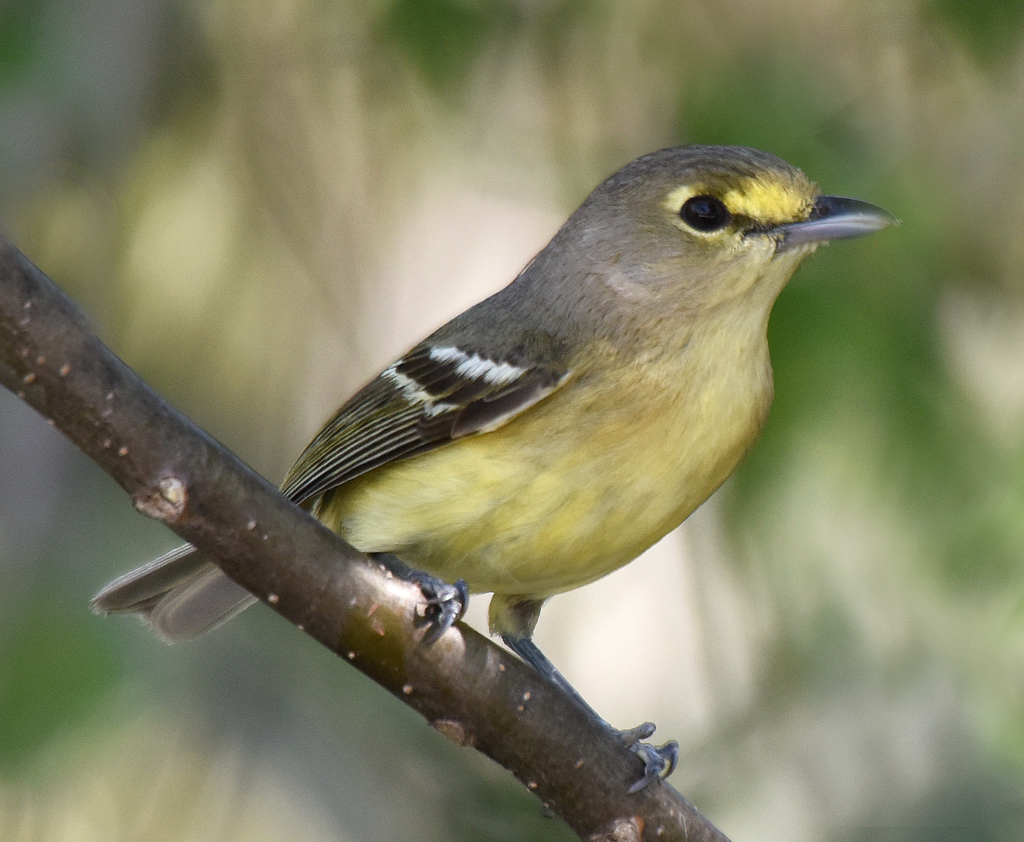
The thick-billed vireo is 11.5 to 13.4 cm (4.5 to 5.3 in) long and weighs about 11 to 16 g (0.39 to 0.56 oz). The sexes have the same plumage. Adults of the nominate subspecies V. c. crassirostris have a mostly grayish olive to brownish olive crown, face, and nape with blackish lores, a pale yellow stripe above the lores, and a pale to darker yellow eye-ring that sometimes is incomplete. Their upperparts are grayish olive to brownish olive with a more olive-green rump and uppertail coverts. Their wing coverts are dusky grayish brown with wide white tips that form two prominent wing bars. Their flight feathers are dusky grayish brown; the primaries have off-white edges, the secondaries have pale olive edges, and the tertials have white edges. Their tail is dusky grayish brown. Their underparts are pale grayish buffy to light yellowish buff or yellow. The other subspecies of the thick-billed vireo differ very little from the nominate. All subspecies have a dark iris, a dusky horn maxilla, a pale horn mandible, and bluish gray legs and feet.
Range & habitat
The subspecies of the thick-billed vireo are found thus:
V. c. crassirostris: the Bahamas V. c. stalagmium: the Turks and Caicos Islands V. c. tortugae: Île de la Tortue off northern Haiti V. c. cubensis: Cayo Coco and Cayo Paredón Grande off northern Cuba V. c. alleni: the Cayman Islands The species has also been recorded several times in Florida. The thick-billed vireo inhabits deciduous woodlands, scrublands, and mangroves.
Wikipedia: “Distribution and habitat”
What it does
The thick-billed vireo feeds primarily on arthropods but also includes some fruit in its diet. It forages at all levels of its habitat taking food by gleaning from leaves and branches.
Wikipedia: “Feeding”
Listen
Looking for field recordings…
Where it lives
Recorded sightings
—
geo-referenced records in GBIF, from museums, herbaria and field observers.
Drag the globe to turn it. Dots are where records exist, not a range map; darker means more records.
In the stacks
Searching the stacks…
Every page naming Vireo crassirostris in the Biodiversity Heritage Library →
This page is assembled live from iNaturalist, GBIF, Wikipedia, the Source Library and the Internet Archive. It is not yet part of the hand-edited codex. iNaturalist taxon 980033.