On eBird ↗
Red-eyed Vireo
Live sightings near you, the range map, bar charts of when it is seen, and Macaulay Library photos and recordings.
Red-eyed Vireo
Vireo olivaceus
The red-eyed vireo (Vireo olivaceus) is a small American songbird. It is somewhat warbler-like but not closely related to the New World warblers (Parulidae). Common across its vast range, this species is not considered threatened by the IUCN.
Vireo is a Latin word referring to a green migratory bird, perhaps the female golden oriole, possibly the European greenfinch. The specific olivaceus is Neo-Latin for 'olive-green', from Latin oliva ('olive').
From the article Red-eyed vireo on Wikipedia (CC BY-SA), quoted section by section
Description
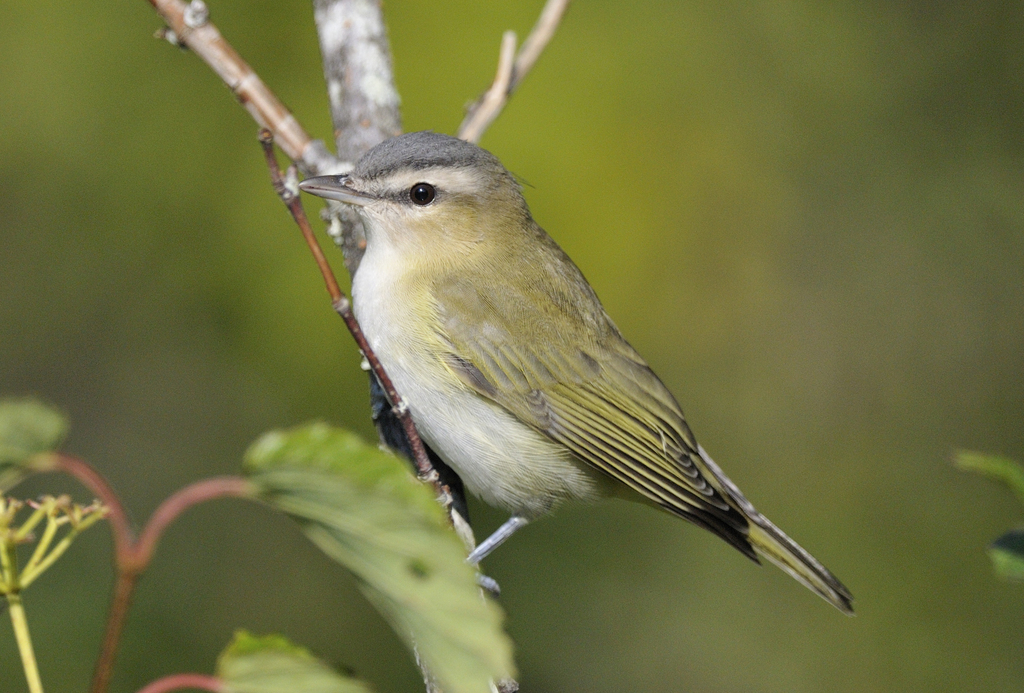
Adults are mainly olive-green on the upper parts with white underparts; they have a red iris and a grey crown edged with black. There is a dark blackish line through the eyes and a wide white stripe just above that line. They have thick blue-grey legs and a stout bill. They are yellowish on the flanks and undertail coverts (though this is faint in some populations). In the past, the yellow-green vireo (V. flavoviridis), the chivi vireo (V. chivi), and the Noronha vireo (V. gracilirostris) have been considered to be conspecific with the red-eyed vireo; the chivi vireo was split most recently. Other closely related species include the black-whiskered vireo (V. altiloquus) and the Yucatan vireo (V. magister). Measurements: Both sexes:
Length: 4.7–5.1 in (12–13 cm) Weight: 0.4–0.9 oz (12–26 g) Wingspan: 9.1-9.8 in (23–25 cm)
Wikipedia: “Description and systematics”
What it does
The breeding habitat of the red-eyed vireo is in the open wooded areas across Canada and the eastern and northwestern United States. These birds migrate to South America, where they spend the winter. Latin American and Mexico are important migratory stopovers, but are not home to permanent populations of red-eyed vireo as it is an exclusively migratory species. Migration primarily occurs in May and September, although interestingly populations that breed in the Northwest boreal forest will migrate east first before beginning their southern migration. Following a trend seen in other bird species, red-eyed vireo have been altering there migration timing forward due to climate change. It is unclear if this is having some affect on their breeding success. In their summer range they are primarily insectavores, using a high protein diet to fuel their young and build fat reserves for their eventual migration south. Red-eyed vireos glean insects from tree foliage, primarily favoring caterpillars, beetles, and aphids, that they sometimes snatch while hovering. In their wintering quarters they are almost exclusivly frugivores, where trees bearing fruit, such as tamanqueiro (Alchornea glandulosa) or gumbo-limbo (Bursera simaruba), will attract them to parks and gardens. Birds are often quite acrobatic when reaching for fruit, even hanging upside down to get specific berries. …
Wikipedia: “Ecology”
Listen
Looking for field recordings…
Where it lives
Recorded sightings
—
geo-referenced records in GBIF, from museums, herbaria and field observers.
Drag the globe to turn it. Dots are where records exist, not a range map; darker means more records.
In the stacks
Searching the stacks…
Every page naming Vireo olivaceus in the Biodiversity Heritage Library →
This page is assembled live from iNaturalist, GBIF, Wikipedia, the Source Library and the Internet Archive. It is not yet part of the hand-edited codex. iNaturalist taxon 891704.