On eBird ↗
Masked Tityra
Live sightings near you, the range map, bar charts of when it is seen, and Macaulay Library photos and recordings.
Masked Tityra
Tityra semifasciata
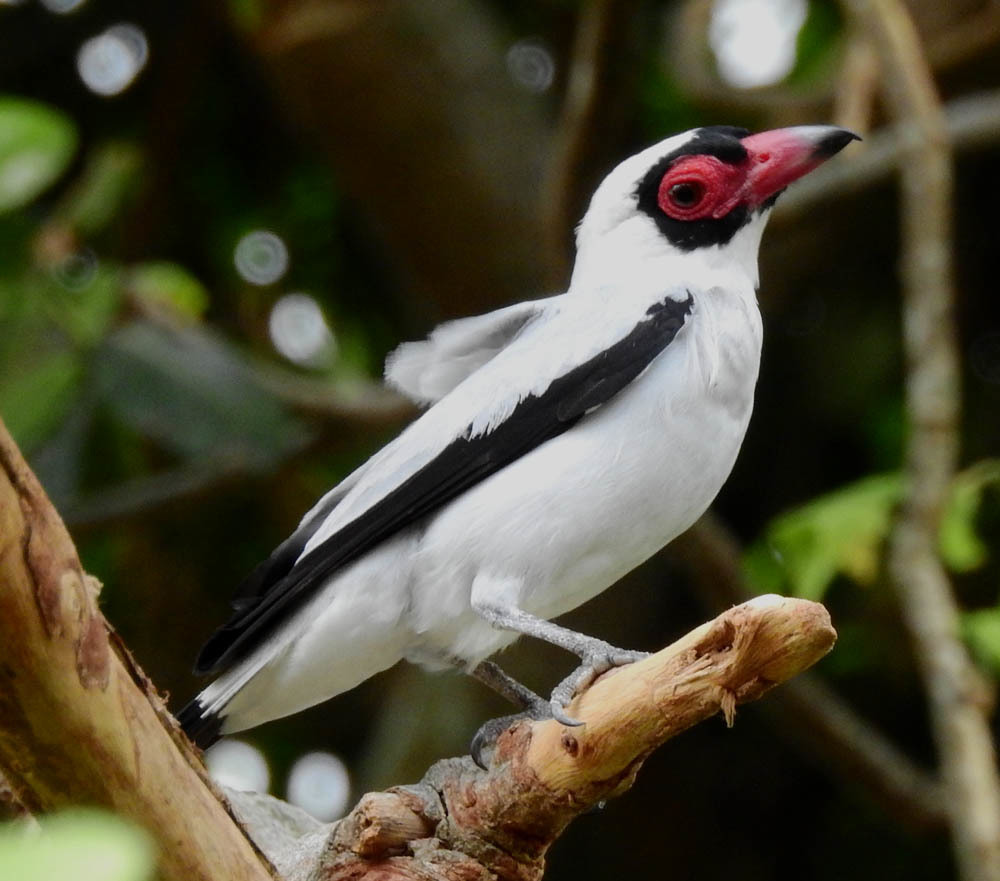
The masked tityra (Tityra semifasciata) is a medium-sized passerine bird. It has traditionally been placed in the cotinga or the tyrant flycatcher family, but evidence strongly suggests that it is better placed in Tityridae, where now placed by SACC.
From the article Masked tityra on Wikipedia (CC BY-SA), quoted section by section
Description
The masked tityra is 20 to 24 cm (7.9 to 9.4 in) long and weighs 77 to 88 g (2.7 to 3.1 oz). The species is sexually dimorphic. Adult males of the nominate subspecies T. s. semifasciata have bare rosy red skin from their bill to and around their eye. They have a black forecrown and the color wraps behind and under the red skin. The rest of their head and their upperparts are pale grayish white with a heavy pearly gray cast. Their wings are mostly black with grayish white tertials. Their tail is grayish white with a wide black band near the end. Their throat and underparts are whitish. Adult females have the same bare red skin as males but without any black on the head; their head is a smokier gray than the male's. Their upperparts are a darker gray than the male's with brown streaks and smudges. Their wings and tail are like the male's. Their throat and underparts are a dingy pale grayish. The other subspecies of the masked tityra differ from the nominate and each other thus:
T. s. hannumi: very similar to nominate T. s. griseiceps: (male) grayer upperparts; (female) pale gray head and upperparts, gray-brown wash on back, paler and grayer wing coverts T. s. deses: paler overall T. s. personata: (male) grayish brown head and upperparts, darker on the head T. s. …
Range & habitat
The subspecies of the masked tityra are found thus:
T. s. hannumi: northwestern Mexico in southeastern Sonora, southwestern Chihuahua, and northeastern Sinaloa T. s. griseiceps: coastal western Mexico from north-central Sinaloa south to southern Oaxaca T. s. deses: Yucatán and northern Quintana Roo in southeastern Mexico T. s. personata: eastern Mexico from southwestern Tamaulipas to Campeche and south through Belize, both sides of Guatemala, central and western Honduras, and El Salvador into north-central Nicaragua T. s. costaricensis: from southeastern Honduras south through most of Nicaragua and Costa Rica into western and central Panama including Coiba and Cébaco islands T. s. columbiana: eastern Panama, western Colombia to Chocó Department and east across the country, the Serranía del Perijá on the Colombia-Venezuela border, both slopes of the Venezuelan Andes, and the Venezuelan Coastal Range from Yaracuy to Miranda (but see below) T. s. nigriceps: from Nariño Department in extreme southwestern Colombia south through western Ecuador to Guayas and northwestern Azuay provinces T. s. semifasciata: Brazil south of the Amazon River from central Amazonas state to the Atlantic in Amapá and south to Rondônia, southern Mato Grosso and northern Goiás and into eastern Paraguay; possibly as far south as far northeastern Argentina (but see below) T. s. …
Wikipedia: “Distribution and habitat”
What it does
The masked tityra feeds mostly on fruits and also includes invertebrates and occasionally small lizards in its diet. It forages singly, in pairs, and in small groups, and is not known to join mixed-species feeding flocks. It forages mostly from the forest's mid-story to its canopy, perching in the open and gleaning while perched or while hopping along a branch. It also sometimes takes its food with a short sally, with or without a brief hover, from the perch.
Wikipedia: “Feeding”
Listen
Looking for field recordings…
Where it lives
Recorded sightings
—
geo-referenced records in GBIF, from museums, herbaria and field observers.
Drag the globe to turn it. Dots are where records exist, not a range map; darker means more records.
In the stacks
Searching the stacks…
Every page naming Tityra semifasciata in the Biodiversity Heritage Library →
This page is assembled live from iNaturalist, GBIF, Wikipedia, the Source Library and the Internet Archive. It is not yet part of the hand-edited codex. iNaturalist taxon 8834.