- Animals
- ›Chordates
- ›Vertebrates
- ›Birds
- ›Perching Birds
- ›Ovenbirds and Woodcreepers
- ›Typical Ovenbirds
- ›Cinclodes
On eBird ↗
Blackish Cinclodes
Live sightings near you, the range map, bar charts of when it is seen, and Macaulay Library photos and recordings.
Blackish Cinclodes
Cinclodes antarcticus
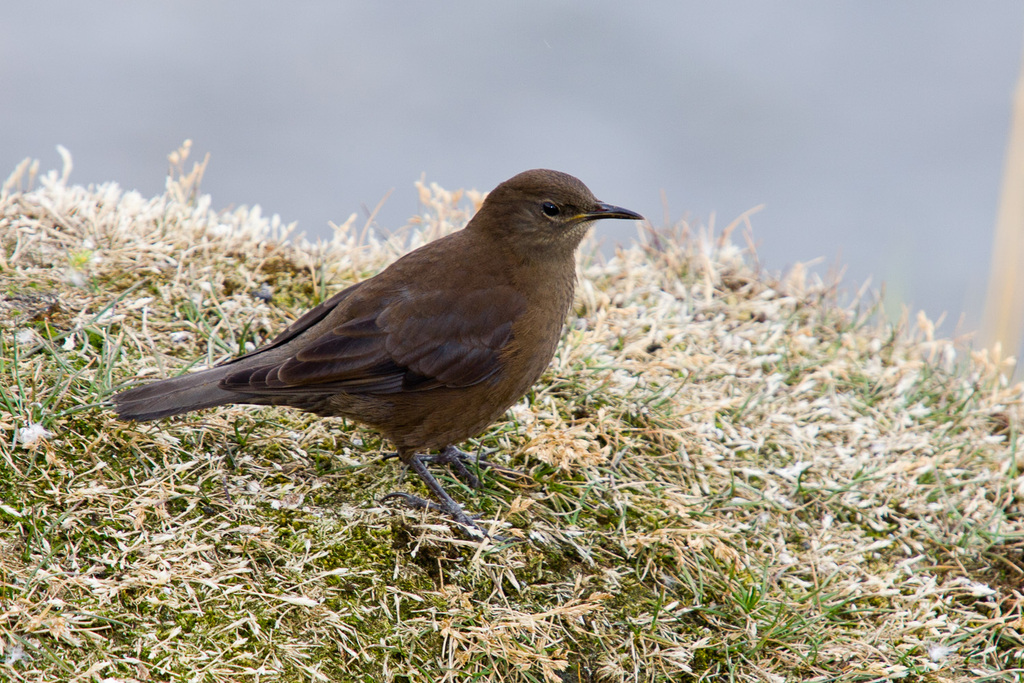
The blackish cinclodes (Cinclodes antarcticus) is a passerine bird of the genus Cinclodes belonging to the ovenbird family Furnariidae. It is native to the southern tip of South America including the Falkland Islands where it is known as the tussac-bird or tussock-bird. It is often very tame and will approach humans closely.
From the article Blackish cinclodes on Wikipedia (CC BY-SA), quoted section by section
Description
The blackish cinclodes is 18 to 23 cm (7.1 to 9.1 in) long and weighs about 63 g (2.2 oz). The sexes have the same plumage. Adults of the nominate subspecies are mostly dark sooty brown, with a slightly paler throat and some dull rufous on the base of the flight feathers. The last is usually visible only in flight. Its iris is dark brown, its bill blackish, and its legs and feet blackish. Juveniles are generally browner than adults. Subspecies C. a. maculirostris is slightly larger than the nominate with a shorter bill and longer tail, and is blacker overall with a visibly yellowish base to its bill and no rufous on its wings.
Range & habitat
The nominate subspecies of the blackish cinclodes is found on the Falkland Islands. Surveys through the late 1990s found them on 40 of the 59 islands studied. Subspecies C. a. maculirostris is found in southernmost mainland Chile, both Chilean and Argentine Tierra del Fuego, and other islands in the Cape Horn Archipelago. The blackish cinclodes is primarily coastal though it does range as far inland as 0.5 km (0.3 mi). It favors landscapes of short grass and tussoc (tussock) grass Poa flabellata, and is also common around human habitations. Both subspecies are often found on rocky beaches near colonies of marine mammals and seabirds. In elevation they range from sea level to about 200 m (700 ft).
Wikipedia: “Distribution and habitat”
What it does
The blackish cinclodes feeds mainly on small invertebrates such as amphipods, isopods, flies, and Orthoptera. Among seabird colonies it feeds on cracked eggs, scraps, and regurgitated matter, and also takes prey from excrement. It has also been documented feeding at wounds on southern elephant seals (Mirounga leonina) and sometimes enters houses to take food crumbs and scraps. On and near beaches it gleans and probes for prey, especially in floating and washed up kelp. It leaps up to capture flies in mid-air and follows humans along beaches to capture what they disturb.
Wikipedia: “Feeding”
Listen
Looking for field recordings…
Where it lives
Recorded sightings
—
geo-referenced records in GBIF, from museums, herbaria and field observers.
Drag the globe to turn it. Dots are where records exist, not a range map; darker means more records.
In the stacks
Searching the stacks…
Every page naming Cinclodes antarcticus in the Biodiversity Heritage Library →
This page is assembled live from iNaturalist, GBIF, Wikipedia, the Source Library and the Internet Archive. It is not yet part of the hand-edited codex. iNaturalist taxon 11383.