On eBird ↗
Eurasian Nuthatch
Live sightings near you, the range map, bar charts of when it is seen, and Macaulay Library photos and recordings.
Eurasian Nuthatch
Sitta europaea
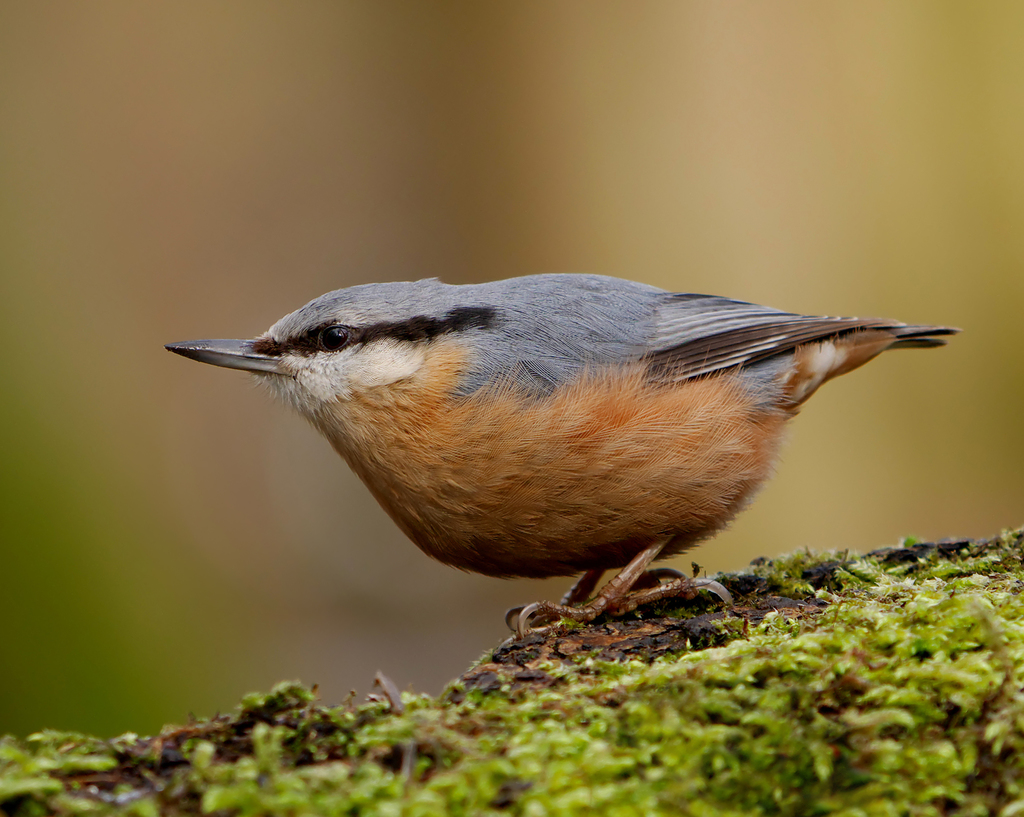
The Eurasian nuthatch, wood nuthatch (Sitta europaea), or simply nuthatch, is a small passerine bird found throughout the Palearctic and in Eurasia. Like other nuthatches, it is a short-tailed bird with a long bill, blue-gray upperparts and a black eye-stripe. It is a vocal bird with a repeated loud dwip call. There are more than 20 subspecies in three main groups; birds in the west of the range have orange-buff underparts and a white throat, those in Russia have whitish underparts, and those in the east have a similar appearance to European birds, but lack the white throat.
Its preferred habitat is mature deciduous or mixed woodland with large, old trees, preferably oak. Pairs hold permanent territories, and nest in tree holes, usually old woodpecker nests, but sometimes natural cavities. If the entrance to the hole is too large, the female plasters it with mud to reduce its size, and often coats the inside of the cavity too. The six to nine red-speckled white eggs are laid on a deep base of pine or other wood chips.
From the article Eurasian nuthatch on Wikipedia (CC BY-SA), quoted section by section
Description
The adult male of the nominate subspecies, S. e. europaea is 14 cm (5.5 in) long with a 22.5–27 cm (8.9–10.6 in) wingspan. It weighs 17–28 g (0.6–1 oz). It has blue-grey upperparts, a black eye-stripe and whitish throat and underparts. The flanks and lower belly are orange-red, mottled with white on the undertail. The stout bill is dark grey with a paler area on the base of the lower mandible, the iris is dark brown and the legs and feet are pale brown or greyish. Most other members of the S. e. europaea group differ only in detail from the nominate form, often with respect to the hue of the underparts, but S. e. arctica is quite distinctive. It is large, pale, has a white forehead and a reduced eye-stripe, and it has more white in the tail and wings than any other subspecies. Nuthatches move on trees with short leaps, and do not use their tails for support. In flight, they have a characteristic appearance, with a pointed head, round wings and a short, square tail. Their flight is fast, with wings closed between beats, and is usually of short duration. S. e. caesia, the most widespread of the western subspecies, has orange-buff underparts except for a white throat and cheeks. The other western forms mainly differ in the exact shade of the underparts, although some southeastern forms also show a white forehead and supercilium. S. e. sinensis and S. e. …
Range & habitat
The Eurasian nuthatch's breeding range extends across temperate Eurasia from Great Britain (but not Ireland) to Japan. It is found between the 16–20 °C (61–68 °F) July isotherms, north to about latitude 64°N in western Russia and 69°N in Siberia. It breeds south to the Mediterranean in Europe, although it is absent from the islands, other than Sicily, and in most of Russia the southern boundary is around 54–55°N. In the east, the range includes most of China and Taiwan and much of Korea. It has occurred as a vagrant in Lebanon and the Channel Islands, and the nominate race has been recorded a few times in Finland where S. e. asiatica is the normal form. Most populations are sedentary, apart from some post-breeding dispersal of young birds, and there is a reluctance to cross even short stretches of open water. Northern and eastern breeders are dependent on the cones of the Siberian stone pine, and if the crop fails many birds of the S. e. asiatica subspecies may move west into northern Sweden and Finland in autumn, sometimes staying to breed. Siberian S. e. arctica may make more limited movements south and east in winter, and S. e. amurensis, from southeast Russia, is regular in winter in Korea. The preferred habitat is mature woodland with large, old trees, which provide extensive growth for foraging and nesting holes. …
Wikipedia: “Distribution and habitat”
What it does
The Eurasian nuthatch eats mainly insects, particularly caterpillar and beetles. In autumn and winter, the diet is supplemented with nuts and seeds, hazel nuts and beech mast being preferred. The young are fed mainly on the insects favoured by their parents, with some seeds. Food items are found mainly on tree trunks and large branches, but smaller branches may also be investigated, and food may be taken from the ground, especially outside the breeding season. Nuthatches can forage when descending trees head first, as well as when climbing. Some prey is caught in flight, and a nuthatch will remove bark or rotten wood to reach insects, although it cannot chisel into healthy wood like a woodpecker. A pair may temporarily join a mixed-species foraging flock as it passes near their territory. The Eurasian nuthatch readily visits bird tables and bird feeders in winter, eating human-made food items such as fat, cheese, butter and bread. It has even been recorded as taking slaughterhouse offal. Sizeable hard food items like nuts or large insects are wedged into crevices in tree bark and smashed with the strong bill.
Plant food is stored year-round, but mainly in autumn. Individual seeds are hidden in cracks in bark, occasionally in walls or in the ground. The food item is usually concealed with lichen, moss or small pieces of bark. The cached food is retrieved in cold weather. …
Wikipedia: “Feeding”
Listen
Looking for field recordings…
Where it lives
Recorded sightings
—
geo-referenced records in GBIF, from museums, herbaria and field observers.
Drag the globe to turn it. Dots are where records exist, not a range map; darker means more records.
In the stacks
Searching the stacks…
Every page naming Sitta europaea in the Biodiversity Heritage Library →
This page is assembled live from iNaturalist, GBIF, Wikipedia, the Source Library and the Internet Archive. It is not yet part of the hand-edited codex. iNaturalist taxon 14824.