On eBird ↗
White-breasted Nuthatch
Live sightings near you, the range map, bar charts of when it is seen, and Macaulay Library photos and recordings.
White-breasted Nuthatch
Sitta carolinensis
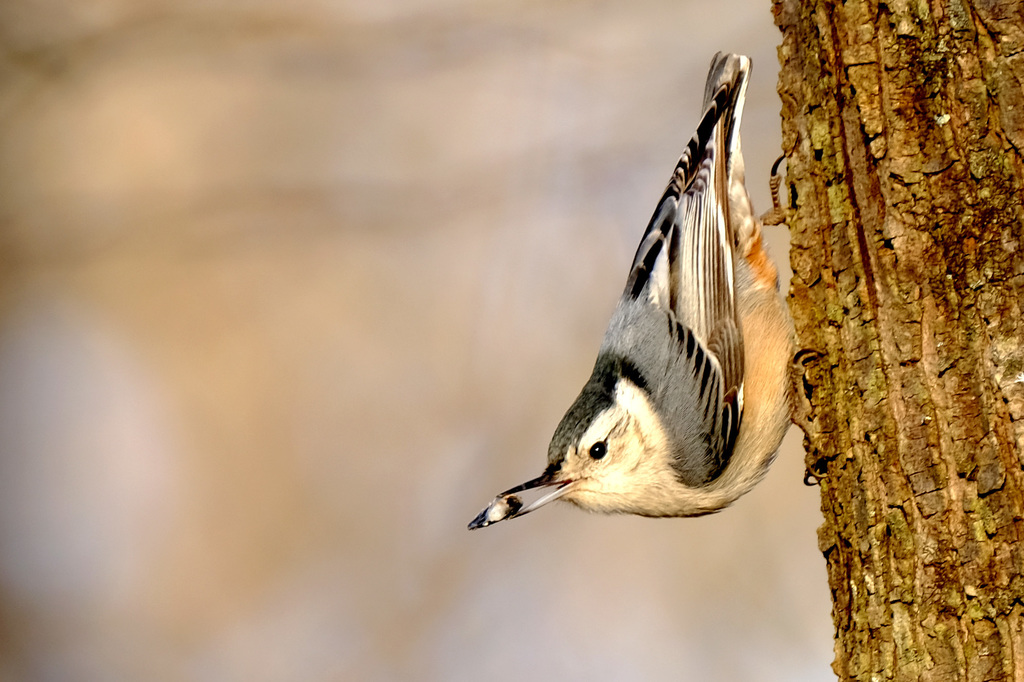
The white-breasted nuthatch (Sitta carolinensis) is a species of bird in the nuthatch family Sittidae. It is a medium-sized nuthatch, measuring approximately 15.5 cm (6.1 in) in length. Coloration varies somewhat along the species' range, but the upperparts are light blue-gray, with a black crown and nape in males, while females have a dark gray crown. The underparts are whitish, with a reddish tinge on the lower abdomen. Despite not being closely related, the white-breasted nuthatch and the white wagtail are very similar in plumage.
The white-breasted nuthatch is a chatty bird. It has a nasal voice and often utters little cries or vocalizations, often composed of repetitions of small invariant whistles. In summer, it is an exclusively insectivorous bird, consuming a wide range of arthropods, but in winter its diet consists mainly of seeds. The nest is located in the cavity of a tree. The clutch consists of five to nine eggs, incubated for two weeks by the female, who is fed by the male. The two adults then feed the young until they fledge, and for a few weeks after that.
From the article White-breasted nuthatch on Wikipedia (CC BY-SA), quoted section by section
Description
The white-breasted nuthatch is a medium-sized nuthatch, measuring about 15.5 cm (6.1 in) in length. Like other members of its genus, it has a large head, short tail, short wings, a powerful bill and strong feet; it is 13–14 cm (5.1–5.5 in) long, with a wingspan of 20–27 cm (7.9–10.6 in) and a weight of 18–30 g (0.63–1.06 oz). The adult male of the nominate subspecies, S. c. carolinensis, has pale blue-gray upperparts, a glossy black cap (crown of the head), and a black band on the upper back. The wing coverts and flight feathers are very dark gray with paler fringes, and the closed wing is pale gray and black, with a thin white wing bar. The face and the underparts are white. The outer tail feathers are black with broad diagonal white bands across the outer three feathers, a feature readily visible in flight. The female has, on average, a narrower black back band, slightly duller upperparts and buffer underparts than the male. Her cap may be gray, but many females have black caps and cannot be reliably distinguished from the male in the field. In the northeastern United States, at least 10% of females have black caps, but the proportion rises to 40–80% in the Rocky Mountains, Mexico and the southeastern U.S. …
Range & habitat
The breeding habitat of the white-breasted nuthatch is woodland across North America, from southern Canada to northern Florida and southern Mexico. In the eastern part of its range, its preferred habitat is old-growth open deciduous or mixed forest, including orchards, parks, suburban gardens and cemeteries; it is found mainly in the lowlands, although it breeds at 1,675 m (5,495 ft) elevation in Tennessee. In the west and Mexico, the white-breasted nuthatch is found in open montane pine and oak woodlands, and nesting occurs at up to 3,200 m (10,500 ft) elevation in Nevada, California and Mexico. Pinyon and juniper and riverside woodlands may be used locally where available. The white-breasted nuthatch is the only North American nuthatch usually found in deciduous trees; red-breasted, pygmy and brown-headed nuthatches prefer pines or other conifers. The presence of mature or decaying trees with holes suitable for nesting is essential, and trees such as oak, beech and hickory are favored in the east since they also provide edible seeds. White-breasted nuthatches seldom excavate their own nest holes like red-breasted nuthatches. Although suitable habitat is distributed continentally, it is discontinuous. …
Wikipedia: “Distribution and habitat”
What it does
The white-breasted nuthatch often travels with small mixed flocks in winter. These flocks are led by titmice and chickadees, with nuthatches and downy woodpeckers as common attendant species. Participants in such flocks are thought to benefit in terms of foraging and predator avoidance. It is likely that the attendant species also access the information carried in the chickadees' calls and reduce their own level of vigilance accordingly.
Breeding. The white-breasted nuthatch is monogamous, and pairs form following a courtship in which the male bows to the female, spreading his tail and drooping his wings while swaying back and forth; he also feeds her morsels of food. The pair establish a territory of 0.1–0.15 km2 (25–37 acres) in woodland, and up to 0.2 km2 (49 acres) in semi-wooded habitats, and then remain together year-round until one partner dies or disappears. The nest cavity is usually a natural hole in a decaying tree, sometimes an old woodpecker nest. The nest hole is usually 3–12 m (9.8–39.4 ft) high in a tree and is lined with fur, fine grass, and shredded bark. The clutch is 5 to 9 eggs which are creamy-white, speckled with reddish brown, and average 19 mm × 14 mm (0.75 in × 0.55 in) in size. The eggs are incubated by the female for 13 to 14 days prior to hatching, and the altricial chicks fledge in a further 18 to 26 days. …
Wikipedia: “Ecology and behavior”
Listen
Looking for field recordings…
Where it lives
Recorded sightings
—
geo-referenced records in GBIF, from museums, herbaria and field observers.
Drag the globe to turn it. Dots are where records exist, not a range map; darker means more records.
In the stacks
Searching the stacks…
Every page naming Sitta carolinensis in the Biodiversity Heritage Library →
This page is assembled live from iNaturalist, GBIF, Wikipedia, the Source Library and the Internet Archive. It is not yet part of the hand-edited codex. iNaturalist taxon 14801.