On eBird ↗
Goldcrest
Live sightings near you, the range map, bar charts of when it is seen, and Macaulay Library photos and recordings.
Goldcrest
Regulus regulus
The goldcrest (Regulus regulus) is a very small passerine bird in the kinglet family. Its colourful golden crest feathers, as well as being called the "king of the birds" in European folklore, gives rise to its English and scientific names. The scientific name, R. regulus, means 'petty king' or prince. Several subspecies are recognised across the very large distribution range that includes much of the Palearctic and the islands of Macaronesia and Iceland. Birds from the north and east of its breeding range migrate to winter further south.
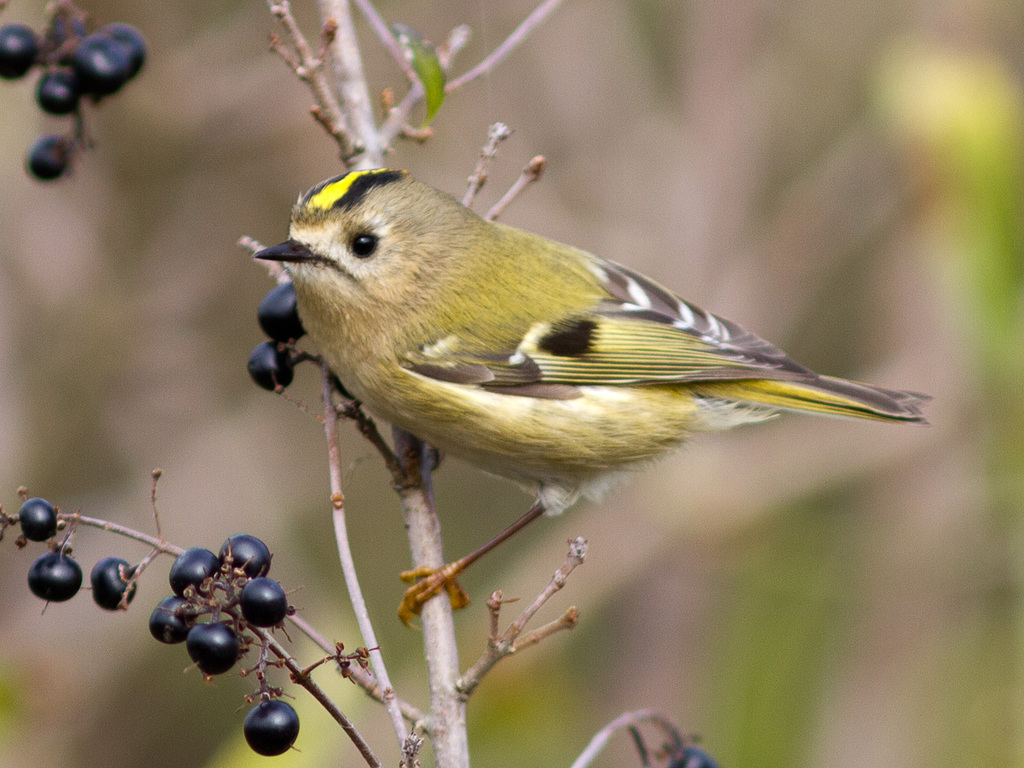
This kinglet has greenish upper-parts, whitish under-parts, and has two white wingbars. It has a plain face contrasting black irises and a bright head crest, orange and yellow in the male and yellow in the female, which is displayed during breeding. It superficially resembles the common firecrest (Regulus ignicapilla), which largely shares its European range, but the latter's bronze shoulders and strong face pattern are distinctive. The song is a repetition of high thin notes, slightly higher-pitched than those of its relative. Birds on the Canary Islands are now separated into two subspecies of the goldcrest, but were formerly considered to be a subspecies of the firecrest or a separate species, Regulus teneriffae.
From the article Goldcrest on Wikipedia (CC BY-SA), quoted section by section
Description
The goldcrest is the smallest European bird, 8.5–9.5 cm (3.3–3.7 in) in length, with a 13.5–15.5 cm (5.3–6.1 in) wingspan and a weight of 4.5–7.0 g (0.16–0.25 oz). It is similar in appearance to a warbler, with olive-green upper-parts, buff-white underparts, two white wing bars, and a plain face with conspicuous black irises. The crown of the head has black sides and a narrow black front, and a bright crest, yellow with an orange centre in the male, and entirely yellow in the female; the crest is erected in display, making the distinctive orange stripe of the male much more conspicuous. The small, thin bill is black, and the legs are dark flesh-brown. Apart from the crest colour, the sexes are alike, although in fresh plumage, the female may have very slightly paler upper-parts and greyer underparts than the adult male. The juvenile is similar to the adult, but has duller upper-parts and lacks the coloured crown. Although the tail and flight feathers may be retained into the first winter, by then the young birds are almost indistinguishable from adults in the field. The flight is distinctive; it consists of whirring wing-beats with occasional sudden changes of direction. Shorter flights while feeding are a mix of dashing and fluttering with frequent hovering. It moves restlessly among foliage, regularly creeping on branches and up and down trunks.
Identification. …
Range & habitat
The goldcrest breeds in mature lowland and mountain coniferous woodlands, mainly up to 3,000 m (9,800 ft), and occasionally to 4,800 m (15,700 ft). It uses spruce, larch, Scots pine, silver fir and mountain pine, and in man-made landscapes also introduced conifers such as douglas fir. Breeding densities of up to 591 pairs per square km (1,530 pairs per square mile) have been recorded in Norway spruce in Ireland, and goldcrests constituted over 60% of all birds found in Welsh Douglas fir and Norway spruce plantations. Broad-leaved woods are used only when some spruce or firs are also present. Sites such as parks and cemeteries are used only when they offer suitable conifers that are not otherwise locally available. The height and nature of any undergrowth is irrelevant. Unlike more specialised birds such as the Eurasian nuthatch and the Eurasian treecreeper, both of which forage on tree trunks, the kinglets do not need large woodlands, and their population density is independent of forest size. Once breeding is over, this species will readily move into deciduous trees and shrubs, heathland and similar more open habitats. The Tenerife subspecies occurs in the mountain region previously occupied by laurisilva, but now dominated by tree heaths. …
Wikipedia: “Distribution and habitat”
What it does
All Regulus species are almost exclusively insectivorous, preying on small arthropods with soft cuticles, such as springtails, aphids and spiders. They also feed on the cocoons and eggs of spiders and insects, and occasionally take pollen. All species will catch flying insects while hovering. Although the similarly sized goldcrest and firecrest are often found together, there are a number of factors that minimise direct competition for food. Goldcrests prefer smaller prey than common firecrests. Although both will take trapped insects from spider webs on autumn migration, firecrests will also eat the large orb-web spiders (on rare occasions kinglets have been found stuck in a spider web, either unable to move or dead). The goldcrest takes a wide variety of prey, especially spiders, caterpillars, bugs, springtails and flies. Larger prey such as oak bush crickets and tortrix moths may sometimes be taken. Flying insects are taken in hovering flight but not normally pursued; there is a record of a goldcrest attacking a large dragonfly in flight, only to be dragged along by the insect before releasing it unharmed. Goldcrests will occasionally feed on the ground among leaf-litter with tits. …
Wikipedia: “Feeding”
In human culture
Aristotle (384–322 BC) and Pliny (23–79 AD) both wrote about the legend of a contest among the birds to see who should be their king, the title to be awarded to the one that could fly highest. Initially, it looked as though the eagle would win easily, but as he began to tire, a small bird that had hidden under the eagle's tail feathers emerged to fly even higher and claimed the title. Following from this legend, in much European folklore the wren has been described as the "king of the birds" or as a flame bearer. However, these terms were also applied to the Regulus species, the fiery crowns of the goldcrest and firecrest making them more likely to be the original bearers of these titles, and, because of the legend's reference to the "smallest of birds" becoming king, the title was probably transferred to the equally tiny wren. The confusion was probably compounded by the similarity and consequent interchangeability of the Greek words for the wren (βασιλεύς basileus, "king") and the crests (βασιλισκος basiliskos, "kinglet"). In English, the association between the goldcrest and Eurasian wren may have been reinforced by the kinglet's old name of "gold-crested wren". It has had little other impact on literature, although it is the subject of Charles Tennyson Turner's short poem, "The Gold-crested Wren", first published in 1868. …
Wikipedia: “In culture”
Listen
Looking for field recordings…
Where it lives
Recorded sightings
—
geo-referenced records in GBIF, from museums, herbaria and field observers.
Drag the globe to turn it. Dots are where records exist, not a range map; darker means more records.
In the old herbals & bestiaries

In the stacks
Searching the stacks…
Every page naming Regulus regulus in the Biodiversity Heritage Library →
This page is assembled live from iNaturalist, GBIF, Wikipedia, the Source Library and the Internet Archive. It is not yet part of the hand-edited codex. iNaturalist taxon 793469.