On eBird ↗
Brown-headed Cowbird
Live sightings near you, the range map, bar charts of when it is seen, and Macaulay Library photos and recordings.
Brown-headed Cowbird
Molothrus ater
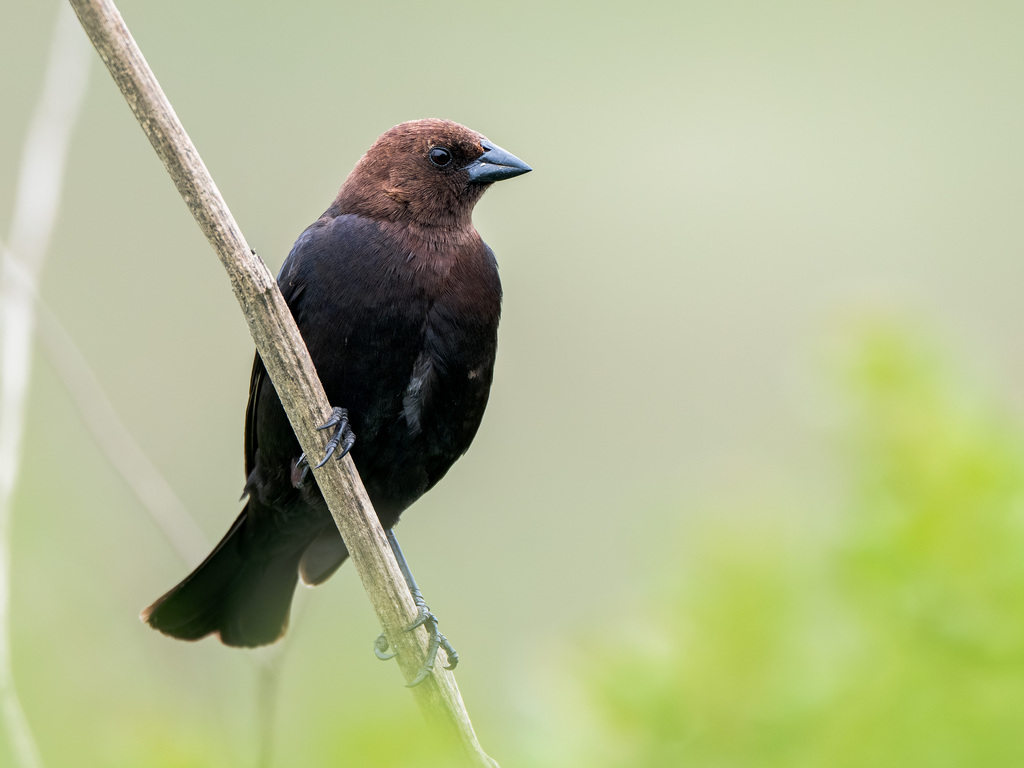
The brown-headed cowbird (Molothrus ater) is a small, obligate brood parasitic icterid native to temperate and subtropical North America. It is a permanent resident in the southern parts of its range; northern birds migrate to the southern United States and Mexico in winter, returning to their summer habitat around March or April.
From the article Brown-headed cowbird on Wikipedia (CC BY-SA), quoted section by section
Description
The brown-headed cowbird is typical for an icterid in general shape, but is distinguished by its finch-like head and beak and smaller size. The adult male is iridescent black in color with a brown head. The adult female is slightly smaller and is dull grey with a pale throat and very fine streaking on the underparts. Their total length is 16–22 cm (6.3–8.7 in) and the average wingspan is 36 cm (14 in). Body mass can range from 30–60 g (1.1–2.1 oz), with females averaging 38.8 g (1.37 oz) against the males' average of 49 g (1.7 oz).
Range & habitat
The species lives in open or semiopen country, and often travels in flocks, sometimes mixed with red-winged blackbirds (particularly in spring) and bobolinks (particularly in fall), as well as common grackles or European starlings. These birds forage on the ground, often following grazing animals such as horses and cattle to catch insects stirred up by the larger animals. They mainly eat seeds, insects and rarely, berries. Before European settlement, brown-headed cowbirds followed bison herds across the prairies. Their population expanded with the clearing of forested areas and the introduction of new grazing animals by settlers across North America. They are now commonly seen at suburban birdfeeders. In 2012, brown-headed cowbirds in northwest Riverside County, CA tested positive for West Nile Virus.
Wikipedia: “Distribution and habitat”
What it does
Social behaviors of cowbird males include aggressive, competitive singing bouts with other males and pair bonding and monogamy with females. In lab experiments, brown-headed cowbirds which are exposed to more complex social environments have greater reproductive success
Wikipedia: “Male behavior and reproductive success”
Listen
Looking for field recordings…
Where it lives
Recorded sightings
—
geo-referenced records in GBIF, from museums, herbaria and field observers.
Drag the globe to turn it. Dots are where records exist, not a range map; darker means more records.
In the old herbals & bestiaries

In the stacks
Searching the stacks…
Every page naming Molothrus ater in the Biodiversity Heritage Library →
This page is assembled live from iNaturalist, GBIF, Wikipedia, the Source Library and the Internet Archive. It is not yet part of the hand-edited codex. iNaturalist taxon 10373.