On eBird ↗
Common Iora
Live sightings near you, the range map, bar charts of when it is seen, and Macaulay Library photos and recordings.
Common Iora
Aegithina tiphia
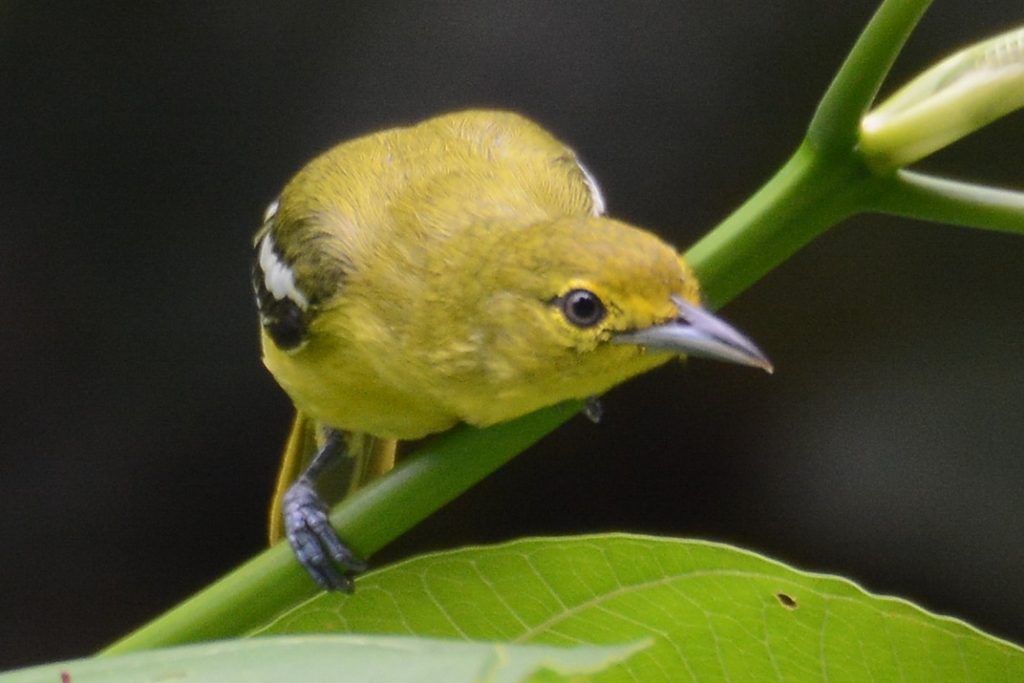
The common iora (Aegithina tiphia) is a small passerine bird found across the tropical Indian subcontinent and Southeast Asia, with populations showing plumage variations, some of which are designated as subspecies. A species found in scrub and forest, it is easily detected from its loud whistles and the bright colours. During the breeding season, males display by fluffing up their feathers and spiral in the air appearing like a green, black, yellow, and white ball.
From the article Common iora on Wikipedia (CC BY-SA), quoted section by section
Description
Ioras have a pointed and notched beak with a culmen that is straight. The common iora is sexually dimorphic, males in the breeding season have a black cap and back adding to a black wing and tail at all seasons. Females have greenish wings and an olive tail. The undersides of both are yellow and the two white bars on the wings of the male are particularly prominent in their breeding plumage. The males in breeding plumage have a very variable distribution of the black on the upperparts and can be confused with Marshall's iora, however, the latter always has white tips to the tail. The nominate subspecies is found along the Himalayas and males of this population are very similar to females or have only a small amount of black on the crown. In northwestern India, septentrionalis is brighter yellow than others and in the northern plains of India humei males in breeding plumage have a black cap and olive on the upper mantle. In southwestern India and Sri Lanka multicolor has the breeding males with a jet black cap and mantle. …
What it does
Ioras forage in trees in small groups, gleaning among the branches for insects. They sometimes join mixed species feeding flocks. The call is a mixture of churrs, chattering and whistles, and the song is a trilled wheeeee-tee. They may sometimes imitate the calls of other birds such as drongos.
During the breeding season, mainly after the monsoons, the male performs an acrobatic courtship display, darting up into the air fluffing up all his feathers, especially those on the pale green rump, then spiralling down to the original perch. Once he lands, he spreads his tail and droops his wings. Two to four greenish white eggs are laid in a small and compact cup-shaped nest made out of grass and bound with cobwebs and placed in the fork of a tree. Both male and female incubate and eggs hatch after about 14 days. Nests predators include snakes, lizards, crow-pheasant and crows. Nests may also be brood-parasitized by the banded bay cuckoo. Ioras moult twice in a year and the plumage variation makes them somewhat complicated for plumage based separation of the populations. A species of Haemoproteus, H. aethiginae, was described from a specimen of the common iora from Goa.
Wikipedia: “Behaviour and ecology”
Listen
Looking for field recordings…
Where it lives
Recorded sightings
—
geo-referenced records in GBIF, from museums, herbaria and field observers.
Drag the globe to turn it. Dots are where records exist, not a range map; darker means more records.
In the stacks
Searching the stacks…
Every page naming Aegithina tiphia in the Biodiversity Heritage Library →
This page is assembled live from iNaturalist, GBIF, Wikipedia, the Source Library and the Internet Archive. It is not yet part of the hand-edited codex. iNaturalist taxon 7938.