On eBird ↗
Dark-faced Ground-Tyrant
Live sightings near you, the range map, bar charts of when it is seen, and Macaulay Library photos and recordings.
Dark-faced Ground-Tyrant
Muscisaxicola maclovianus
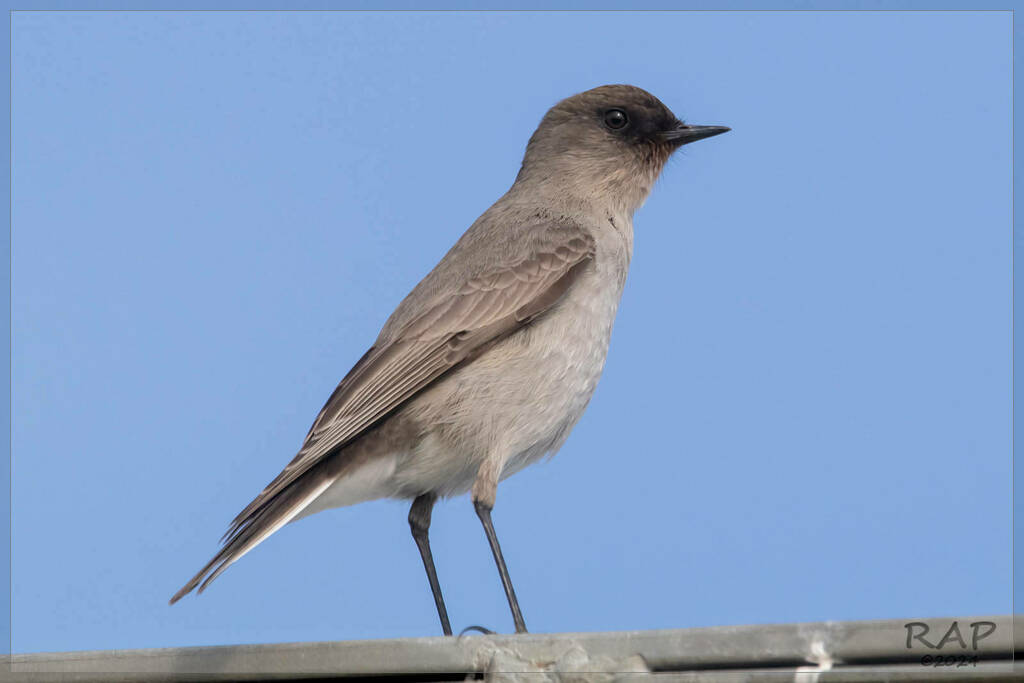
The dark-faced ground tyrant (Muscisaxicola maclovianus) is a small passerine bird belonging to the tyrant flycatcher family. It is a ground-dwelling bird that breeds in the southern Andes region and the Falkland Islands. It feeds on small invertebrates such as flies and moths.
From the article Dark-faced ground tyrant on Wikipedia (CC BY-SA), quoted section by section
Description
The dark-faced ground tyrant is 15 to 16.5 cm (5.9 to 6.5 in) long. The two subspecies and both sexes have the same plumage, though subspecies M. m. mentalis is significantly smaller than the nominate. Adults have a blackish forehead, lores, and cheeks and a dull chestnut-brown crown. Their upperparts are mostly dark brown to smoky brown with a black lower rump. Their wings are a duskier brown than the upperparts. Their tail is black with whitish edges on the outer webs of the outermost feathers. Their throat and breast are gray and their belly and crissum white. They have a dark iris, a short black bill, and black legs and feet. Juveniles have a streaky throat and buffy edges on the wing coverts.
Range & habitat
The nominate subspecies of the dark-faced ground tyrant is found only on the Falkland Islands. Subspecies M. m. mentalis is found from southern Ancash Department in west-central Peru south through the length of Chile. Its range extends across Argentina roughly from San Juan Province (or perhaps further north) east to Entre Ríos Province and across southern Uruguay, and from that line south to Cape Horn. The species has reached southern Brazil and also South Georgia Island as a vagrant. In addition, unconfirmed sight records in Ecuador lead the South American Classification Committee of the American Ornithological Society to call it hypothetical there. During the breeding season the dark-faced ground tyrant inhabits open grasslands that have forest nearby or are near rivers and also marshy areas in valleys. In the non-breeding season it inhabits grasslands and pastures but also irrigated fields, sandy desert, and beaches; at the last it sometimes is seen on dried or floating seaweed. One source places its usual upper elevation limit at 1,200 m (3,900 ft) with rare excursions to 2,500 m (8,200 ft). Another says its upper limit is 1,500 m (4,900 ft). A third says it reaches 4,000 m (13,000 ft) in Peru but only rarely.
Wikipedia: “Distribution and habitat”
What it does
The dark-faced ground tyrant feeds on insects. It is almost wholly terrestrial; it will perch on trees or utility poles and sometimes hovers. It runs and hops along the ground, stopping to stand erect before grabbing prey, or drops on it from a perch or a hover. In the breeding season it mostly forages by itself but is often in flocks of up to 100 outside that season.
Wikipedia: “Feeding”
Listen
Looking for field recordings…
Where it lives
Recorded sightings
—
geo-referenced records in GBIF, from museums, herbaria and field observers.
Drag the globe to turn it. Dots are where records exist, not a range map; darker means more records.
In the stacks
Searching the stacks…
Every page naming Muscisaxicola maclovianus in the Biodiversity Heritage Library →
This page is assembled live from iNaturalist, GBIF, Wikipedia, the Source Library and the Internet Archive. It is not yet part of the hand-edited codex. iNaturalist taxon 16156.