On eBird ↗
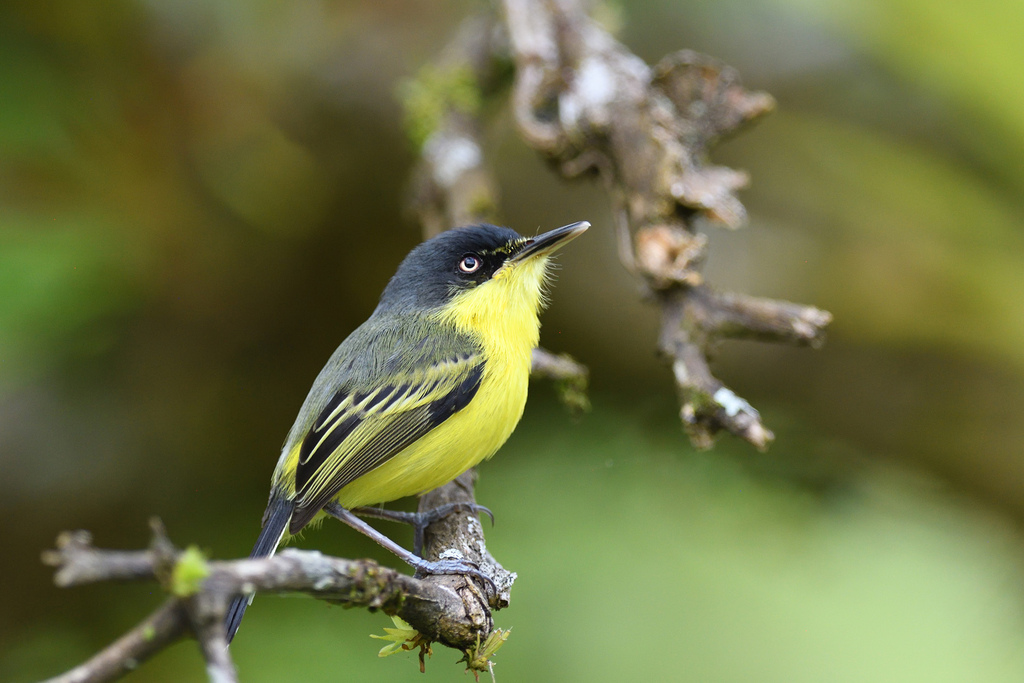
Common Tody-Flycatcher
Live sightings near you, the range map, bar charts of when it is seen, and Macaulay Library photos and recordings.
Common Tody-Flycatcher
Todirostrum cinereum
The common tody-flycatcher (Todirostrum cinereum) is a small passerine bird in the family Tyrannidae, the tyrant flycatchers. It is found in Mexico, in every Central American country, and in every mainland South American country except Chile and Uruguay.
From the article Common tody-flycatcher on Wikipedia (CC BY-SA), quoted section by section
Description
The common tody-flycatcher is a tiny, big-headed bird, 8.8 to 10.2 cm (3.5 to 4.0 in) long, weighing 4 to 8 g (0.14 to 0.28 oz), and with a long, flattened, straight bill. Adult males of the nominate subspecies T. c. cinereum have a glossy black forecrown and a slate-gray hindcrown and nape. Their lores and the area around their eyes are glossy black. Their upper back is slate-gray that becomes dark olive all the way to the uppertail coverts. Their wings are black with yellow edges on the flight feathers and yellow edges and tips on the coverts; the last show as two wing bars. Their tail is black with white tips on the outer feathers. Their entire underparts are bright yellow. They have an all-black maxilla and a black mandible with a pinkish white base. Adult females have a grayer head than males and an entirely pinkish white mandible. Both sexes have a yellowish to white iris and bluish gray legs and feet. Juveniles have dark gray crown and cheeks, a buffy tinge to the wings' yellow parts, a dark iris, and paler yellow underparts than adults. The other subspecies of the common tody-flycatcher differ from the nominate and each other thus:
T. c. virididorsale: brighter green upperparts than nominate T. c. finitimum: grayish (somewhat slaty) green upperparts T. c. wetmorei: brighter green upperparts than nominate T. c. sclateri: white throat and sometimes a dark iris T. c. …
Range & habitat
The common tody-flycatcher is found from Mexico to northern Argentina and southern Brazil, though its range does not include most of the Amazon Basin. The subspecies are found thus:
T. c. virididorsale: central Veracruz and adjacent northern Oaxaca in southern Mexico T. c. finitimum: from southern Veracruz, Chiapas, Tabasco, and the Yucatán Peninsula in southern Mexico south on both the Caribbean and Pacific slopes to northwestern Costa Rica T. c. wetmorei: central and eastern Costa Rica and Panama; Coiba Island off Panama's Pacific coast T. c. sclateri: from Cauca and Nariño departments in southwestern Colombia south through western Ecuador to Lambayeque Department in far northwestern Peru T. c. cinereum: Colombia's three Andean ranges (except in the southwest) and from Meta Department north and east across northern Venezuela except its far northwest, the Guianas, and northeastern Brazil from eastern Roraima to the Atlantic in Amapá T. c. peruanum: eastern Ecuador and south in eastern Peru to Cuzco Department T. c. coloreum: northern Bolivia, northern Paraguay, far northeastern Argentina's Misiones Province, and southeastern Brazil roughly bounded by southern Mato Grosso, Espírito Santo, and Santa Catarina states T. c. …
Wikipedia: “Distribution and habitat”
What it does
The common tody-flycatcher feeds on a wide variety of arthropods and also includes fruit in its diet. It typically forages in pairs or in small family groups, though sometimes singly, and rarely joins mixed-species feeding flocks. It mostly forages in dense vegetation near the ground but sometimes ascends as high as the canopy where the forest is most open. It primarily takes prey from foliage by gleaning while perched and with short upward and outward sallies from a perch. It occasionally captures prey in mid-air. It forages very actively, hopping sideways along branches with its tail cocked and wagging. A study in Brazil showed that there it took almost all of its prey from live leaves by using strikes from a sally and hover-gleaning about equally.
Wikipedia: “Feeding”
Listen
Looking for field recordings…
Where it lives
Recorded sightings
—
geo-referenced records in GBIF, from museums, herbaria and field observers.
Drag the globe to turn it. Dots are where records exist, not a range map; darker means more records.
In the stacks
Searching the stacks…
Every page naming Todirostrum cinereum in the Biodiversity Heritage Library →
This page is assembled live from iNaturalist, GBIF, Wikipedia, the Source Library and the Internet Archive. It is not yet part of the hand-edited codex. iNaturalist taxon 17148.