 NL·0378
Herbarium of the Nature Library
- Name
- Corvus splendens
- Family
- Corvidae
- Native to
- Pakistan, India, Nepal, Bangladesh, Sri Lanka, the Maldives and Myanmar; introduced to East Africa, the Arabian Peninsula, Singapore and elsewhere
- Habitat
- Urban, Farmland, Coastal
On eBird ↗
House Crow
Live sightings near you, the range map, bar charts of when it is seen, and Macaulay Library photos and recordings.
House crow
Corvus splendens
Also calledKauwa (Hindi/Urdu) · Kāṅ (Punjabi) · Pati kak (Bengali) · Kākkai (Tamil) · Kāg (Nepali) · Jiā yā 家鸦 (Chinese)
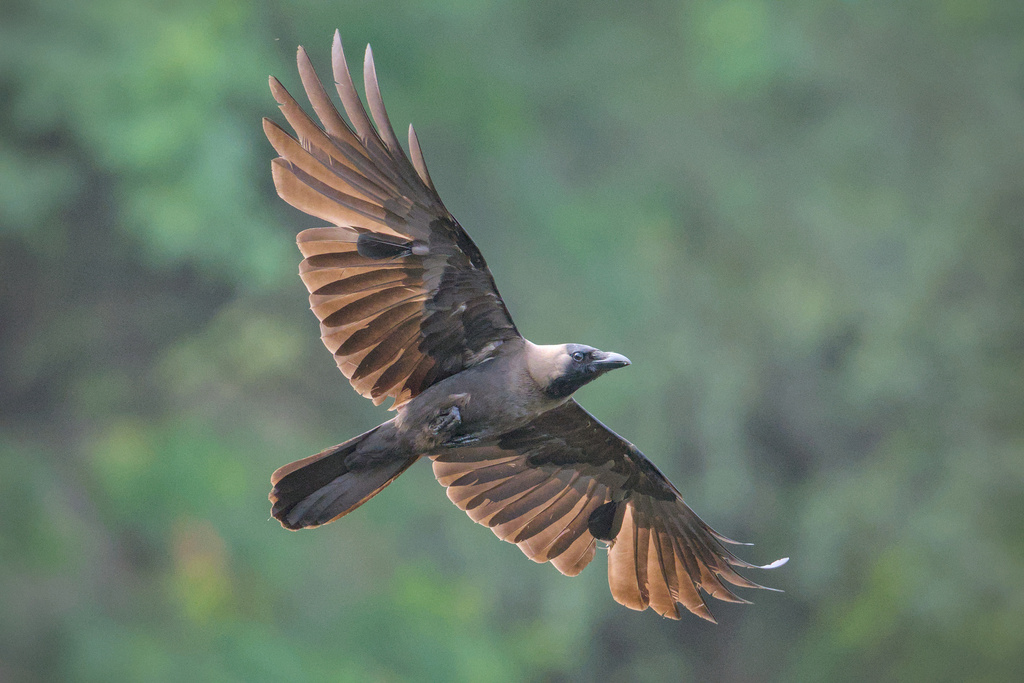
The grey-necked crow of South Asian cities, living almost entirely alongside people and scavenging from markets, rubbish heaps and rooftops. Bold, intelligent and ship-borne, it has spread to ports from East Africa to the Netherlands.
The house crow, also known as the Indian, greynecked, Ceylon or Colombo crow, is a common bird of the crow family that is of Asian origin but now found in many parts of the world, where they arrived assisted by shipping. It is between the jackdaw and the carrion crow in size but is slimmer than either. The forehead, crown, throat and upper breast are a richly glossed black, whilst the neck and breast are a lighter grey-brown in colour. The wings, tail and legs are black. There are regional variations in the thickness of the bill and the depth of colour in areas of the plumage. Wikipedia
What it can do
- iExploits human settlements so completely that it is rarely found away from people
- iiSpreads by stowing away on ships, founding colonies in distant ports
- iiiMobs predators in noisy groups and is host to the parasitic Asian koel
- ivGathers in communal roosts numbering thousands
In the field
Field marks
- aMedium-sized crow with glossy black face, crown, throat, wings and tail
- bContrasting grey nape, neck and breast forming a collar
- cRelatively slim black bill and domed forehead
- Voice
- A flat, dry 'kaaw-kaaw', higher-pitched than the Large-billed crow
- Not to be confused with
- Large-billed (Jungle) crow is all glossy black with a much heavier arched bill and deeper call.
- Where to see it
- Every city of the subcontinent, from Karachi and Mumbai harbours to Colombo
- When
- Resident year-round
Listen
Looking for field recordings…
Life & habits
- Diet
- Omnivorous scavenger: food waste, carrion, insects, eggs and nestlings, fruit and grain
- Habitat
- Cities, towns, villages and harbours
- Size
- About 40 cm long
Highly social and quick to learn; groups gather around a dead crow and call loudly, and they steal food from people and other birds with practised timing.
Where it lives
Recorded sightings
—
geo-referenced records in GBIF, from museums, herbaria and field observers.
Native range
Pakistan, India, Nepal, Bangladesh, Sri Lanka, the Maldives and Myanmar; introduced to East Africa, the Arabian Peninsula, Singapore and elsewhere
Drag the globe to turn it. Dots are where records exist, not a range map; darker means more records.
In the old herbals & bestiaries
No plate in the Source Library names this exact species, so these show its closest relatives as the old naturalists drew them: same genus, or the same kind of animal. Click a plate to read the page it came from, with translation.

History of Animals, Book I: On Viviparous Quadrupeds
Relative · Conrad Gessner · 1554 · p.523

Ornithology
Relative · Ulisse Aldrovandi · 1599 · p.729

De Indiae utriusque re naturali et medica
Relative · Willem Piso · 1658 · p.464

History of Animals, Book I: On Viviparous Quadrupeds
Relative · Conrad Gessner · 1554 · p.506

Ornithology: The History of Birds
Relative · Ulisse Aldrovandi · 1599 · p.726

De Piscibus Libri V et De Cetis Liber Unus
Relative · Ulisse Aldrovandi · 1661 · p.669

Noah's Ark
Relative · Athanasius Kircher · 1675 · p.131

The Secrets of Albertus Magnus on the Nature of Women and the Virtues of Herbs
Relative · Albertus, Magnus, Heiliger · 1604 · p.70

Ulyssis Aldrovandi ... Ornithologiae
Relative · Aldrovandi, Ulisse · 1610 · p.358
In the stacks
Searching the stacks…
Every page naming Corvus splendens in the Biodiversity Heritage Library →
Marginalia
In Hindu ritual crows are fed rice balls (pinda) during shraddha and Pitru Paksha as messengers of the ancestors, and a crow cawing on the roof was said in Urdu and Hindi folklore to announce an arriving guest.
Curiosity
House crows reached Hoek van Holland in the Netherlands by ship and bred there, thousands of kilometres from the nearest native population.
Kinship
Fact-checked: 1 correction made to this sheet. Photographs: iNaturalist contributors under the licences shown. Records: GBIF.org. Historical plates: Source Library (CC BY-SA 4.0; originals public domain). Summary text: Nature Library editors and Wikipedia (CC BY-SA). Medicinal and edibility notes are historical and educational, not advice. iNaturalist taxon 8031.