On eBird ↗
Oriental Darter
Live sightings near you, the range map, bar charts of when it is seen, and Macaulay Library photos and recordings.
Oriental Darter
Anhinga melanogaster
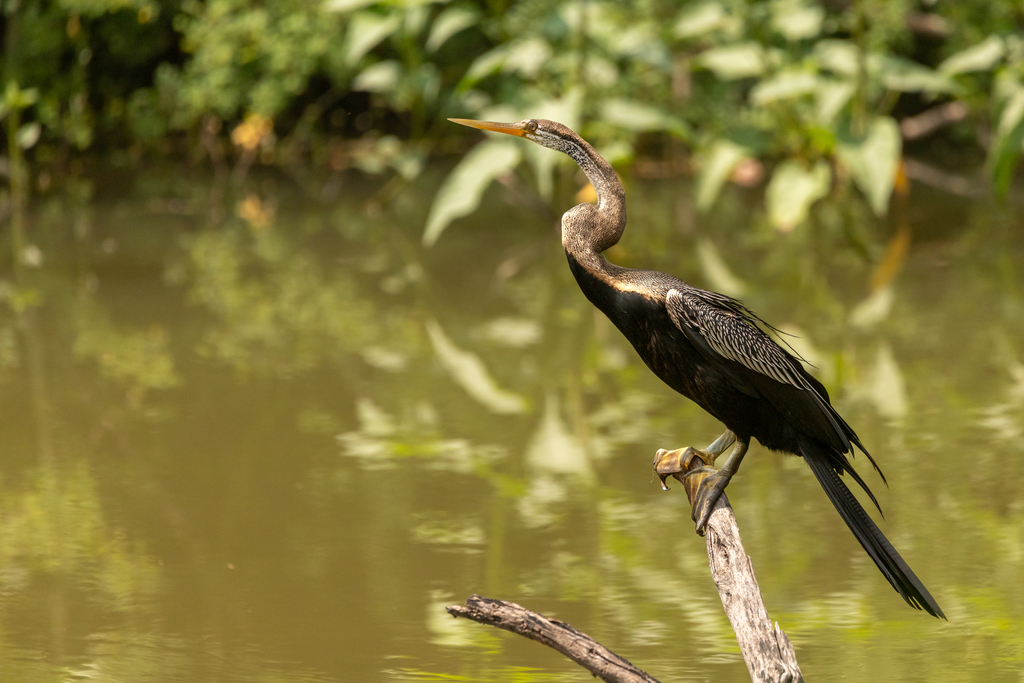
The Oriental darter (Anhinga melanogaster) is a water bird of tropical South Asia and Southeast Asia. It has a long and slender neck with a straight, pointed bill and, like the cormorant, it hunts for fish while its body is submerged in water. It spears a fish underwater, bringing it above the surface, tossing and juggling it before swallowing the fish head first. The body remains submerged as it swims, and the slender neck alone is visible above the water, which accounts for the colloquial name of snakebird. Like the cormorants, it has wettable feathers and it is often found perched on a rock or branch with its wings held open to dry.
From the article Oriental darter on Wikipedia (CC BY-SA), quoted section by section
Description
The Oriental darter is like all other anhingas, a cormorant-like species that has a very long neck. The structure of the neck is as in other species of darter with strongly developed muscles about a kink in the neck at the 8th and 9th vertebrae that allows it to be flexed and darted forward with rapid force to stab fish underwater. The edges of the commissures of the mandible tips have minute inward pointing serrations that hold impaled fish. The adult plumage is black. The crown and neck are ideally bole (though often whitish or even amber) shading darker towards the back of the neck. The wing coverts and tertials have a silvery streaka along the shaft. A pale line over the eye and throat and a line running along the sides of the neck gives it a striped appearance. The iris is white with a yellow ring (brighter yellow in breeding birds) around it. The tip of the upper mandible is dark while the base is pale brown bill while the lower mandible is yellowish. The legs and webbing on the foot are yellow in immatures and non-breeding birds while breeding birds have darker grey tarsi and toes with yellow webbing. The sexes are not easily distinguishable but males tend to have black speckles that coalesce on the white throat. …
What it does
The Oriental darter is found mainly in freshwater lakes and streams. They usually forage singly, with the entire body submerged, swimming slowly forward using their webbed feet while the head and neck is moved jerkily above the water. It darts its neck to impale fish and then brings them out of water, tossing them into the air before swallowing the fish head first. They may sometimes be found along with cormorants which share the habit of spreading out their wings to dry when perched on a waterside rock or tree. They sometimes soar on thermals during the warm part of the day but will alternate flapping and gliding in normal flight. They nest in mixed species heronries where they build a stick platform on the nest tree which is usually surrounded by water. Several pairs may nest close to each other. The branch is flattened by the birds prior to the placement of the sticks that form the nest platform. The nest sites are defended from other birds with posturing and thrusts of the neck. The breeding season is June to August (during the rainy season) in northern India, April–May in southwestern India and in winter in southeastern India (during the northeast monsoon). The usual clutch consists of three to six spindle shaped bluish-green eggs with a white chalky covering that gets soiled over time. …
Wikipedia: “Behaviour and ecology”
Listen
Looking for field recordings…
Where it lives
Recorded sightings
—
geo-referenced records in GBIF, from museums, herbaria and field observers.
Drag the globe to turn it. Dots are where records exist, not a range map; darker means more records.
In the stacks
Searching the stacks…
Every page naming Anhinga melanogaster in the Biodiversity Heritage Library →
This page is assembled live from iNaturalist, GBIF, Wikipedia, the Source Library and the Internet Archive. It is not yet part of the hand-edited codex. iNaturalist taxon 5062.