On eBird ↗
Black Stork
Live sightings near you, the range map, bar charts of when it is seen, and Macaulay Library photos and recordings.
Black Stork
Ciconia nigra
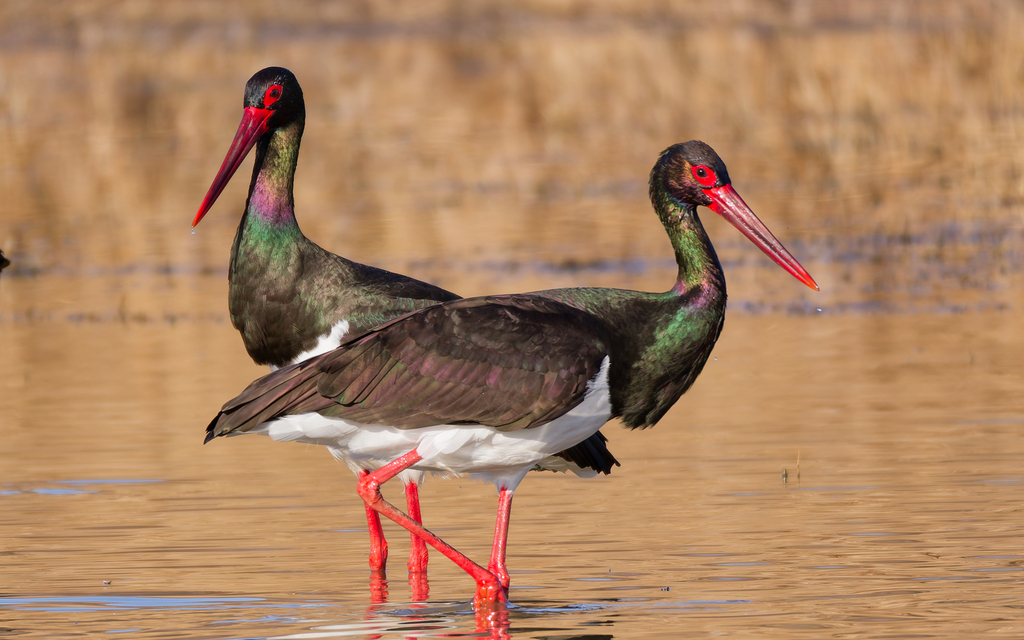
The black stork (Ciconia nigra) is a large bird in the stork family Ciconiidae. It was first described by Carl Linnaeus in the 10th edition of his Systema Naturae. Measuring on average 95 to 100 cm (37 to 39 in) from beak tip to end of tail with a 145-to-155 cm (57-to-61 in) wingspan, the adult black stork has mainly black plumage, with white underparts, long red legs and a long pointed red beak. A widespread but uncommon species, it breeds in scattered locations across Europe (predominantly in Portugal and Spain, and central and eastern parts), and east across the Palearctic to the Pacific Ocean. It is a long-distance migrant, with European populations wintering in tropical Sub-Saharan Africa, and Asian populations in the Indian subcontinent. When migrating between Europe and Africa, it avoids crossing broad expanses of the Mediterranean Sea and detours via the Levant in the east, the Strait of Sicily in the center, or the Strait of Gibraltar in the west. An isolated non-migratory population lives in Southern Africa.
Unlike the closely related white stork, the black stork is a shy and wary species. It is seen singly or in pairs, usually in marshy areas, rivers or inland waters. It feeds on amphibians, small fish and insects, generally wading slowly in shallow water stalking its prey. Breeding pairs usually build nests in large forest trees—most commonly deciduous but also coniferous—which can be seen from long distances, as well as on large boulders, or under overhanging ledges in mountainous areas.
From the article Black stork on Wikipedia (CC BY-SA), quoted section by section
Description
The black stork is a large bird, measuring between 95 and 100 cm (37 and 39 in) in length with a 145-to-155 cm (57-to-61 in) wingspan, and weighing around 3 kg (6.6 lb). Standing as tall as 102 cm (40 in), it has long red legs, a long neck and a long, straight, pointed red beak. It bears some resemblance to Abdim's stork (C. abdimii), which can be distinguished by its much smaller build, predominantly green bill, legs and feet, and white rump and lower back. The plumage is black with a purplish green sheen, except for the white lower breast, belly, armpits, axillaries and undertail coverts. The breast feathers are long and shaggy, forming a ruff which is used in some courtship displays. The black stork has brown irises, and bare red skin around its eyes. The sexes are identical in appearance, except that males are larger than females on average. Moulting takes place in spring, with the iridescent sheen brighter in new plumage. It walks slowly and steadily on the ground and like all storks, it flies with its neck outstretched. The juvenile resembles the adult in plumage, but the areas corresponding to the adult black feathers are browner and less glossy. The scapulars, wing and upper tail coverts have pale tips. The legs, bill and bare skin around the eyes are greyish green. …
Range & habitat
During the summer, the black stork is found from Eastern Asia (Siberia and northern China) west to Central Europe, reaching Estonia in the north, Poland, Lower Saxony and Bavaria in Germany, the Czech Republic, Hungary, Italy and Greece in the south, with an outlying population in the central-southwest region of the Iberian Peninsula (Extremadura and surrounding provinces of Spain, plus Portugal). It is migratory, wintering in tropical Africa and Asia, although certain populations of black storks are sedentary or dispersive. An isolated population exists in Southern Africa, where the species is more numerous in the east, in eastern South Africa and Mozambique, and is also found in Zimbabwe, Eswatini, Botswana and less commonly Namibia. Most of the black storks that summer in Europe migrate to Africa, with those from western Germany and points west heading south via the Iberian Peninsula and the rest via Turkey and the Levant. Those flying via Spain spend winter in the Falémé River basin of eastern Senegal, Guinea, southern Mauritania, Ivory Coast, Sierra Leone and western and central Mali, while those flying via the Sinai end up in northern Ethiopia, the Kotto River basin in the Central African Republic, the Mbokou river basin in Chad and northeastern Nigeria. …
Wikipedia: “Distribution and habitat”
What it does
A wary species, the black stork avoids contact with people. It is generally found alone or in pairs, or in flocks of up to 100 birds when migrating or during winter. The black stork has a wider range of calls than the white stork, its main call being a chee leee, which sounds like a loud inhalation. It makes a hissing call as a warning or threat. Displaying males produce a long series of wheezy raptor-like squealing calls rising in volume and then falling. It rarely indulges in mutual bill-clattering when adults meet at the nest. Adults will do so as part of their mating ritual or when angered. The young clatter their bills when aroused. The up-down display is used for a number of interactions with other members of the species. Here a stork positions its body horizontally and quickly bobs its head up from down-facing to around 30 degrees above horizontal and back again, while displaying the white segments of its plumage prominently, and this is repeated several times. The display is used as a greeting between birds, and—more vigorously—as a threat display. The species' solitary nature means that this threat display is rarely witnessed.
Breeding. The black stork breeds between April and May in the Northern Hemisphere, with eggs usually laid in late April. …
Wikipedia: “Behaviour”
In human culture
English naturalist Francis Willughby wrote about the black stork in the 17th century, having seen one in Frankfurt. He named it Ciconia nigra, from the Latin words for "stork" and "black" respectively. It was one of the many species originally described by Swedish zoologist Carl Linnaeus in the landmark 1758 10th edition of his Systema Naturae, where it was given the binomial name of Ardea nigra. It was moved to the new genus Ciconia by French zoologist Mathurin Jacques Brisson two years later. The word stork is derived from the Old English word storc, thought to be related to the Old High German storah, meaning "stork", and the Old English stearc, meaning "stiff".
The black stork is a member of the genus Ciconia, or typical storks, a group of seven extant species, characterised by straight bills and mainly black and white plumage. The black stork was long thought to be most closely related to the white stork (C. ciconia). However, genetic analysis via DNA–DNA hybridization and mitochondrial cytochrome b DNA by Beth Slikas in 1997 found that it was basal (an early offshoot) in the genus Ciconia. Fossil remains have been recovered from Miocene beds on Rusinga and Maboko Islands in Kenya, which are indistinguishable from the white and black storks.
Wikipedia: “Taxonomy and etymology”
Listen
Looking for field recordings…
Where it lives
Recorded sightings
—
geo-referenced records in GBIF, from museums, herbaria and field observers.
Drag the globe to turn it. Dots are where records exist, not a range map; darker means more records.
In the old herbals & bestiaries

In the stacks
Searching the stacks…
Every page naming Ciconia nigra in the Biodiversity Heritage Library →
This page is assembled live from iNaturalist, GBIF, Wikipedia, the Source Library and the Internet Archive. It is not yet part of the hand-edited codex. iNaturalist taxon 4736.