On eBird ↗
Ruddy Turnstone
Live sightings near you, the range map, bar charts of when it is seen, and Macaulay Library photos and recordings.
Ruddy Turnstone
Arenaria interpres
The ruddy turnstone (Arenaria interpres) is a small cosmopolitan wading bird, one of two species of turnstone in the genus Arenaria.
It is now classified in the sandpiper family Scolopacidae but was formerly sometimes placed in the plover family Charadriidae. It is a highly migratory bird, breeding in northern parts of Eurasia and North America, and flying south to winter on coastlines almost worldwide. It is the only species of turnstone in much of its range and is often known simply as turnstone.
From the article Ruddy turnstone on Wikipedia (CC BY-SA), quoted section by section
Description
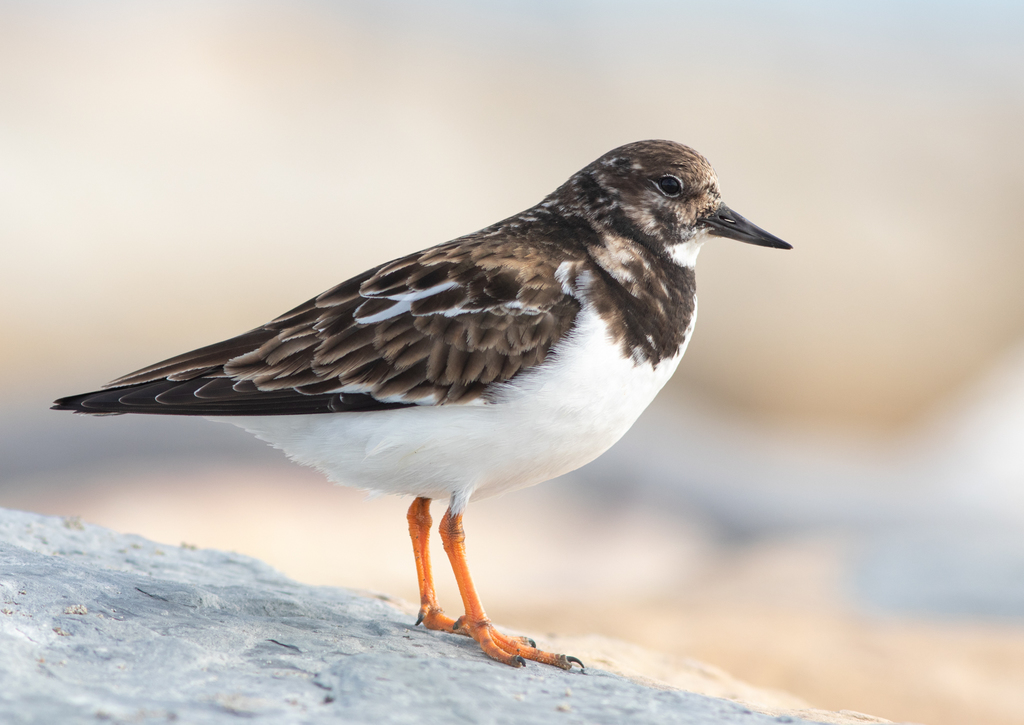
It is a fairly small and stocky bird, 22–24 cm (8.7–9.4 in) long with a wingspan of 50–57 cm (20–22 in) and a weight of 85–150 g (3.0–5.3 oz). The dark, wedge-shaped bill is 2–2.5 cm (0.79–0.98 in) long and slightly upturned. The legs are fairly short at 3.5 cm (1.4 in) and are bright orange. In all seasons, the plumage is dominated by a harlequin-like pattern of brown, black and white. Breeding birds have reddish-brown upper parts with black markings. The head is mainly white with black streaks on the crown and a black pattern on the face. The breast is mainly black apart from a white patch on the sides. The rest of the underparts are white. In flight it reveals a white wingbar, white patch near the base of the wing and white lower back, rump and tail with dark bands on the uppertail-coverts and near the tip of the tail. The female is slightly duller than the male and has a browner head with more streaking. Non-breeding adults are duller than breeding birds and have dark grey-brown upperparts with black mottling and a dark head with little white. Juvenile birds have a pale brown head and pale fringes to the upperpart feathers creating a scaly impression. Birds of the subspecies A. i. …
Range & habitat
The ruddy turnstone breeds in northern latitudes, usually no more than a few kilometres from the sea. The subspecies A. i. morinella occurs in northern Alaska and in Arctic Canada as far east as Baffin Island. A. i. interpres breeds in western Alaska, Ellesmere Island, Greenland, Norway, Denmark, Sweden, Finland, Estonia and northern Russia. It formerly bred on the Baltic coast of Germany and has possibly bred in Scotland and the Faroe Islands. In the Americas, the species winters on coastlines from Washington and Massachusetts southwards to the southern tip of South America although it is scarce in southern parts of Chile and Argentina and is only an unconfirmed vagrant in the Falkland Islands. In Europe, it winters in western regions from Iceland, Norway and Denmark southwards. Only small numbers are found on Mediterranean coasts. In Africa, it is common all the way down to South Africa with good numbers on many offshore islands. In Asia, it is widespread in the south with birds wintering as far north as southern China and Japan (mainly in the Ryukyu Islands). It occurs south to Tasmania and New Zealand and is present on many Pacific islands. Some non-breeding birds remain year round in many parts of the wintering range, with some of those birds still taking on breeding plumage in the spring and summer.
Wikipedia: “Distribution”
What it does
The ruddy turnstone has a varied diet including carrion, eggs, fish and plant material but it feeds mainly on invertebrates. Insects and their larvae are particularly important in the breeding season. At other times it also takes crustaceans, spiders, molluscs, and worms. It often flips over stones and other objects to get at prey items hiding underneath; this behaviour is the origin of the name "turnstone". It usually forages in flocks. They have also been observed preying on the eggs of other bird species such as gulls, terns, ducks, and even other turnstones, though this behaviour is uncommon. In the majority of observed cases, turnstones typically go after undefended or unattended nests, puncturing the shells with their beaks to get at the contents within. Ruddy turnstones engage in a variety of behaviours to locate and capture prey. …
Wikipedia: “Feeding and diet”
Listen
Looking for field recordings…
Where it lives
Recorded sightings
—
geo-referenced records in GBIF, from museums, herbaria and field observers.
Drag the globe to turn it. Dots are where records exist, not a range map; darker means more records.
In the stacks
Searching the stacks…
Every page naming Arenaria interpres in the Biodiversity Heritage Library →
This page is assembled live from iNaturalist, GBIF, Wikipedia, the Source Library and the Internet Archive. It is not yet part of the hand-edited codex. iNaturalist taxon 3938.