On eBird ↗
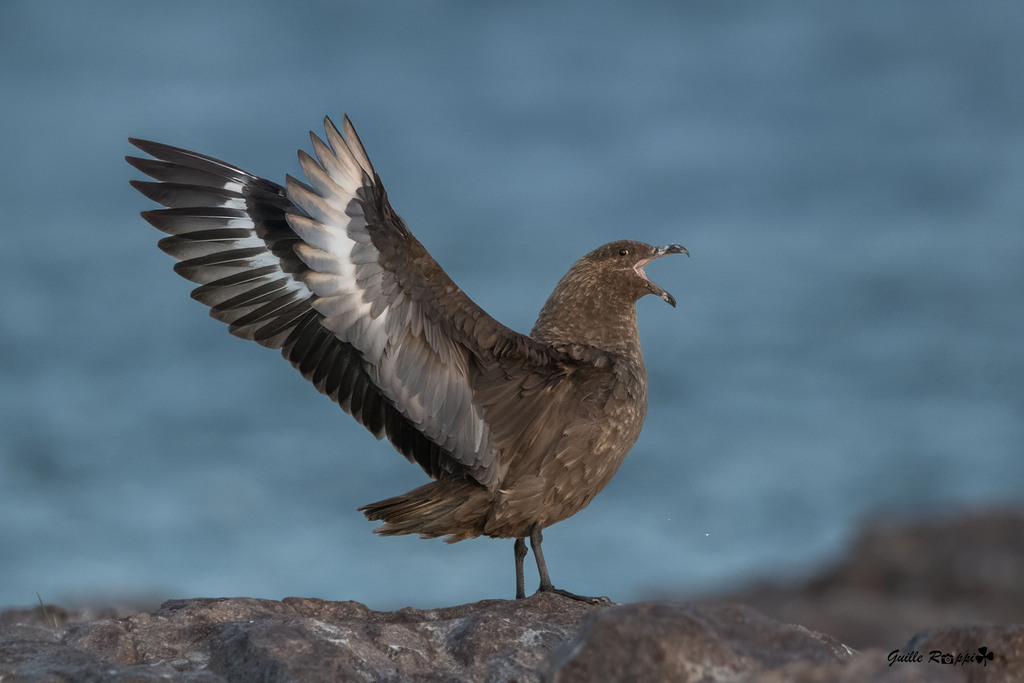
Brown Skua
Live sightings near you, the range map, bar charts of when it is seen, and Macaulay Library photos and recordings.
Brown Skua
Stercorarius antarcticus
The brown skua (Stercorarius antarcticus), also known as the Antarctic skua, Subantarctic skua, southern great skua, southern skua, or hākoakoa (Māori), is a large seabird that breeds in the subantarctic and Antarctic zones and moves farther north when not breeding. Its taxonomy is highly complex and a matter of dispute, with some splitting it into two or three species: Falkland skua (S. antarcticus), Tristan skua (S. hamiltoni), and subantarctic skua (S. lonnbergi). To further confuse, it hybridizes with both the south polar and Chilean skuas, and the entire group has been considered to be a subspecies of the great skua, a species otherwise restricted to the Northern Hemisphere.
From the article Brown skua on Wikipedia (CC BY-SA), quoted section by section
Description
This is the heaviest species of skua and rivals the largest gulls, the great black-backed gull and glaucous gull, as the heaviest species in the shorebird order although not as large in length or wingspan. It is 52–64 cm (20–25 in) in length, 126–160 cm (50–63 in) in wingspan and has a body mass of 1.2–2.18 kg (2.6–4.8 lb). S. a. hamiltoni measured on Gough Island, weighed an average of 1.43 kg (3.2 lb) in 9 males and 1.65 kg (3.6 lb) in 9 females. S. a. lonnbergi measured in the Chatham Islands weighed an average of 1.73 kg (3.8 lb) in 30 males and an average of 1.93 kg (4.3 lb) in 32 females. The latter is one of the highest colony mean body mass for any living species of shorebird. A study in 2016 reported that brown skuas can identify individual human beings, possibly indicating high cognitive abilities. Brown skuas have been noted for sometimes bonding with humans who live for extended periods in Antarctica, such as the Eastern Orthodox clergymen at Trinity Church, and engaging in playful or apparently mischievous behavior with them.
What it does
It feeds on fish (often via kleptoparasitism), penguin chicks and other seabirds, small mammals, eggs and carrion.
Wikipedia: “Diet”
Listen
Looking for field recordings…
Where it lives
Recorded sightings
—
geo-referenced records in GBIF, from museums, herbaria and field observers.
Drag the globe to turn it. Dots are where records exist, not a range map; darker means more records.
In the stacks
Searching the stacks…
Every page naming Stercorarius antarcticus in the Biodiversity Heritage Library →
This page is assembled live from iNaturalist, GBIF, Wikipedia, the Source Library and the Internet Archive. It is not yet part of the hand-edited codex. iNaturalist taxon 339921.