On eBird ↗
Blue Petrel
Live sightings near you, the range map, bar charts of when it is seen, and Macaulay Library photos and recordings.
Blue Petrel
Halobaena caerulea
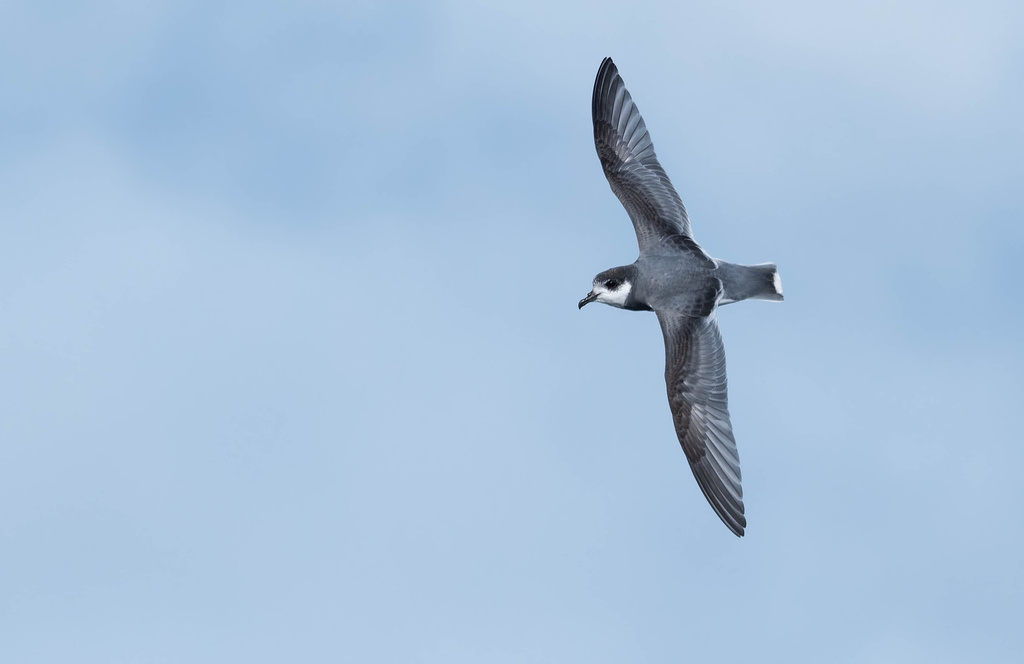
The blue petrel (Halobaena caerulea) is a small seabird in the shearwater and petrel family, Procellariidae. This small petrel is the only member of the genus Halobaena, but is closely allied to the prions. It is distributed across the Southern Ocean but breeds at only six known sites, all close to the Antarctic Convergence zone.
From the article Blue petrel on Wikipedia (CC BY-SA), quoted section by section
Description
The blue petrel's plumage is predominantly blue-grey, with a dark "M" extending across the upperwing from wingtip to wingtip. It has a prominent black cap and white cheeks. It is white below apart from dark patches at the side of the neck. The square tail has a white tip. It has a slender black bill. It is 26–32 cm (10–13 in) in length, has a wing span of 62–71 cm (24–28 in) and weighs approximate 200 g (7.1 oz).
Range & habitat
The blue petrel inhabits the southern oceans ranging as far north as South Africa, Australia and portions of South America. They mostly only breed in a narrow latitudinal band from 47° to 56° S on either side of the Antarctic Polar Front, nesting on subantarctic islands, such as the Diego Ramírez Islands, the Crozet Islands, Kerguelen Islands, Macquarie Island, South Georgia, and Prince Edward Island. In 2014, a breeding colony was discovered on Gough Island (40° S, 10° W), central South Atlantic Ocean, more than 700 km north of its known and usual breeding range. Breeding here appears to take place later than at colonies farther south, so although the discovery is recent it does not necessarily represent a recent range extension.
Wikipedia: “Distribution and habitat”
What it does
The blue petrel feeds predominantly on krill, as well as other crustaceans, small fish, squid and occasionally insects. It can dive to a depth of up to 6.2 m (20 ft).
Wikipedia: “Feeding”
Listen
Looking for field recordings…
Where it lives
Recorded sightings
—
geo-referenced records in GBIF, from museums, herbaria and field observers.
Drag the globe to turn it. Dots are where records exist, not a range map; darker means more records.
In the stacks
Searching the stacks…
Every page naming Halobaena caerulea in the Biodiversity Heritage Library →
This page is assembled live from iNaturalist, GBIF, Wikipedia, the Source Library and the Internet Archive. It is not yet part of the hand-edited codex. iNaturalist taxon 4200.