On eBird ↗
Laysan Albatross
Live sightings near you, the range map, bar charts of when it is seen, and Macaulay Library photos and recordings.
Laysan Albatross
Phoebastria immutabilis
The Laysan albatross (Phoebastria immutabilis) is a large seabird that ranges across the North Pacific. The Northwestern Hawaiian Islands are home to 99.7% of the population. This small (for its family) gull-like albatross is the second-most common seabird in the Hawaiian Islands, with an estimated population of 1.18 million birds, and is currently expanding (or possibly re-expanding) its range to new islands. The Laysan albatross was first described as Diomedea immutabilis by Lionel Walter Rothschild, in 1893, on the basis of a specimen from Laysan Island.
From the article Laysan albatross on Wikipedia (CC BY-SA), quoted section by section
Description
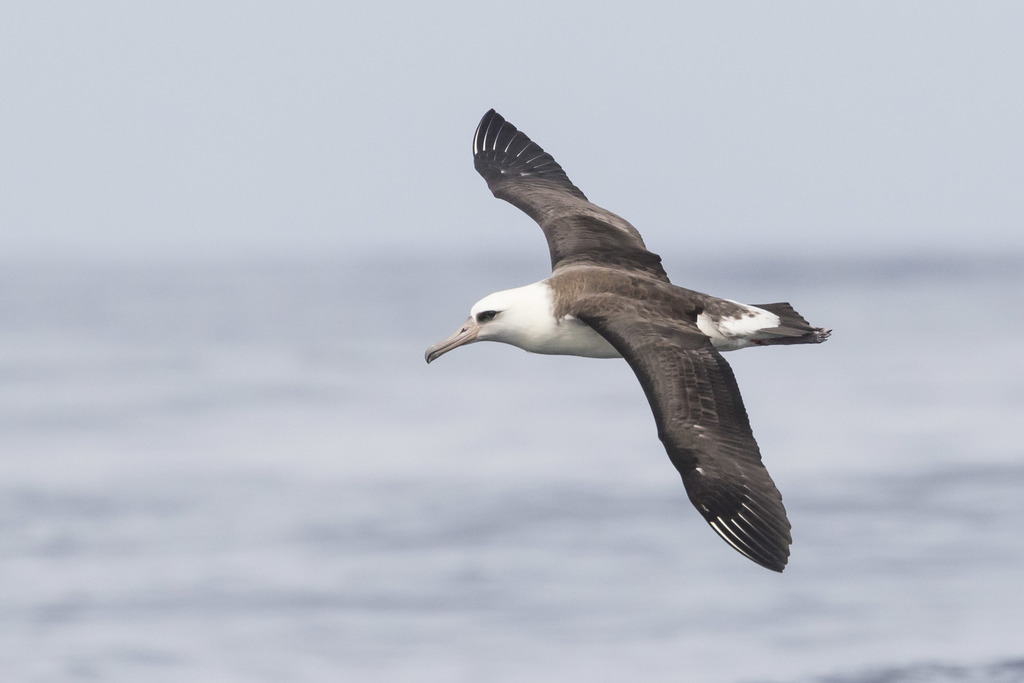
The Laysan albatross averages 81 cm (32 in) in length and has a wingspan of 195 to 203 cm (77–80 in). Males, which weigh 2.4 to 4.1 kg (5.3–9.0 lb), are larger than females, which weigh 1.9 to 3.6 kg (4.2–7.9 lb). This albatross has blackish-gray upperwing, mantle, back, upper rump, and tail, and its head, lower rump, and underparts are white. It has a black smudge around the eye, and its underwing pattern varies between individuals, with some having narrower black margins and variable amounts of black in the underwing coverts. Finally, the bill is pink with a dark tip. Juveniles have a gray bill and a dark upper rump. This species does not have a breeding plumage. The Laysan albatross is usually easy to identify. In the North Pacific, it is simple to separate from the other relatively common albatross, the all black black-footed albatross. It can be distinguished from the very rare short-tailed albatross by its all-dark back and smaller size. The Laysan albatross's plumage has been compared to that of a gull, two-toned with a dark gray mantle and wings and a white underside and head.
Range & habitat
The Laysan albatross has a wide range across the North Pacific, with 16 nesting sites. All but 0.3% of the breeding population is found among the Northwestern Hawaiian Islands, particularly the islands of Midway and Laysan. Small populations are found on the Bonin Islands near Japan and the bird has begun to colonize islands off Mexico, such as Guadalupe Island and others in the Revillagigedo Archipelago. The Laysan Albatross is protected in Guadalupe Island Biosphere Reserve. When away from the breeding areas, they range widely from Japan to the Bering Sea and south to 15°N.
Wikipedia: “Distribution and habitat”
What it does
The Laysan albatross is normally a silent bird, but on occasion may be observed emitting long "moo"-ing sounds, descending whinnies, or rattles. Female Laysan albatrosses may bond for life and cooperatively raise their young. A female Laysan albatross named Wisdom is the oldest known wild bird in the world. Wisdom was banded by a U.S. Geological Survey researcher in 1956, and in December 1956, she was seen rearing a new chick on Midway Atoll. Because Laysan albatrosses cannot breed until they are five years old, as of 2016, Wisdom was estimated to be at least 66 years old. Wisdom's latest chick hatched on February 1, 2021, and her current estimated age is 74. In December 2024, the U.S. Fish and Wildlife Service announced that Wisdom was observed at the Midway Atoll National Wildlife Refuge. Wisdom, first banded in 1956, laid an egg, marking her first in four years and estimated to be her 60th egg. Wisdom had been returning to the atoll with her long-term mate, Akeakamai, since 2006 for breeding. However, Akeakamai has yet to be observed in recent years, and Wisdom was seen interacting with another male during this visit.
Reproduction. Laysan albatrosses are colonial, nesting on scattered small islands and atolls, often in huge numbers, and building different styles of nests depending on the surroundings, ranging from simple scoops in the sand to nests using vegetation. …
Wikipedia: “Behavior”
In human culture
It is named for Laysan, one of its breeding colonies in the Northwestern Hawaiian Islands and the island where the type specimen was collected. The genus name, Phoebastria, comes from Greek phoibastria, meaning a prophetess. The species name, immutabilis, is Latin for "unchanging" and refers to the similarity of immature birds' plumage to that of adults.
Wikipedia: “Etymology”
Listen
Looking for field recordings…
Where it lives
Recorded sightings
—
geo-referenced records in GBIF, from museums, herbaria and field observers.
Drag the globe to turn it. Dots are where records exist, not a range map; darker means more records.
In the stacks
Searching the stacks…
Every page naming Phoebastria immutabilis in the Biodiversity Heritage Library →
This page is assembled live from iNaturalist, GBIF, Wikipedia, the Source Library and the Internet Archive. It is not yet part of the hand-edited codex. iNaturalist taxon 4144.