On eBird ↗
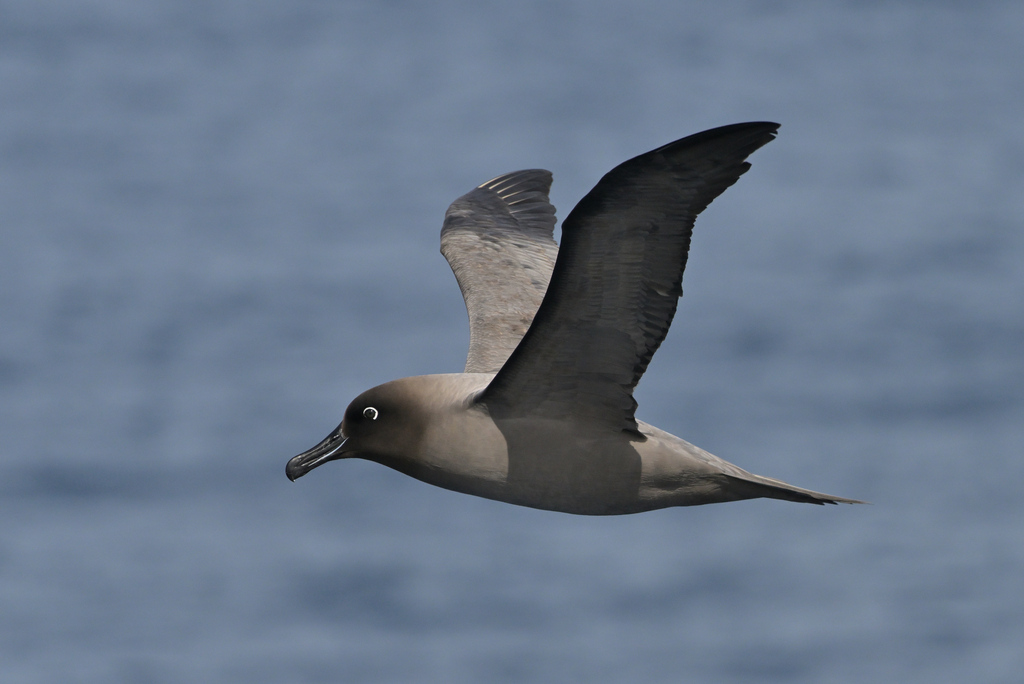
Light-mantled Albatross
Live sightings near you, the range map, bar charts of when it is seen, and Macaulay Library photos and recordings.
Light-mantled Albatross
Phoebetria palpebrata
The light-mantled albatross (Phoebetria palpebrata), also known as the grey-mantled albatross or the light-mantled sooty albatross, is a small albatross in the genus Phoebetria, which it shares with the sooty albatross. The light-mantled albatross was first described as Phoebetria palpebrata by Johann Reinhold Forster, in 1785, based on a specimen from south of the Cape of Good Hope.
From the article Light-mantled albatross on Wikipedia (CC BY-SA), quoted section by section
Description
The light-mantled albatross is largely sooty-brown or blackish, darker on the head, with paler upperparts from the nape to the upper tail-coverts which are grey to light grey, the palest on the mantle and back. The plumage has been described as being similar in appearance to the colouring of a Siamese cat. The eyes are partly encircled with thin post-orbital crescents of very short grey feathers. The bill is black with a blue sulcus and a greyish-yellow line along the lower mandible, and is about 105 mm (4.1 in). Measurements show that males and females are similar in size, with average length of 79 to 89 cm (31–35 in), wing-span of 183 to 232 cm (6.00–7.61 ft), and weight of 2.5 to 3.7 kg (5.5–8.2 lb).
Range & habitat
The light-mantled albatross has a circumpolar pelagic distribution in the Southern Ocean. It ranges in latitude from the pack-ice around Antarctica, with the southernmost record from 78°S in the Ross Sea, to about 35°S, with occasional sightings further north along the Humboldt Current. It breeds on several subantarctic islands including the Prince Edward Island, Marion Island, Crozet Islands, Amsterdam Island, St. Paul Island, Kerguelen Islands, Heard Island, Macquarie Island, Campbell Island, Auckland Islands, Antipodes Islands and South Georgia and at least on one island in the maritime Antarctic at 62°S on King George Island. Except when breeding, its habitat is entirely marine, and it will forage from the edges of the Antarctic pack-ice to about 40°S. When foraging during the breeding season, the birds will remain closer to their nest sites.
Wikipedia: “Distribution and habitat”
What it does
They have a loud shrill voice that is trumpet-like, and when threatened will snap their bills or utilize a throaty "gaaaa". When courting, they will utilize aerial displays and formation flying. They will also use mutual calling with deviations in tone brought occurring by head positioning, and finally, they use their tail in displays more than other albatrosses.
Reproduction. The species breeds in loose colonies or small groups, and sometimes is a solitary breeder. The nest is built on a vegetated cliff ledge, or a steep slope, sheltered from the prevailing westerly winds. Structurally it is a low mound of peat and mud, 15 to 30 cm (5.9–11.8 in) high and 45 to 55 cm (18–22 in) wide at the base, with a cupped hollow at the top. It incorporates some plant material and a grass lining. Around October or November, a single egg is laid, which is not replaced if lost. Both sexes incubate alternately in shifts that vary from a day or two up to nearly a month in length. This egg measures 9.8–10.7 cm (3.9–4.2 in) in length and 6.3–7 cm (2.5–2.8 in) in width, with a mass of 210–280 g (7.4–9.9 oz). The incubation period is 65 to 72 days. After hatching in December or January, which takes 3 to 5 days, the chicks are brooded in shifts for about 20 days, following which they are left alone in the nests while the adults forage, returning to feed the chicks by regurgitation every 2 to 3 days. …
Wikipedia: “Behaviour”
Listen
Looking for field recordings…
Where it lives
Recorded sightings
—
geo-referenced records in GBIF, from museums, herbaria and field observers.
Drag the globe to turn it. Dots are where records exist, not a range map; darker means more records.
In the stacks
Searching the stacks…
Every page naming Phoebetria palpebrata in the Biodiversity Heritage Library →
This page is assembled live from iNaturalist, GBIF, Wikipedia, the Source Library and the Internet Archive. It is not yet part of the hand-edited codex. iNaturalist taxon 4191.