On eBird ↗
Red-tailed Tropicbird
Live sightings near you, the range map, bar charts of when it is seen, and Macaulay Library photos and recordings.
Red-tailed Tropicbird
Phaethon rubricauda
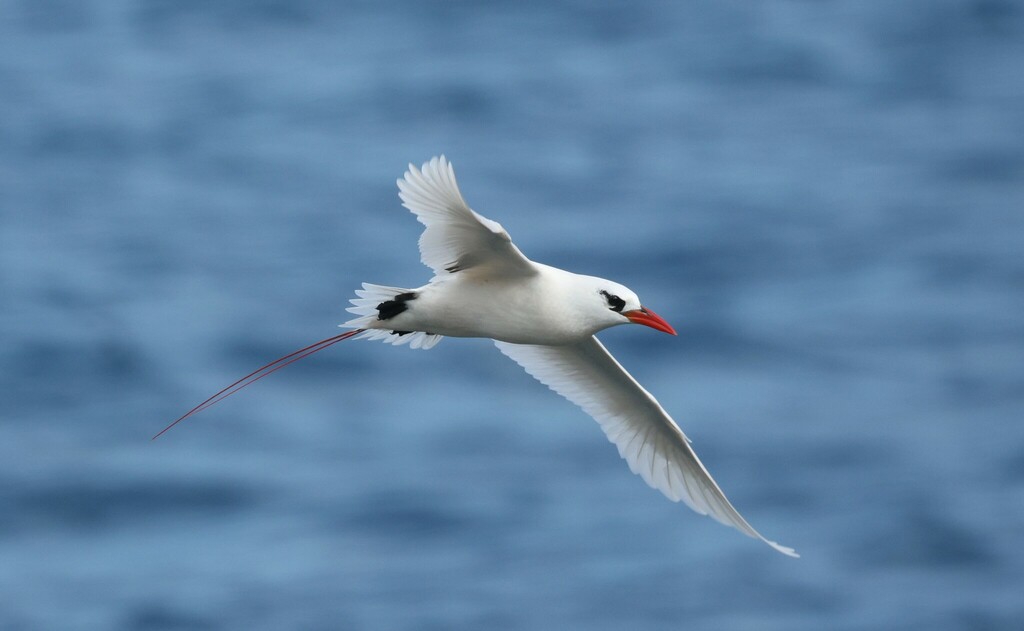
The red-tailed tropicbird (Phaethon rubricauda) is a seabird native to tropical parts of the Indian and Pacific Oceans. One of three closely related species of tropicbird (Phaethontidae), it was described by Pieter Boddaert in 1783. Superficially resembling a tern in appearance, it has almost all-white plumage with a black mask and a red bill. The sexes have similar plumage. As referenced in the common name, adults have red tail streamers that are about twice their body length. Four subspecies are recognised, but there is evidence of clinal variation in body size—with smaller birds in the north and larger in the south—and hence no grounds for subspecies.
The red-tailed tropicbird eats fish—mainly flying fish and squid—after catching them by plunge-diving into the ocean. Nesting takes place in loose colonies on oceanic islands; the nest itself is a scrape found on a cliff face, in a crevice, or on a sandy beach. A single egg is laid, then is incubated by both sexes for about six weeks. The parents make long food-foraging trips of about 150 hours during incubation, but once the chick has hatched, the parents specialize their foraging: one forages for the chick for a few hours at a time, while the other makes much longer trips to feed themselves.
From the article Red-tailed tropicbird on Wikipedia (CC BY-SA), quoted section by section
Description
The red-tailed tropicbird measures 95 to 104 cm (37 to 41 in) on average, which includes the 35 cm (14 in) tail streamers, and weighs around 800 g (30 oz). It has a wingspan of 111 to 119 cm (44 to 47 in). It has a streamlined but solid build with almost all-white plumage, often with a pink tinge. The sexes are similar in plumage. A dark brown comma-shaped stripe extends back from the lores, through and over the eyes and reaching the ear coverts. The iris is dark brown. The bill is bright red, slightly paler at the base and black around the nostrils. The legs and base of the toes are pale blue-mauve, while the webbing and rest of the toes are black. The white feathers of the head and rump have concealed dark brown bases, while those of the mantle, back, tail rectrices and tail coverts have dark brown shaft bases. The two long tail feathers are orange or red with white bases for around a tenth of their length, and can be hard to see when the bird is flying. The white wings are marked by dark chevron-shaped patches on the tertials, and the dark shafts of the primary flight feathers are visible. The pink tinge is often more pronounced in the remiges of the upper wing. Moulting takes place outside the breeding season, the streamers being replaced before the rest of the feathers. …
Range & habitat
The red-tailed tropicbird ranges across the southern Indian, and western and central Pacific Oceans, from the East African coast to Indonesia, the waters around the southern reaches of Japan, across to Chile, and the Hawaiian Islands, where they are more common on the northwestern islands. It frequents areas of ocean with water temperatures from 24 to 30 °C (75 to 86 °F) and salinity under 35% in the southern hemisphere and 33.5% in the northern hemisphere. In the Pacific Ocean, the southern boundary of its range runs along the 22 °C (72 °F) summer surface isotherm. The birds disperse widely after breeding. Evidence suggests birds in the Indian Ocean follow prevailing winds westwards, young individuals banded in Sumatra and Sugarloaf Rock, Western Australia, being recovered at Mauritius and Réunion respectively. Banding on Kure Atoll suggests birds in the North Pacific disperse in an easterly direction, following prevailing winds there. Strong winds can blow them inland on occasions, which explains some sighting records away from the coast and their preferred habitats. Johnston Atoll It is the world's largest colony of red-tailed tropicbirds, with 10,800 nests in 2020. In the Pacific area, it nests on the Australian offshore territories of Norfolk and Lord Howe Islands, and on Queensland's coral islands (including Raine Island and Lady Elliot Island). …
Wikipedia: “Distribution and habitat”
What it does
The red-tailed tropicbird is a strong flyer, and walks on land with difficulty using a shuffling gait. They can hover in midair by flying into the wind; pairs may even fly backwards and circle each other during courtship displays.
Breeding. The red-tailed tropicbird is thought to be monogamous, pairs remaining bonded over successive breeding seasons, although such information as age at first breeding and pair-formation is not known. It nests in loose colonies, on offshore islands and stacks, rocky cliffs, coral atolls and cays. It rarely nests on large bodies of land, though has done so in southern Western Australia. The nest itself is a shallow scrape, in either shaded sand or a rocky crevice, or under a shrub. Because the red-tailed tropicbird does not walk well, it lands by flying into the wind, stalling and dropping to the ground. The nest is often located within one metre (3.3 ft) of the edge of the shrub (or other shaded area) to minimise walking distance. The tropicbird often chooses shrubs with fewer stems for accessibility.
The species is territorial to a degree, aggressively defending the nest site and pecking radius around it, commencing around three months before breeding. Birds are more aggressive at crowded colonies, where numbers are large or suitable nest sites less common. …
Wikipedia: “Behaviour”
Listen
Looking for field recordings…
Where it lives
Recorded sightings
—
geo-referenced records in GBIF, from museums, herbaria and field observers.
Drag the globe to turn it. Dots are where records exist, not a range map; darker means more records.
In the stacks
Searching the stacks…
Every page naming Phaethon rubricauda in the Biodiversity Heritage Library →
This page is assembled live from iNaturalist, GBIF, Wikipedia, the Source Library and the Internet Archive. It is not yet part of the hand-edited codex. iNaturalist taxon 4320.