 NL·0441
Herbarium of the Nature Library
- Name
- Caracara plancus
- Family
- Falconidae
- Native to
- Florida, Texas and Arizona south through Mexico, Central America and South America to Tierra del Fuego
- Habitat
- Grassland, Savanna, Ranchland, Desert scrub
On eBird ↗
Crested Caracara
Live sightings near you, the range map, bar charts of when it is seen, and Macaulay Library photos and recordings.
Crested caracara
Caracara plancus
Also calledCarancho (Spanish, Southern Cone) · Carcará (Portuguese, from Tupi) · Quebrantahuesos (Spanish, Mexico) · Mexican eagle (English, Texas)
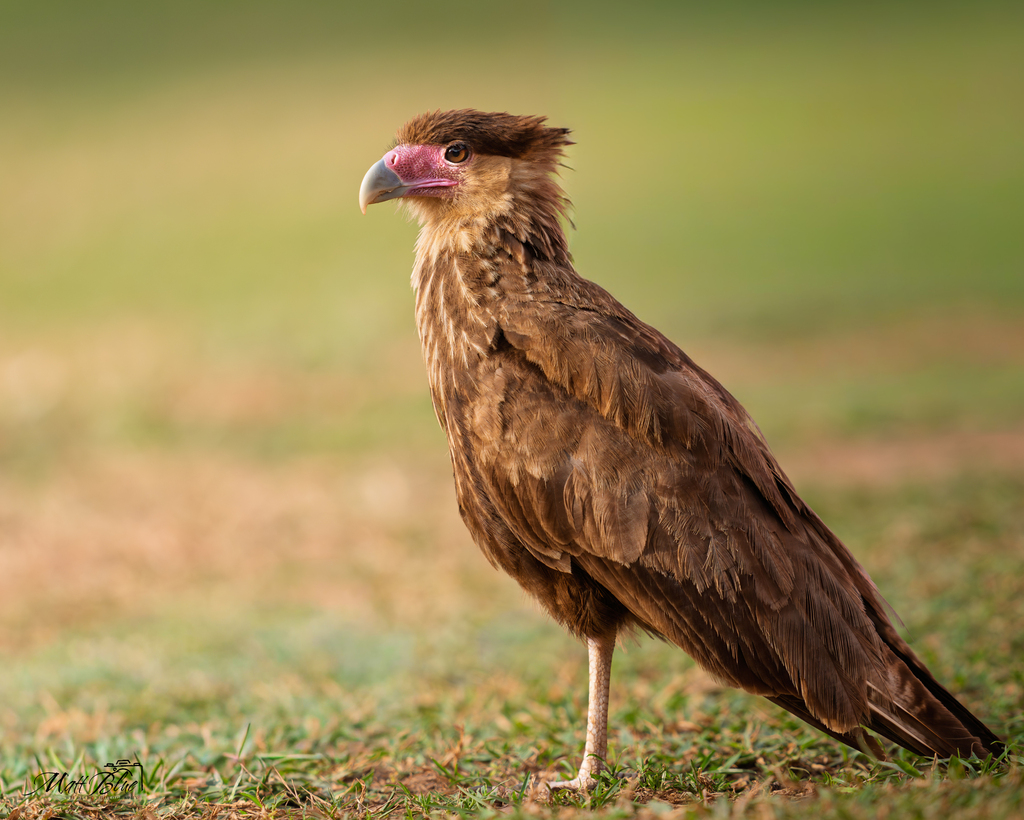
A long-legged, eagle-like falcon with a bare red face that walks the ground scavenging and hunting. It is as likely to be found at a roadkill or behind a plough as on the wing.
The crested caracara is a bird of prey (raptor) in the falcon family, Falconidae. It was formerly placed in the genus Polyborus before being given in its own genus, Caracara. It is native to and found in the southern and southeastern United States, Mexico and the majority of mainland Latin America, as well as some Caribbean islands. The crested caracara is quite adaptable and hardy, for a species found predominantly in the neotropics; it can be found in a range of environments and ecosystems, including semi-arid and desert climates, maritime or coastal areas, subtropical and tropical forests, temperate regions, plains, swamps, and even in urban areas. Documented, albeit rare, sightings have occurred as far north as Minnesota and the Canadian provinces of Alberta, Ontario, and Prince Edward Island. The southern extent of the crested caracara's distribution can reach as far as Tierra del Fuego and Magallanes Region, Chile. Wikipedia
What it can do
- iHunts on foot, turning over debris and dung for insects and small animals
- iiRobs vultures and other birds of food
- iiiFollows tractors, fires and cattle to catch flushed prey
- ivThrows its head back over its back while calling
In the field
Field marks
- aBlack cap and shaggy crest above bare red-orange to yellow facial skin
- bHeavy, pale bluish hooked bill
- cWhite throat and neck; barred breast; black belly
- dIn flight: white patches near the wingtips and white tail with a black terminal band; long yellow legs
- Voice
- A dry, harsh rattle, given with the head thrown back; the name 'caracara' imitates it.
- Not to be confused with
- Black Vulture has a bare grey head and lacks the white neck. Bald Eagle immature lacks the black cap and orange face.
- Where to see it
- Ranchland of central Florida (Kissimmee Prairie), south Texas, the Pantanal and the Argentine Pampas.
- When
- Resident year-round
Listen
Looking for field recordings…
Life & habits
- Diet
- Carrion, insects, small mammals, reptiles, fish and eggs
- Habitat
- Open country — prairies, pastures, savanna, desert scrub
- Size
- 49–64 cm; wingspan about 120 cm; 0.8–1.6 kg
Unlike most falcons, it builds its own stick nest, often in palms or cacti.
Where it lives
Recorded sightings
—
geo-referenced records in GBIF, from museums, herbaria and field observers.
Native range
Florida, Texas and Arizona south through Mexico, Central America and South America to Tierra del Fuego
Drag the globe to turn it. Dots are where records exist, not a range map; darker means more records.
In the old herbals & bestiaries
No plate in the Source Library names this exact species, so these show its closest relatives as the old naturalists drew them: same genus, or the same kind of animal. Click a plate to read the page it came from, with translation.


In the stacks
Searching the stacks…
Every page naming Caracara plancus in the Biodiversity Heritage Library →
Marginalia
Some historians argue that the bird in the Aztec founding legend of Tenochtitlan — an eagle on a cactus devouring a snake — was a caracara, though Mexico's coat of arms shows a Golden Eagle; in Brazil, João do Vale's 1964 song 'Carcará' made it a symbol of the drought-hardened north-east.
Curiosity
The Florida population is federally listed as threatened in the US because of the loss of native prairie.
Kinship
- kingdomAnimalia
- ›phylumChordata
- ›subphylumVertebrata
- ›classAves
- ›orderFalconiformes
- ›familyFalconidae
- ›genusCaracara
Neighbours on the shelf
Photographs: iNaturalist contributors under the licences shown. Records: GBIF.org. Historical plates: Source Library (CC BY-SA 4.0; originals public domain). Summary text: Nature Library editors and Wikipedia (CC BY-SA). Medicinal and edibility notes are historical and educational, not advice. iNaturalist taxon 4715.